2AM Keeps Task Memory in the Agent, Not the Robot Policy
Long-horizon manipulation needs memory. 2AM argues it does not have to live inside the motor policy. A multimodal Agent holds the episode. A single RGB Action Model executes a short chunk and then forgets the task.
The paper (arXiv:2609.11308, submitted September 10, 2026) is from KU Leuven and Meituan. The contract is strict: no depth, no online geometry, no planner-driven object motion. Every task-relevant movement goes through one episodically stateless VLA.
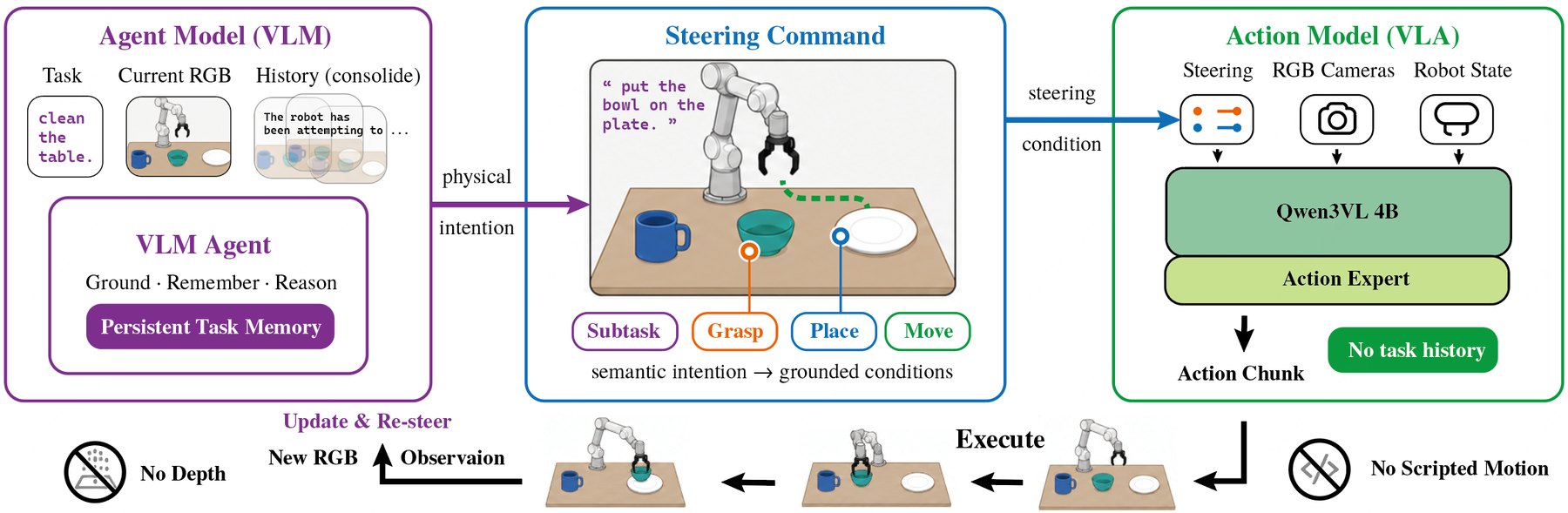
The steering command
After each chunk, the Agent sees fresh agent-view RGB and a consolidated history (object, destination, count, stage). It emits:
- subtask language
- optional 2D grasp_target
- optional 2D place_target
- optional 2D move_target
Coordinates are in the current agent image, [0, 1000]². A missing field is omitted, not faked. Grasp is for “which object” before contact. Place is the destination during transport. Move is a near-term progress cue, not a waypoint the gripper must hit.
The Action Model sees agent RGB, wrist RGB, robot state, and that command. No history. Implementation: Qwen3-VL-4B plus a flow-matching action expert, 16-step chunks. The current Agent is Qwen3.8-27B.
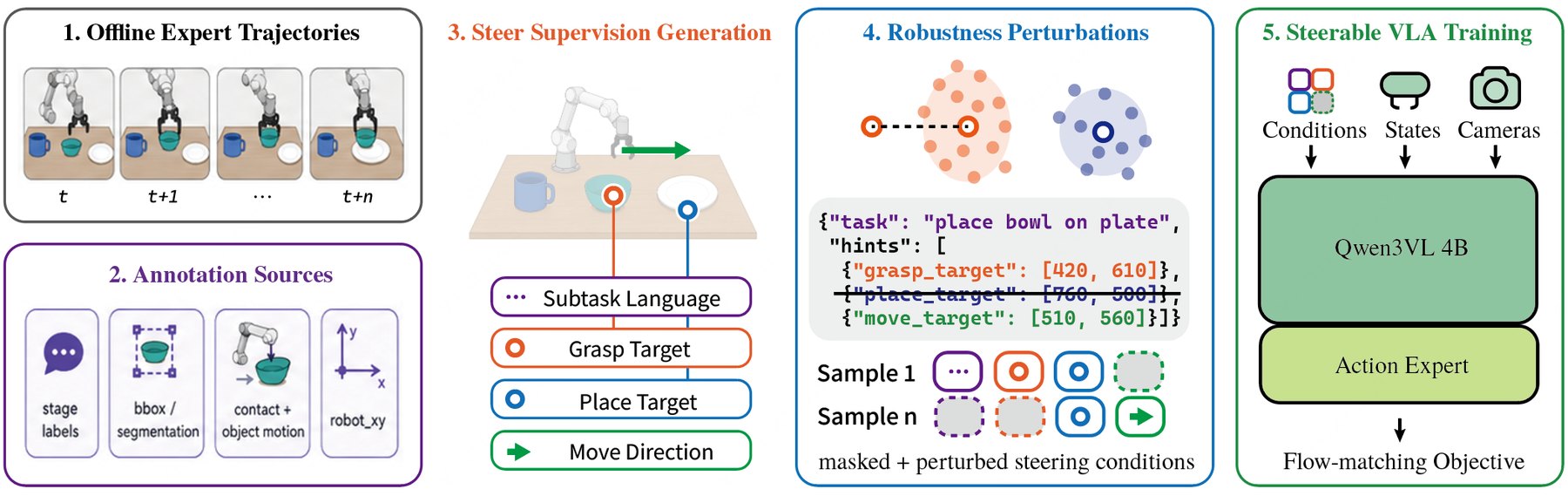
Training recovers hints from demonstrations (boxes, contact, projected end-effector). Then it drops fields, adds spatial noise, and jitters the move window so the policy can stand a sloppy Agent.
LIBERO-Mem, with an honest baseline
LIBERO-Mem’s ten tasks change instance, destination, count, or stage while the local pick-and-place repeats. Published SlotSSM completion is 14.8%. The authors’ own π0 reproduction, same backbone and cameras, already reaches 70.79% completion, 37.42% relaxed success, 12.25% strict success.
2AM: 76.29% completion, 63.00% relaxed success, 11.83% strict success. Relaxed success (finish the ordered goal, ignore a later overshoot) jumps 25.58 points. Strict success does not. Language-only ablation, same Agent and motors, no 2D hints: 53.72% completion, 19.42% relaxed, 7.25% strict. Adding grasp/place/move is the gain.
The 63% → 12% strict gap is the paper’s own warning: carrying remembered intent through the sequence is not the same as stopping when you are done. Real-robot closed-loop tests are listed as future work.
A Human’s Take
Stuffing more history into the VLA is the default move. 2AM’s bet is that the policy should be allowed to retry from a clean observation after the Agent rewrites the instruction. The 25-point relaxed-success jump is real. The missing stop button is also real. I would not ship this until someone measures the same contract on a physical arm that can overshoot a bowl onto the floor.