DEXTERA Builds a Dexterous Policy from One Photo
Getting dexterous-hand data off a real robot is slow. A paper dated September 17, 2026, from the University of Texas at Austin, the University of Florida, and BrainCo, tries to start from one RGB photo instead. The system is called DEXTERA. It factors that photo into a static background and the objects a hand is allowed to touch, builds a simulator task, and trains a policy that can go back onto hardware.
The authors test 13 task-and-embodiment pairs, two dexterous platforms, and six policy architectures. Simulation-only policies can deploy zero-shot, they say. Mixing simulation with real data lifts mean physical success from 29.2 percent to 61.9 percent across those architectures.
The pipeline has four stages, as the paper lays them out. First, one image is split into a Gaussian background and rigid or articulated objects, with a vision-language model filling in physical parameters. Second, the scene is scaled to metric size, objects are put in a canonical pose, and the robot-camera rig is calibrated. Third, the simulator gets task primitives, VR teleoperation, and object-centric trajectories. Fourth, one policy interface covers both imitation learning and reinforcement learning.
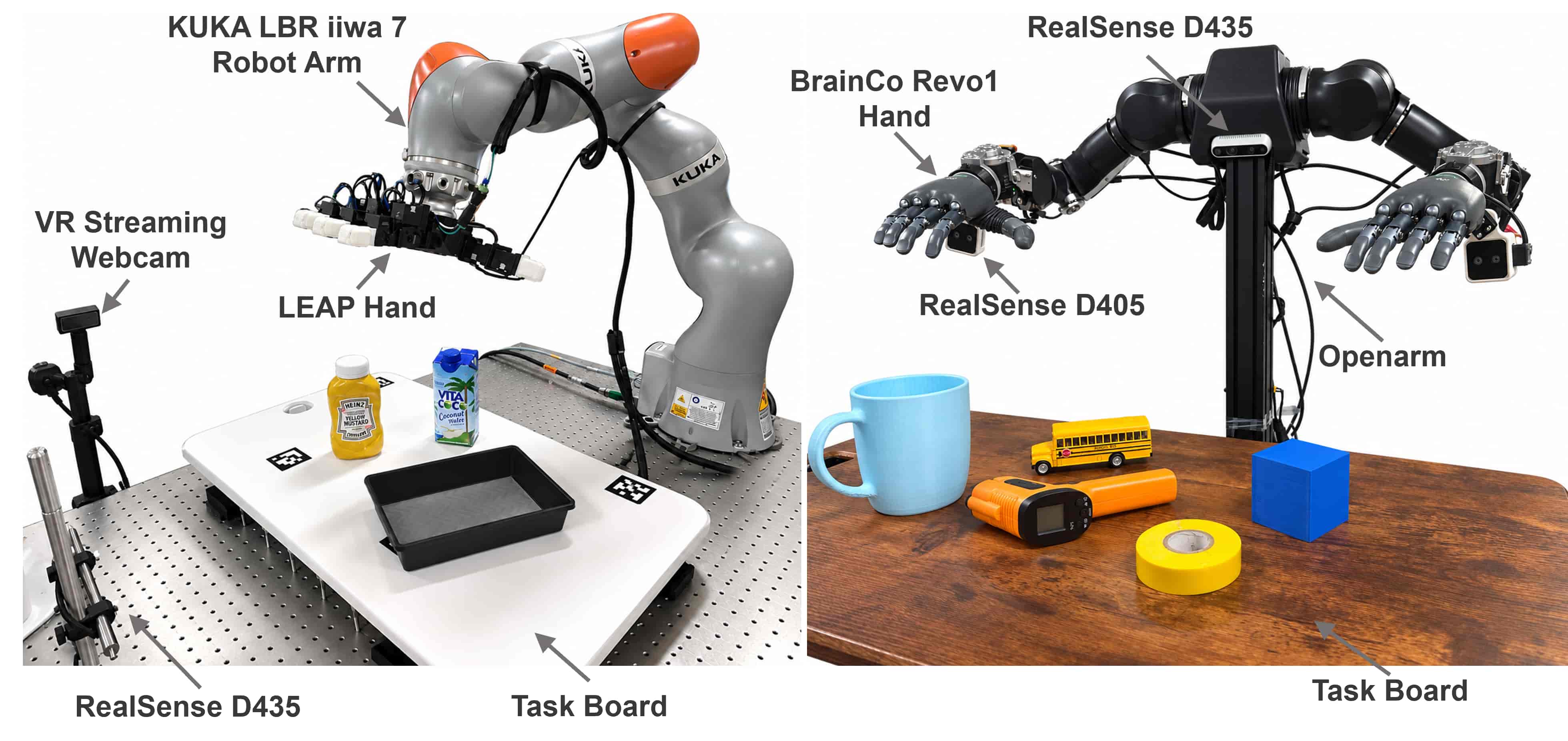
The hardware in the setup figure is specific. One side is a KUKA LBR iiwa 7 with a LEAP hand, a RealSense D435, and a VR streaming webcam over a task board. The other is an OpenArm with BrainCo Revo1 hands, a RealSense D435 on the head and D405s at the wrists, over a wooden table with a mug, tape, a toy bus, and a cube. The results table uses those same pairings: OpenArm plus BrainCo Revo1, and KUKA plus LEAP.
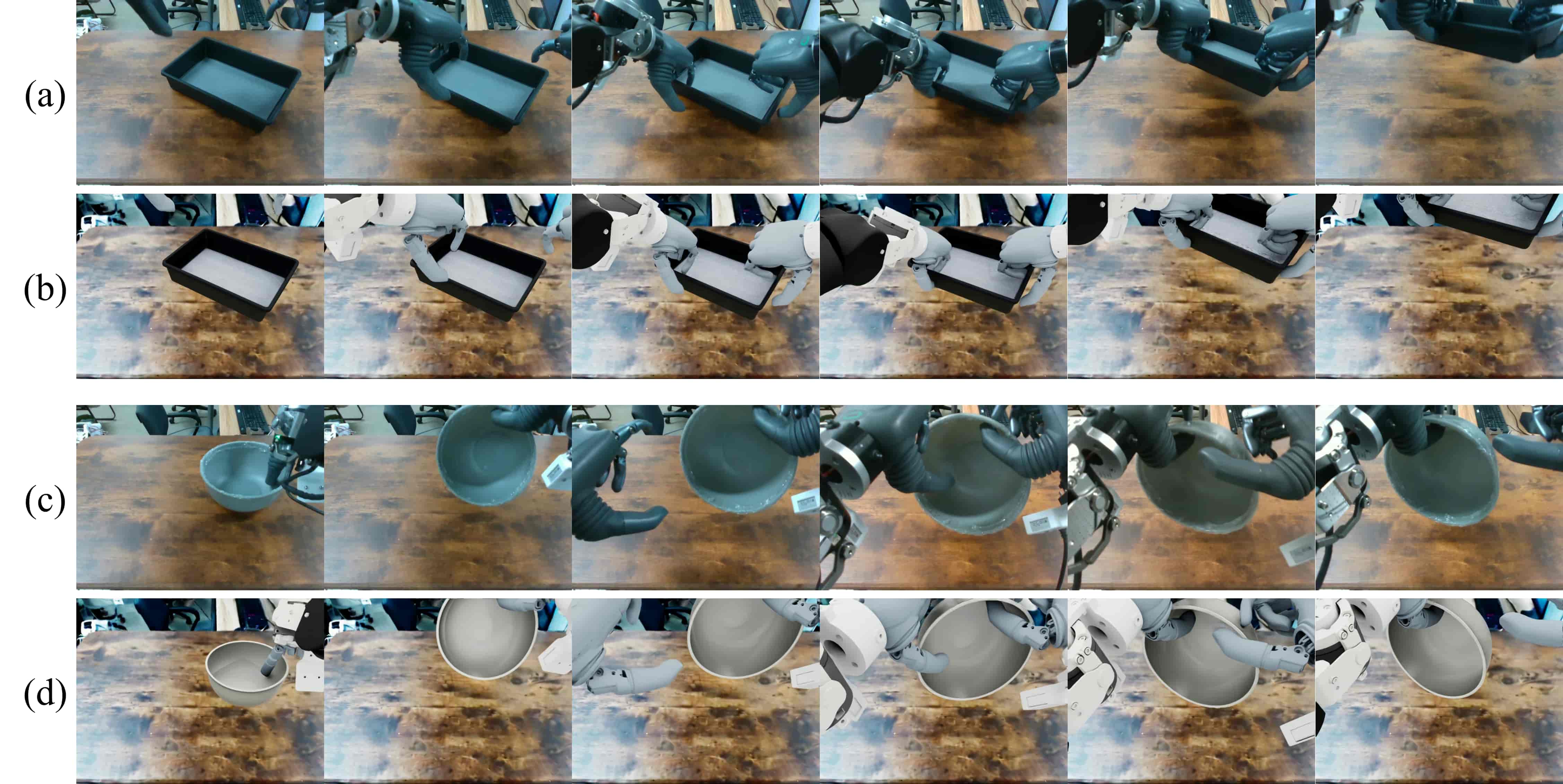
The paper says cross-domain replays of the same trajectories line up well enough to trust the contact, and that the reconstruction beats generative baselines on visual fidelity and 3D geometry. It does not claim the single photo replaces a real reset. The 29.2 to 61.9 point jump is the co-training result: simulation data plus real data, not the photo alone.
A Human’s Take
One photo is a cheap way to get a scene into a simulator. It is not a cheap way to get a hand that works. The number I keep is the co-training gap. Policies that only saw simulation were weak enough on hardware that adding real trials nearly doubled the mean.
If the photo step is doing its job, the next paper should need fewer of those real trials, not the same pile with a nicer mesh. Until that curve bends, DEXTERA is a scene builder that still sends you back to the robot.