AdaDexGrasp Fuses Geometry and Touch for Adaptive Dexterous Grasps
Vision-only dexterous grasp planners freeze after the first contact. If the pad slips or the contact map was optimistic, the hand just commits.
AdaDexGrasp, accepted at ECCV 2026 and posted as arXiv:2608.07600 (Aug 6, 2026), is a closed-loop visuo-tactile framework from Peking University, HKUST, and UC Berkeley authors. It plans with a semantic contact map (which finger or palm should touch which surface), then uses measured tactile IDs on the object point cloud to classify grasp quality and, if needed, adapt the pose before lift.
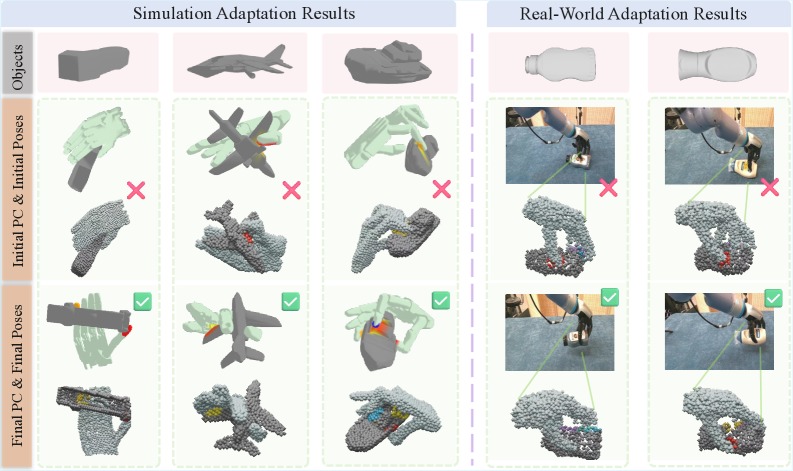
Pipeline
Three modules share one representation:
- Contact-driven generator — PointNet++ predicts per-point finger/palm labels and a grasp pose.
- Classifier — after contact, annotates the object cloud with tactile markers and scores success.
- Adaptation model — diffusion-style correction of pose and joints when the score is low, up to a fixed iteration budget.
Training data comes from PPO rollouts in a custom Isaac Gym tactile ShadowHand environment (22 hand DoF + 6 root). Real tests use a Psibot hand with high-resolution tactile sensors.
Results
| Setting | Seen | Unseen objects | Unseen categories |
|---|---|---|---|
| Sim (ours) | 91% | 82% | 83% |
| Best baseline (DexGraspAnything) | 77% | 72% | 67% |
| Real (ours) | 90% | 87% | 81% |
| Best real baseline (DexGraspAnything) | 81% | 71% | 73% |
On the large DexGrasp Anything asset set (15k+ objects), the authors report 87%. Ablations show contact IDs and the adaptation loop both matter — without adaptation, unseen-category success falls from 83% to 59%.
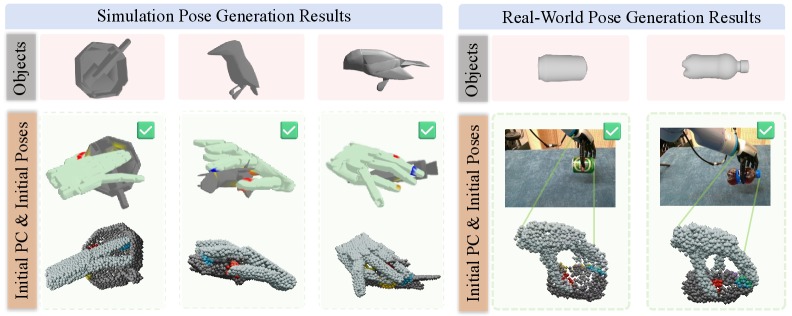
A Human’s Take
The useful idea is not “add tactile features.” It is naming which finger owns which contact before and after touch, then refusing to lift until the classifier is happy. That is closer to how people actually recover a bad pinch. I want to see the same loop on industrial multi-finger hands with oily parts and partial sensor dropout — sim numbers are clean; shops are not.