ETH’s ADAPT Turns Text Into Closed-Loop G1 Motion at 50 Hz
ETH Zurich posted ADAPT on 1 September 2026 (arXiv:2609.00677): a diffusion policy that maps a text command and proprioceptive history straight to joint actions on a Unitree G1, closed-loop at 50 Hz.
This is not the AdaPT tennis-from-broadcast paper we already covered. This one is Agile Diffusion Action Priors, from Yan Wu, Chenhao Li, Kaifeng Zhao, Gen Li, Marco Hutter, and Siyu Tang.
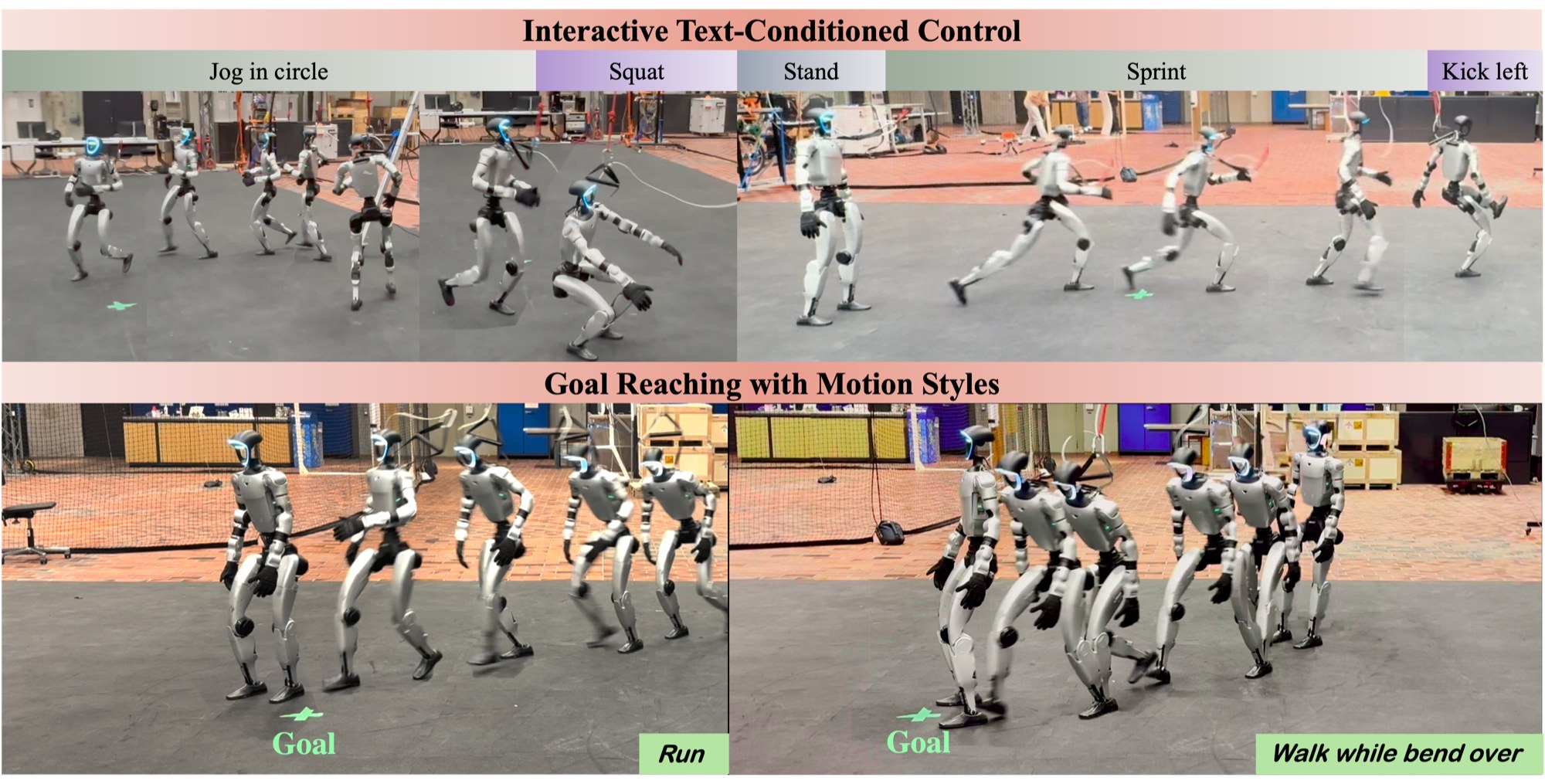
Language as a control problem
Most text-to-motion stacks generate a kinematic clip, then a tracker tries to follow it. ADAPT treats prompt switching as a closed-loop dynamics job. The team retargets AMASS motions to G1, tracks them in physics, and labels frames with BABEL, so the policy sees skill boundaries instead of one caption per clip.
The denoiser is an 8-layer causal transformer (hidden size 512, 8 heads). It predicts future actions and future states. Inference uses two DDIM steps and a CLIP text embedding. The project page says that keeps 50 Hz deployment; the paper’s limitations section puts inference around 2 ms.
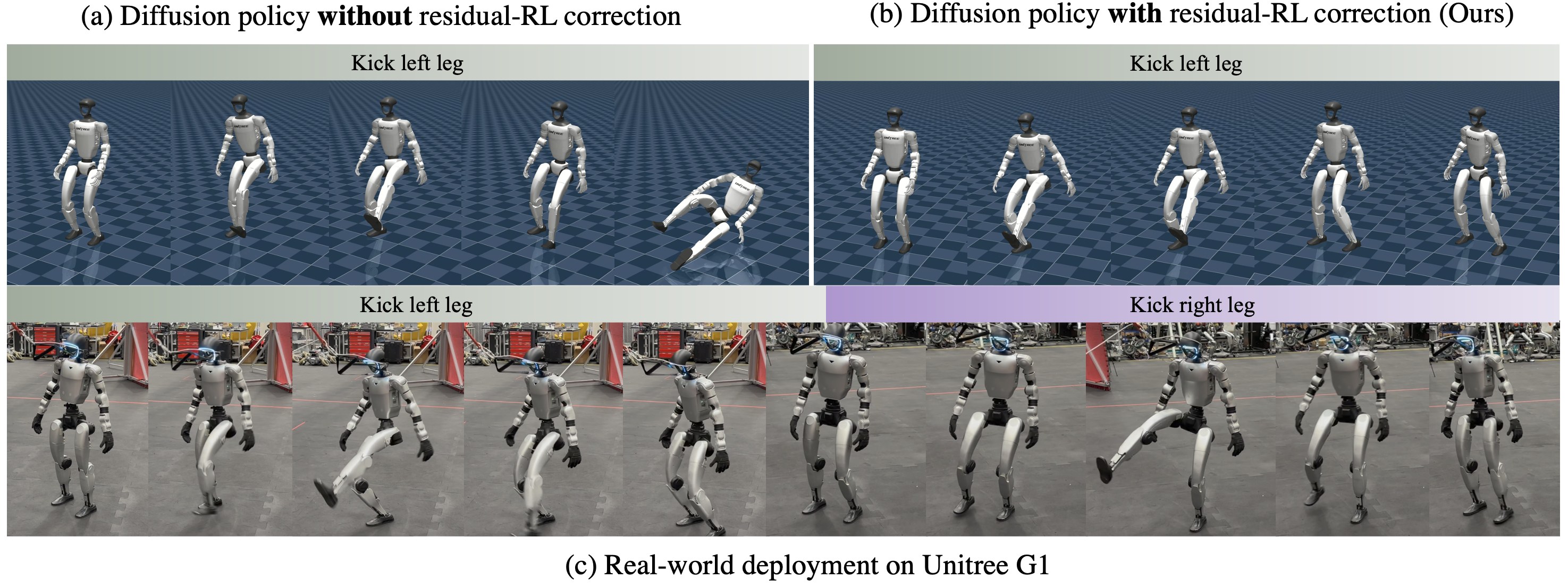
Offline behavior cloning still falls when you switch prompts at odd times. So they freeze the diffusion prior and train a PPO residual that:
- corrects lower body only
- warms the residual scale up from zero
- uses a self-tracking reward so the corrected state stays near the diffusion-predicted next state
- sees random prompt switches every 5–10 s in training
Numbers from the paper
On a pool of 130 commands, 2,048 simulated rollouts of 20 s with switches every 5–10 s, ADAPT’s success (no fall) is 0.984. Ablating the residual drops that to 0.804. Two-stage baselines in the same table: DART+track 0.764, offline TextOp 0.522, LangWBC 0.923. Those two-stage numbers are offline (full prompt schedule known ahead). ADAPT is online.
Hardware: five trials per skill on G1. The paper says locomotion transfers more reliably; failures cluster on long single-leg support (kicks) and repeated high jumps.
A second frozen-prior trick steers diffusion noise toward a goal while keeping the text style (“run”, “walk while bending over”, even an unseen “jog”). Steering cuts fall rate from 34.7% to 2.9% in that goal-reaching setup.
A Human’s Take
Fifty hertz from two DDIM steps is the part that makes this deployable instead of a renderer. Residual RL buying success at the cost of a bit of semantic alignment is an honest trade. I’d rather a G1 that stays up when you yell “squat” mid-sprint than a prettier kick that dumps the robot. Next test is whether that residual starts sanding off the fun motions the authors already flag as a limitation.