AdaPT Teaches G1 and Dobot Atom Pro Tennis Styles From Broadcast Tape
A team from Noitom Robotics, Shanghai AI Lab, Shanghai Jiao Tong University, and Dobot Robotics posted AdaPT, a planner-plus-tracker stack that copies professional tennis styles onto humanoids. The paper went up on arXiv August 20. The project site has the footage.
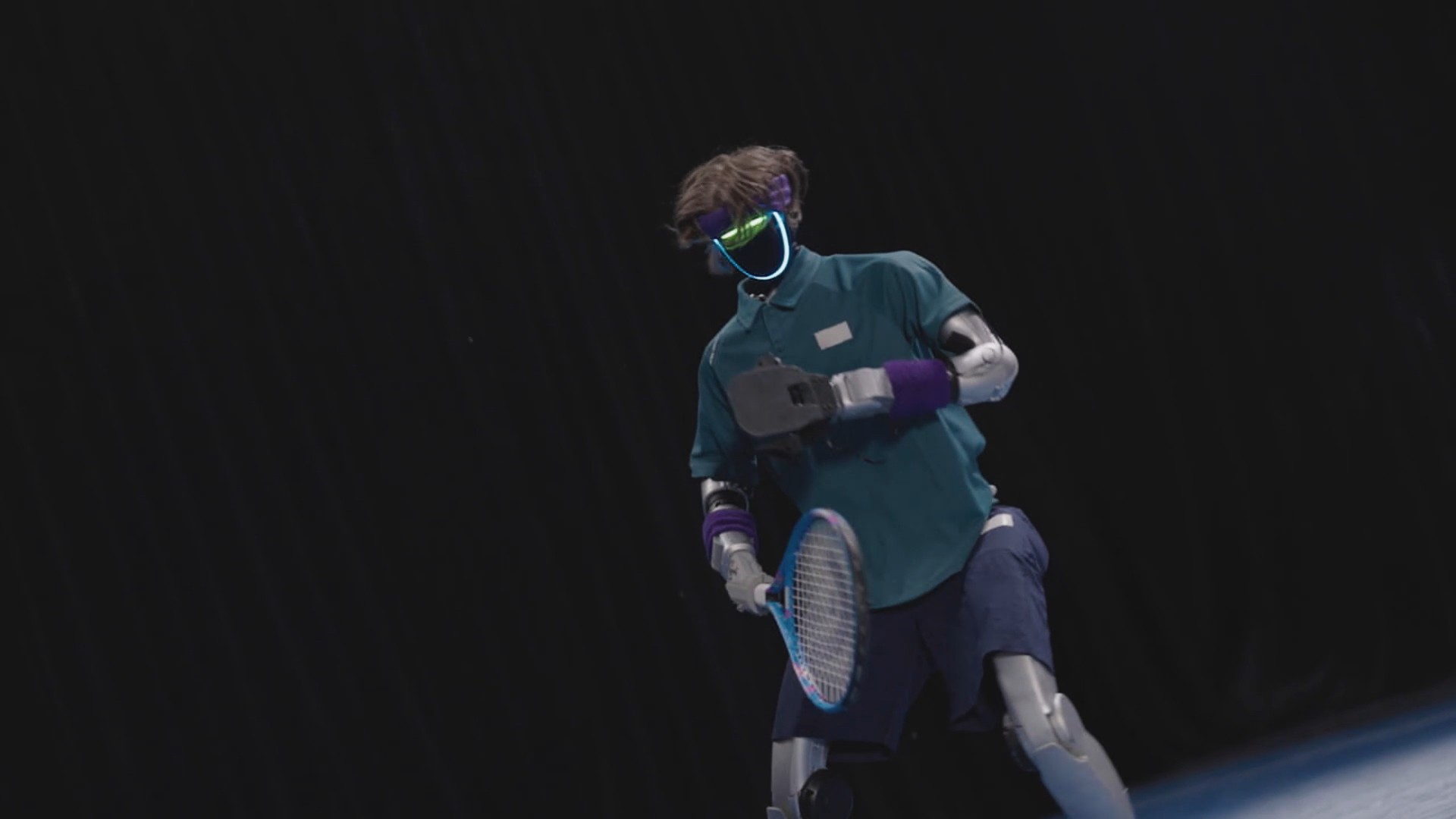
The robots are a Unitree G1 in a motion-capture gym and a full-size Dobot Atom at about 1.7 m, which they take outdoors to serve without mocap.
Styles from TV, not just mocap
AdaPT learns serve and rally styles from broadcast clips of Rafael Nadal, Roger Federer, and Novak Djokovic, plus a mocap athlete the authors call Mr. Black. The project page totals 21.5 hours of motion across six athlete styles and seven stroke and serve types.
The paper’s table of video data is even larger than that highlight reel: Nadal 267 minutes (5,664 clips), Federer 179 minutes, Djokovic 189 minutes, Mr. Black mocap 219 minutes. Clips run about two seconds and cover a full stroke plus footwork.
The stack is split on purpose. A high-level planner emits stylistic kinematics. A low-level tracker tries to execute them. In simulation that looks clean. On metal, tracking slips, the planner compounds the error, and noisy ball perception makes it worse. AdaPT’s fix is to train the tracker on randomized execution speeds, then let the planner pick a speed so it does not outrun the body.
What they measured on G1
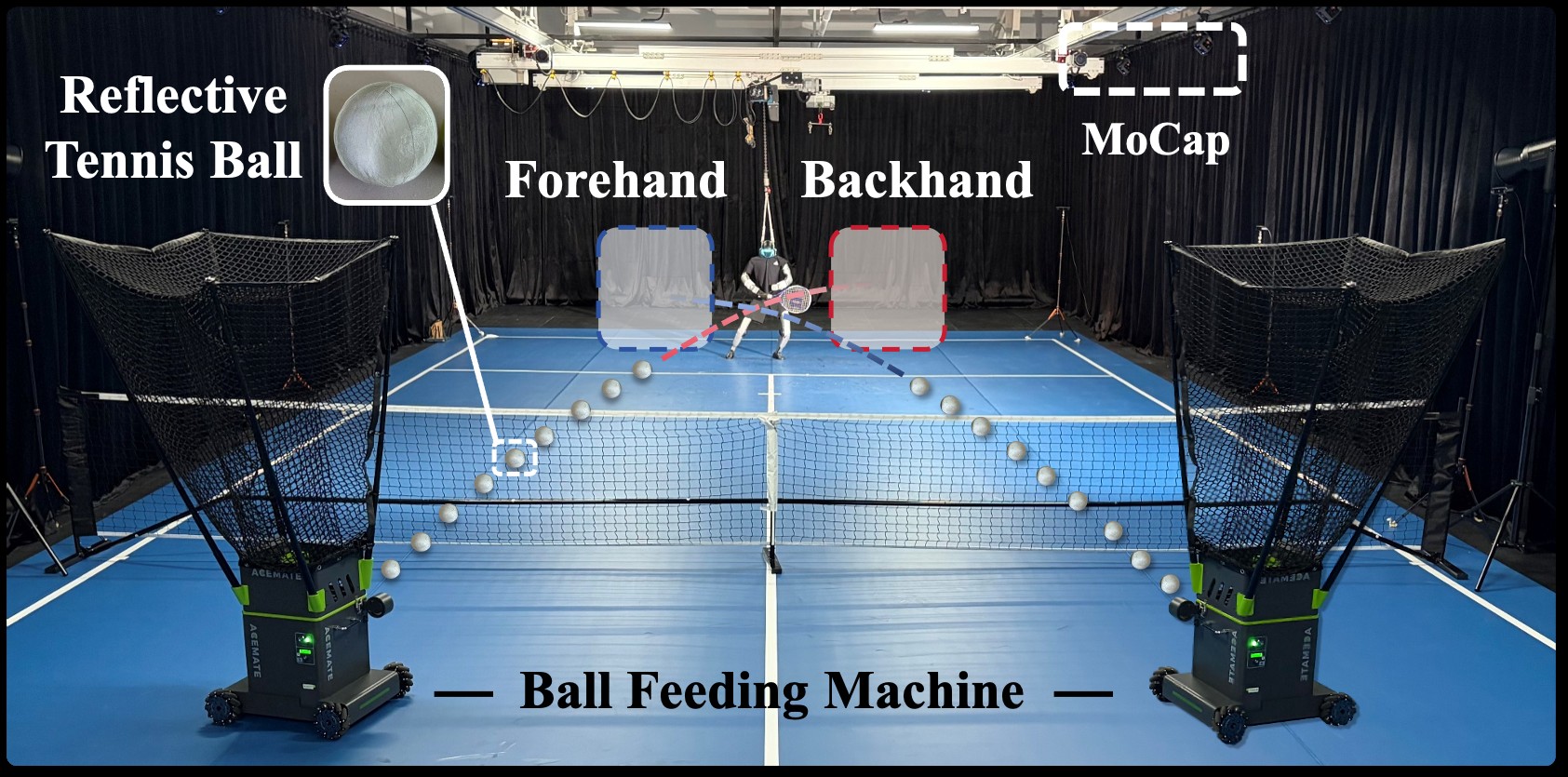
Lab work ran in an about 20 m × 8 m mocap volume with 35 Noitom MCC-400 cameras. Court size follows Tennis 10s, roughly 18 × 6.5 m, which the authors say matches G1’s 1.35 m height. The racket is a 23-inch junior frame, wrist-mounted at a 25-degree offset.
Rally tests used an Acemate ball machine, 25 repeats per region, one ball every 4.5 s. On the real G1, AdaPT’s hit rates versus a Vid2Player3D baseline were:
- Nadal style: 91.5% vs 82.6%
- Federer: 96.3% vs 81.5%
- Djokovic: 92.3% vs 83.2%
Net clearance also rose. Ablations that drop either the adaptive tracker or the adaptive planner lose those gains.
For serving they used a Synria Gloria-D parallel gripper, 15 trials per model. A Unitree Dex-3 hand was too heavy for G1 to balance under the professional serve motions, so that hand only ran simpler amateur motions.
Out of the cage
The same policies go onto Atom for in-the-wild serving. Balls are found with a YOLO-based stereo detector. Robot pose comes from HTC VIVE Ultimate Trackers instead of the 35-camera cage. The paper is frank that post-bounce trajectory noise is the rally killer, and that a standing policy has to take over when no ball is in play so the motion generator does not drift.
Code is on GitHub under noitom-robotics/AdaPT.
A Human’s Take
Copying Federer’s swing is catnip. The useful bit is the speed adapter: the planner has to know how late the body is. I want the Atom serve clip without the mocap hall more than I want another FID table. If the 1.7 m machine can toss, see the ball, and hit a box on a real court, that is a sports robot. If it only works while 35 cameras babysit the G1, it is still a paper.