Collaborative Spray Painting: Robot Holds the Part, You Hold the Gun
Spray painting awkward panels still needs a human wrist. The robot’s job should be holding the part so your shoulder does not do a full shift of overhead work.
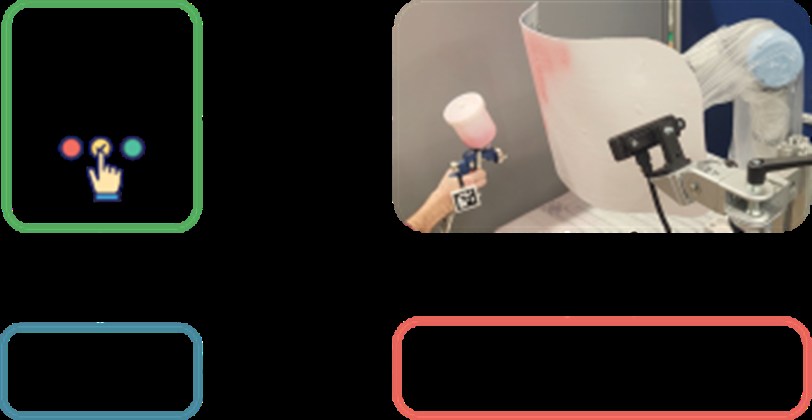
A Politecnico di Milano team (arXiv:2608.01981, also IEEE RA-L 2026) describes a human-centered collaborative painting setup: a UR5e holds the workpiece while the operator sprays; the robot reorients the part online so small hand rotations become scaled, trackable piece motions. Preference-based optimization (GLISp) tunes three process knobs from qualitative feedback; modified Dynamic Movement Primitives execute the motion.
How the assist works
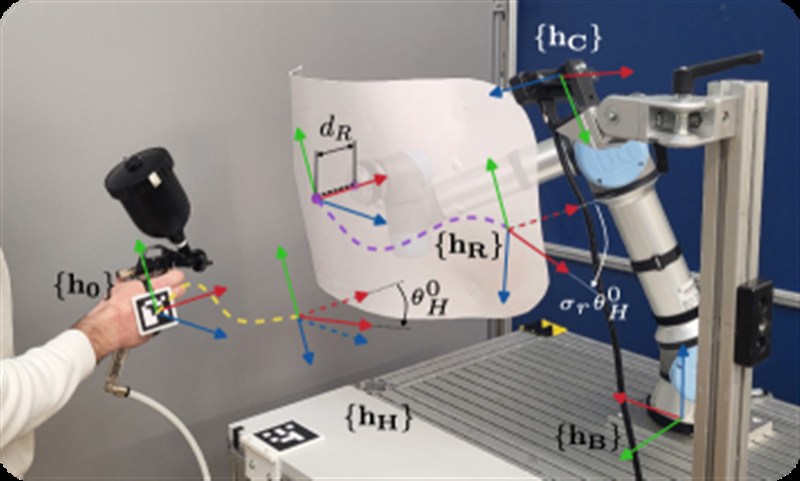
The robot does not paint. It holds a large surface (~1 m² in their test piece) on a 3D-printed flange support and tracks the operator’s hand orientation via an OAK-D Pro camera at 30 Hz. Modified DMP equations introduce:
- Rotation amplification (σ_r / k_m): small hand turns map to larger piece turns, so the painter stays in a smaller workspace
- Responsiveness term (γ_s / k_s): when hand–piece orientation error grows, damping drops so the robot catches up
- Time scaling (τ̄): preferred execution pace
GLISp then optimizes θ = [τ̄, k_s, k_m] from pairwise “better / same / worse” feedback after each trial (N = 15 preference iterations after N̄ = 6 initial samples).
User study numbers
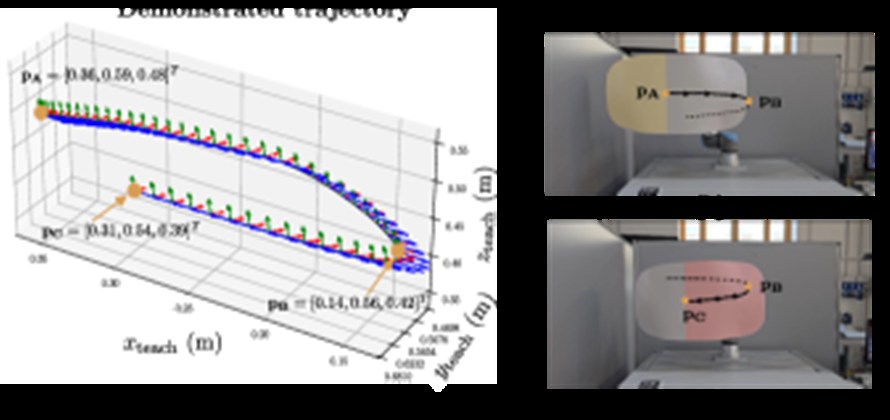
15 participants (8 men, 7 women; mean age 25.2 ± 0.98; mean height 180.8 ± 11.26 cm) ran a static baseline (robot fixed at pose A) versus the optimized collaborative policy. Custom ergonomics metrics:
- Lateral reach: hand spread along X reduced for all participants (about 29–73% depending on person; max at P10)
- Overhead: mean ~31% reduction in Z variability; most subjects kept hands below shoulder height after optimization
Food-safe colorant stood in for paint so coverage could be checked visually. A public experiment video is linked from the paper: https://youtu.be/0POZMUFvQUE.
A Human’s Take
This is the kind of HRC I actually want on a line: robot does the heavy hold and awkward reorientation; human keeps the spray quality judgment. Preference learning from “that felt better” is messier than a CAD cost function, but it is how people talk about assist robots. Watch whether the same three knobs transfer beyond a student cohort and a single ~1 m² panel — and whether factories will accept a 15-trial personalization loop per operator.