Adaptive-WAM: Stop Generating the Future Video Just to Steer
Driving world models love to render the next few seconds of road. Deployment only needs a trajectory. Paying for the full movie every frame is optional.
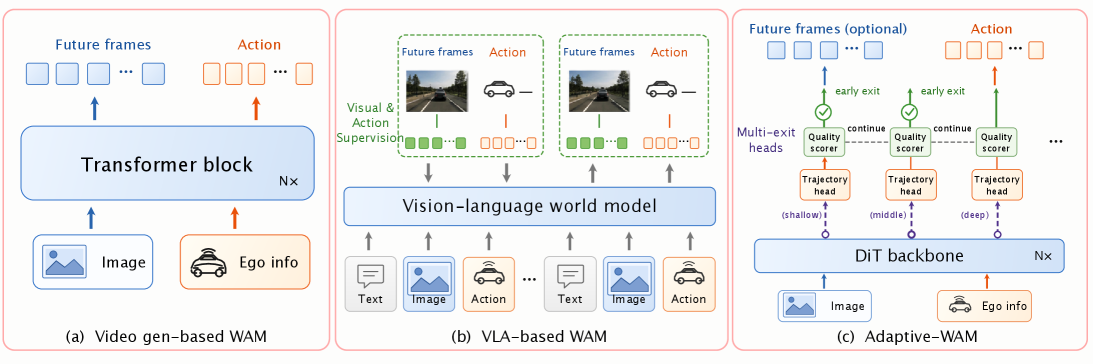
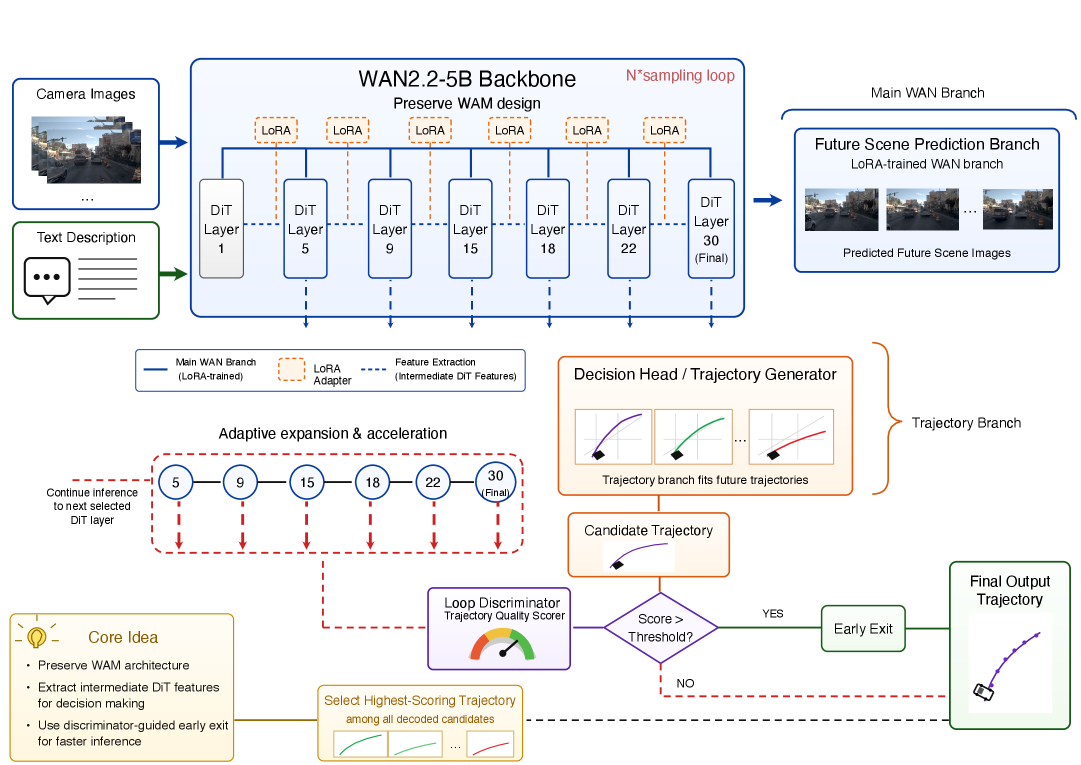
Adaptive-WAM (arXiv:2608.06008, submitted Aug 6, 2026) builds a quality-aware multi-exit planner on a Wan2.2-5B video DiT backbone. Trajectory heads hang off intermediate blocks; a lightweight DINOv2-Small scorer decides whether the best decoded plan so far is good enough, or whether the backbone should keep going deeper. Training still uses future-video supervision; the default planner path does not run the full denoising loop or VAE decode of future frames.
Depth beats noise in the ablation
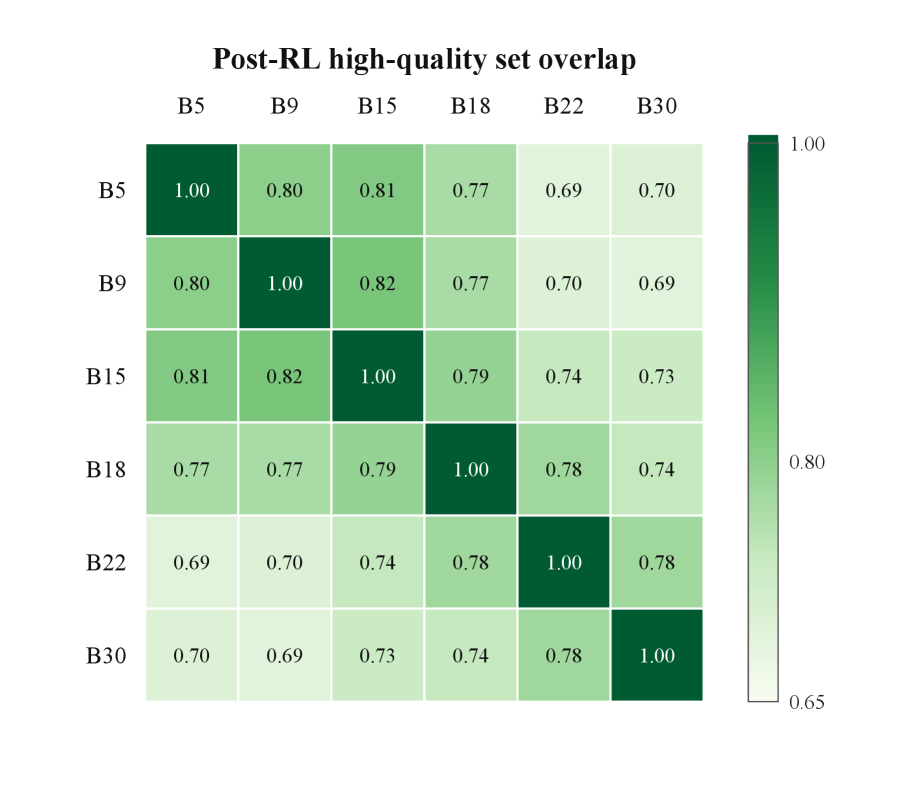
A controlled study on NAVSIM finds planning scores barely move across five tested video-noise indices (ranges of ~0.13–0.15 PDMS at fixed layers). DiT depth does matter: intermediate exits can beat full-depth single-trajectory readouts, and different layers solve overlapping but non-identical scene sets. That motivates adaptive routing instead of one fixed block.
Exits: blocks {5, 9, 15, 18, 22, 30}. Each exit has an independent five-step trajectory diffusion head (ReCogDrive-style). At inference, one trajectory is decoded per attempted exit; the scorer predicts NAVSIM component scores and stops when the best so far clears threshold η.
Numbers
On NAVSIM v1 navtest, the adaptive single-trajectory planner reports 90.8 PDMS. A separate fixed block-22 variant with 64 proposals reaches 92.6 PDMS. On NAVSIM v2, Adaptive-WAM reports 89.9 EPDMS, which the authors call best among the compared front-view video world-model planners.
Without nuScenes fine-tuning: 0.88 m average L2 and 0.08% collision rate.
Latency on one A100 (batch 1, end-to-end planning): adaptive ~170 ms, fixed block-15 ~190 ms, fixed full-depth ~320 ms. For contrast, a full 40-step classifier-free future-video generation path is reported at 13.22 s under the same hardware setting. At the selected threshold, more than 94% of scenes terminate within the first three exits.
A Human’s Take
World models for driving only matter if they fit a real control cycle. Early-exit trajectory heads that skip the cinematic rollout is the right failure mode: spend compute when the plan is bad, cash out when it is already fine. I want third-party replications on NAVSIM and a public code drop before treating 90.8 PDMS as a settled ranking — but the “how much of the DiT do you actually need?” question is the useful one.