AdaRoboVLG Splits Grasp Physics From Language, Then Shares the Policy Across Hands
AdaRoboVLG, posted 3 September (arXiv:2609.04096), is a vision-language-grasp stack that refuses to bake the hand into the language model. A shared base policy proposes physically feasible grasps. Separate foundation-model modules dump spatial, cognitive, and temporal priors into a structured interface. Swap the hand, keep the policy.
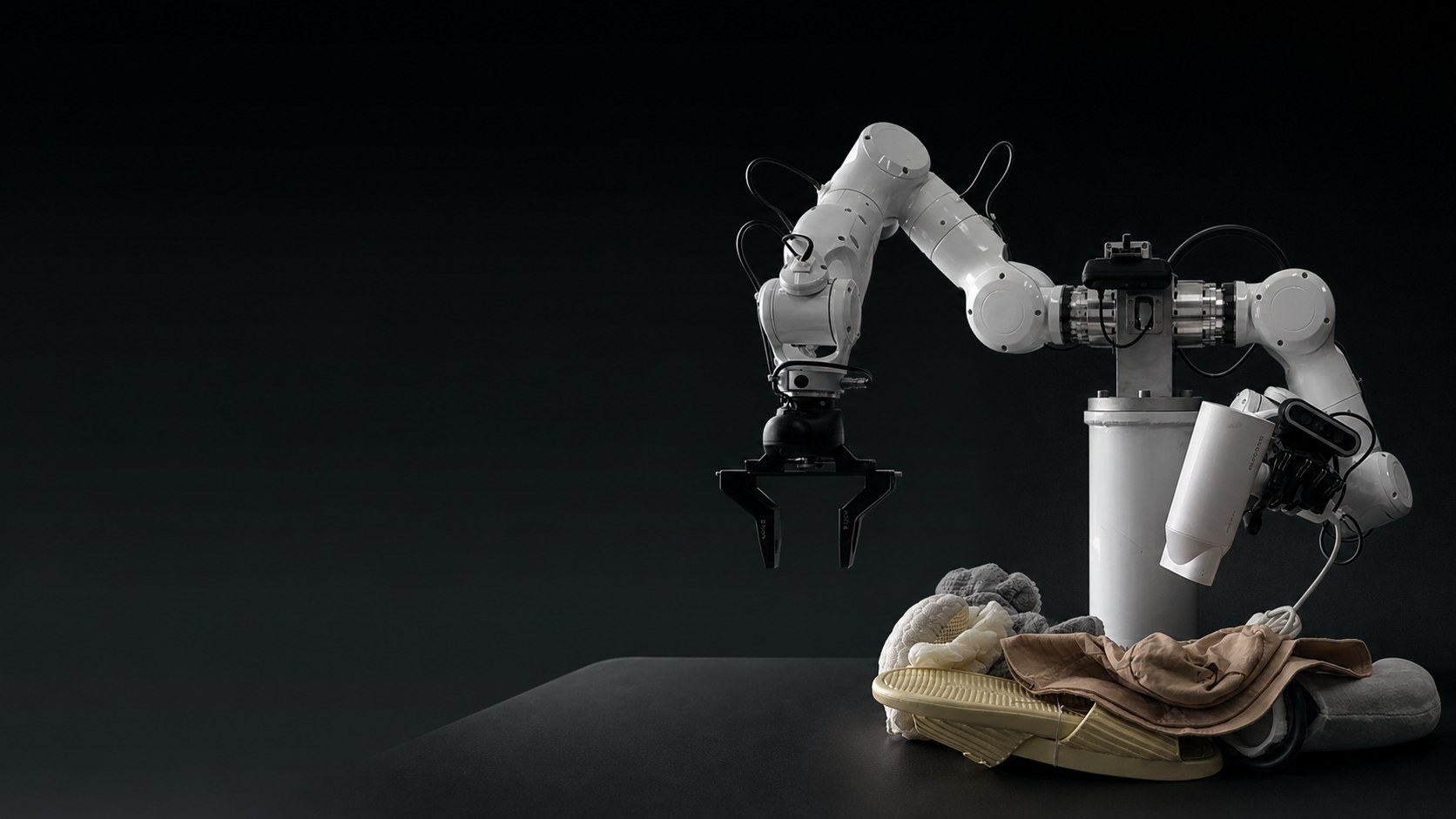
The project page’s hero is a dual-arm cell hovering over a pile of clothes and a slipper. That is the point: functional grasps in a mess, not a single trained pose on a cube.
One policy, three hands
The base policy maps object geometry and contact grasp representations into executable poses, then scores them with a hand-object interaction embedding that is supposed to be hand-agnostic. The paper trains that decision model jointly on DH3 (3-finger), Allegro (4-finger), and Inspire (5-finger).
On DexGraspNet 2.0, the project page’s clutter-aware table lists AdaRoboVLG success at 91.2% (DH3), 90.5% (Allegro), and 92.7% (Inspire) in the first reported column of the comparison. The authors say compact contact representations plus a human-inspired grasp taxonomy shrink the search, which is why clutter does not fall off a cliff as fast as the baselines they plot.
The three priors do different jobs:
- Spatial: scene-level contacts for collision-aware clutter
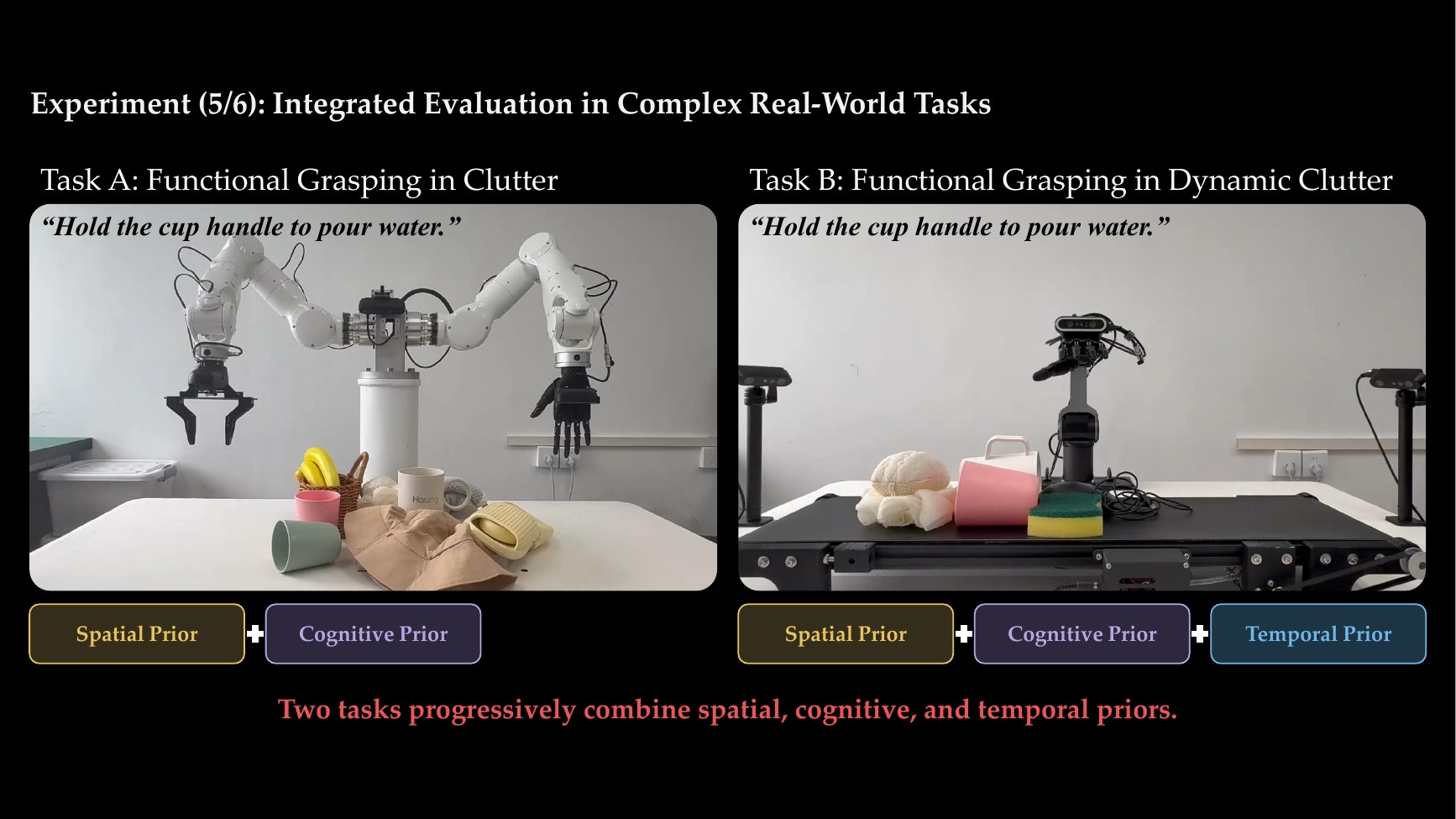
- Cognitive: language to functional part and grasp type (RAG + chain-of-thought; 0.94 part accuracy and 0.87 grasp-type accuracy on 125 open-set instructions / 57 tasks / 80 object categories)
- Temporal: object-motion updates for moving targets. On GraspNet-1Billion they report association 1.0 and the lowest translation error in their table (0.22 on the seen split)
Clutter that moves
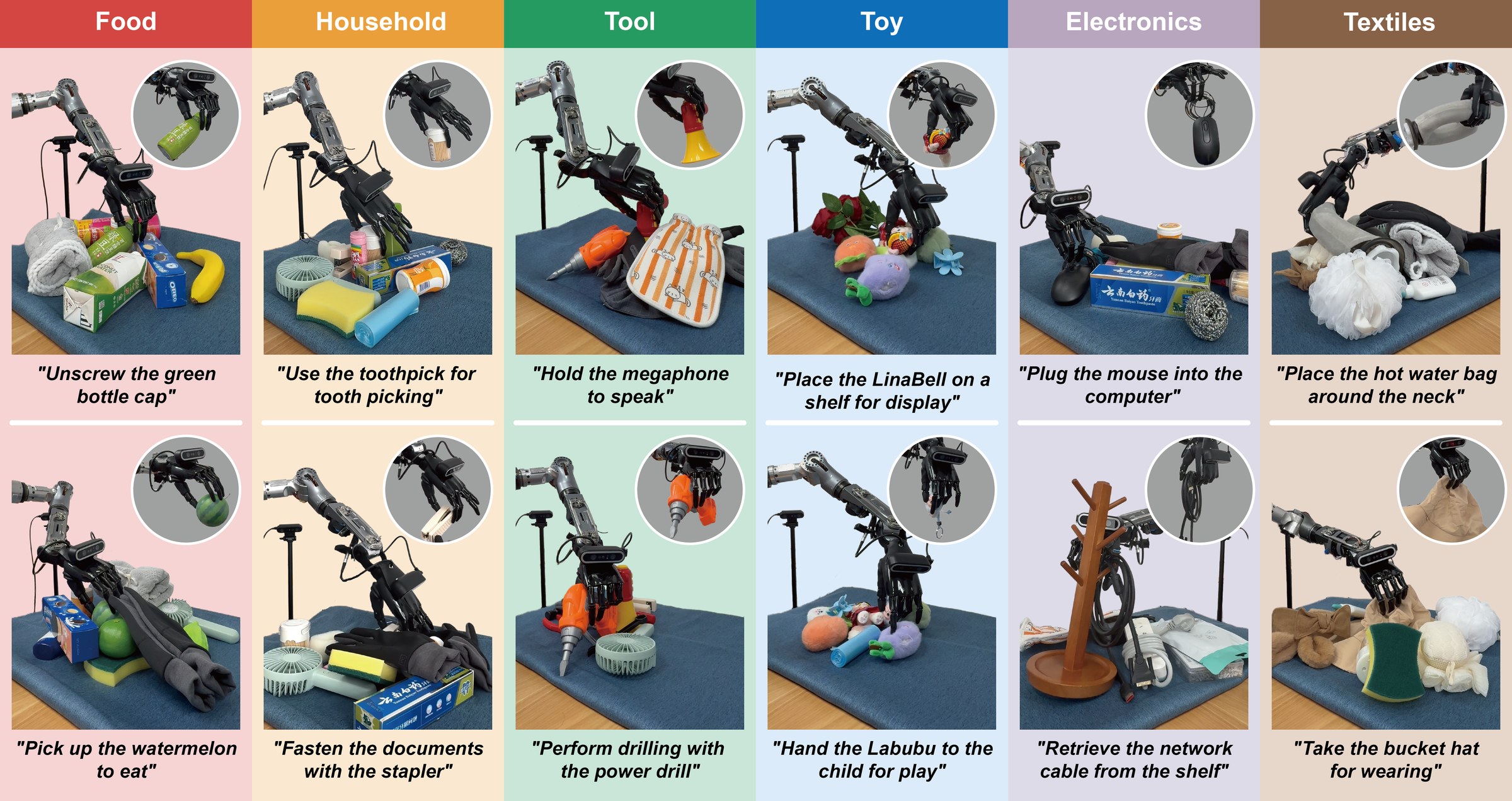
Static clutter is 102 everyday objects, 510 trials, 83.3% overall success. Failure slices on the project page: 30% functional-part recognition, 22% pose estimation, 20% contact stability, 16% multi-object interference, 12% grasp-type error. Hardware shown includes KEENON XMAN-R1 + ROHand, TianJi Marvin + ROHand, and TianJi Marvin + Pika gripper.
Dynamic clutter is a conveyor at 2–5 cm/s with 16 targets plus distractors. A separate disturbance set (out-of-view recovery, fast motion, occlusion, simultaneous translation and rotation) hits 89.7% over 10 objects, five trials each. Grasp updates run at 5 Hz.
They also bolt on extras without retraining the grasp policy: bimanual sorting via a task-allocation module, and transparent objects via depth completion.
A Human’s Take
Decoupling “what the sentence wants” from “whether this hand can close on it” is the part I want copied. Hands keep changing. If every new five-finger design forces you to retrain the whole VLA, nobody ships. Eighty-three percent in real clutter with 102 objects is a serious table. I still want to see the 16.7% that failed, especially the 20% that lost contact. That is the shift, not the studio hero.