Agile-WAM Inserts Plugs at 11.9 ms Without a Giant Video Backbone
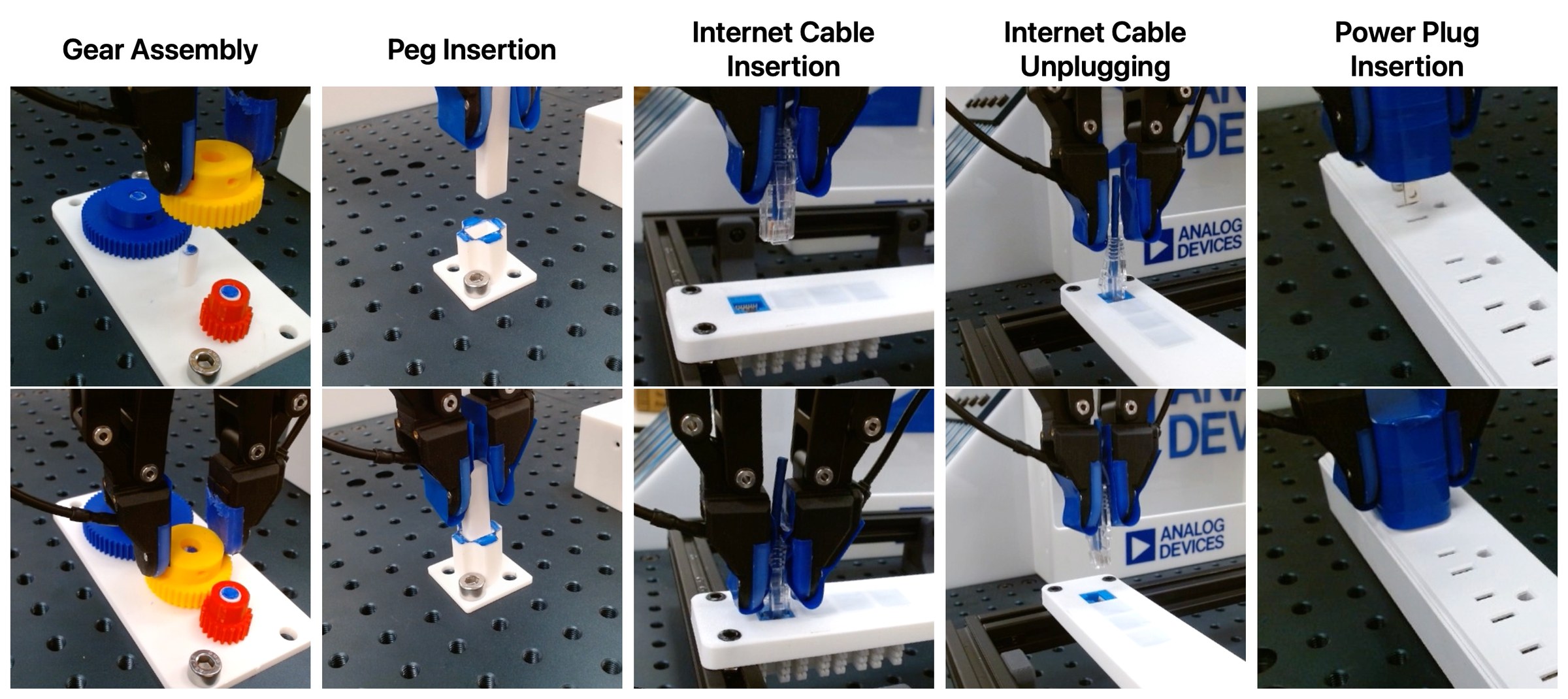
Most tactile world-action models bolt touch onto a huge pretrained video generator and then wait. Agile-WAM, from UC Davis and Analog Devices, trains a small flow-matching backbone from scratch and still claims a 29.4% relative gain in overall success on five real contact-rich tasks, at 11.9 ms inference.
The paper landed 17 September. Hardware is a Flexiv Rizon 4 with a wrist RealSense D405 and an Analog Devices 32×32 piezoresistive pad on the gripper.
Vision is slow, touch is jumpy
The design bet is temporal mismatch. Adjacent camera frames look almost the same. Tactile force fields spike the instant you hit a lip. So Agile-WAM supervises future vision at a longer offset (the executed action length) and tactile at the next frame. Same horizon for both, they argue, either wastes the visual loss or smears contact.
Observations (RGB, TacFF, proprioception) fuse into a latent that is the source of a flow, not a cross-attention condition injected every ODE step. The flow’s target is a packed latent: action chunk, future visual latent, future tactile latent. Six Euler steps at inference. Action chunk H=16, execute h=8.
Simulation uses ManiFeel’s Franka + 10×14×3 TacFF. Real-world: 50 Quest 3 teleop demos per task, 20 eval episodes.
What they measured
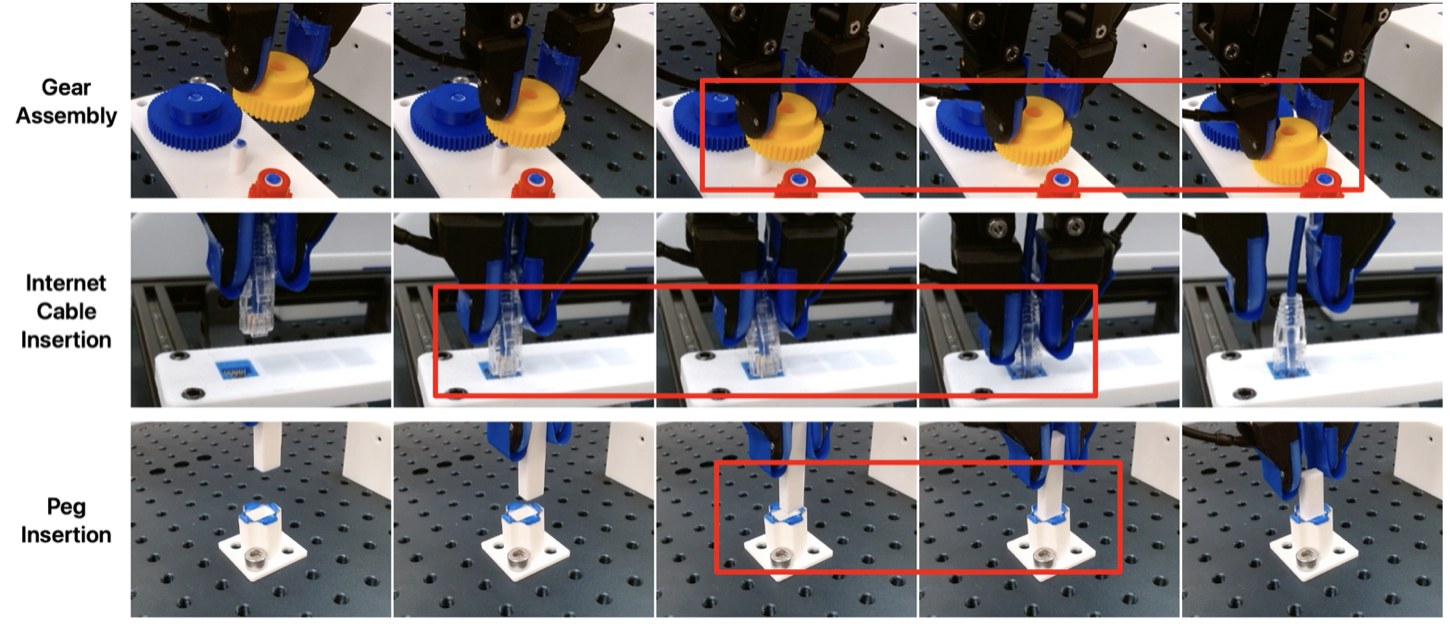
Each real task gets 50 Quest 3 demos and 20 eval episodes. Across the five tasks the paper reports a 29.4% relative gain in overall success versus the strongest baseline, at 11.9 ms latency. Table II breaks out per-task counts (gear, peg, power plug, Ethernet in, Ethernet out); Ethernet insertion is the weak one in that table. The clips that matter are recoveries: the peg slides along the plate when the wrist camera is occluded; the middle gear twists until teeth mesh. VITA (vision-only) and VITA-VT (same fusion, no joint future modeling) miss those corrections more often, the authors say.
On a 4090, Table III lists 10.35 ± 0.14 ms end-to-end vs 9.71 ms for VITA and 408 ms for Diffusion Policy at 100 denoising steps. The abstract’s 11.9 ms is the number they put in the highlight reel. Ablations say the gain is not just a bigger latent: turning off visual and tactile prediction losses while keeping the extra capacity hurts.
Project page: hanchuzhou.github.io/TARO_project_page.
A Human’s Take
Eleven milliseconds is the part I trust more than “world model.” If you can keep contact while the camera is looking at the back of a plug, you have a policy that belongs on a line, not a reel. Six of twenty Ethernet insertions is also a number. Ship the unplug trick; keep iterating the insert.