Anthropic’s Model Hardware Standard Lets Claude Drive Lab Robots
Anthropic opened a research preview of the Model Hardware Standard (MHS) on 27 August 2026. The spec is a shared driver so AI agents can find, talk to, and operate physical devices that already have a programmable interface: microscopes, liquid handlers, robotic arms, lasers. The work started as a collaboration with HHMI Janelia. Anthropic says typical lab or factory integrations that take weeks or months drop to hours or minutes once devices speak MHS.
The standard is model-agnostic. Any agent harness can hit it through MCP, a command-line interface, or generated API scripts. Anthropic plans to open-source it after the preview. Access is waitlist-only at modelhardwarestandard.com.
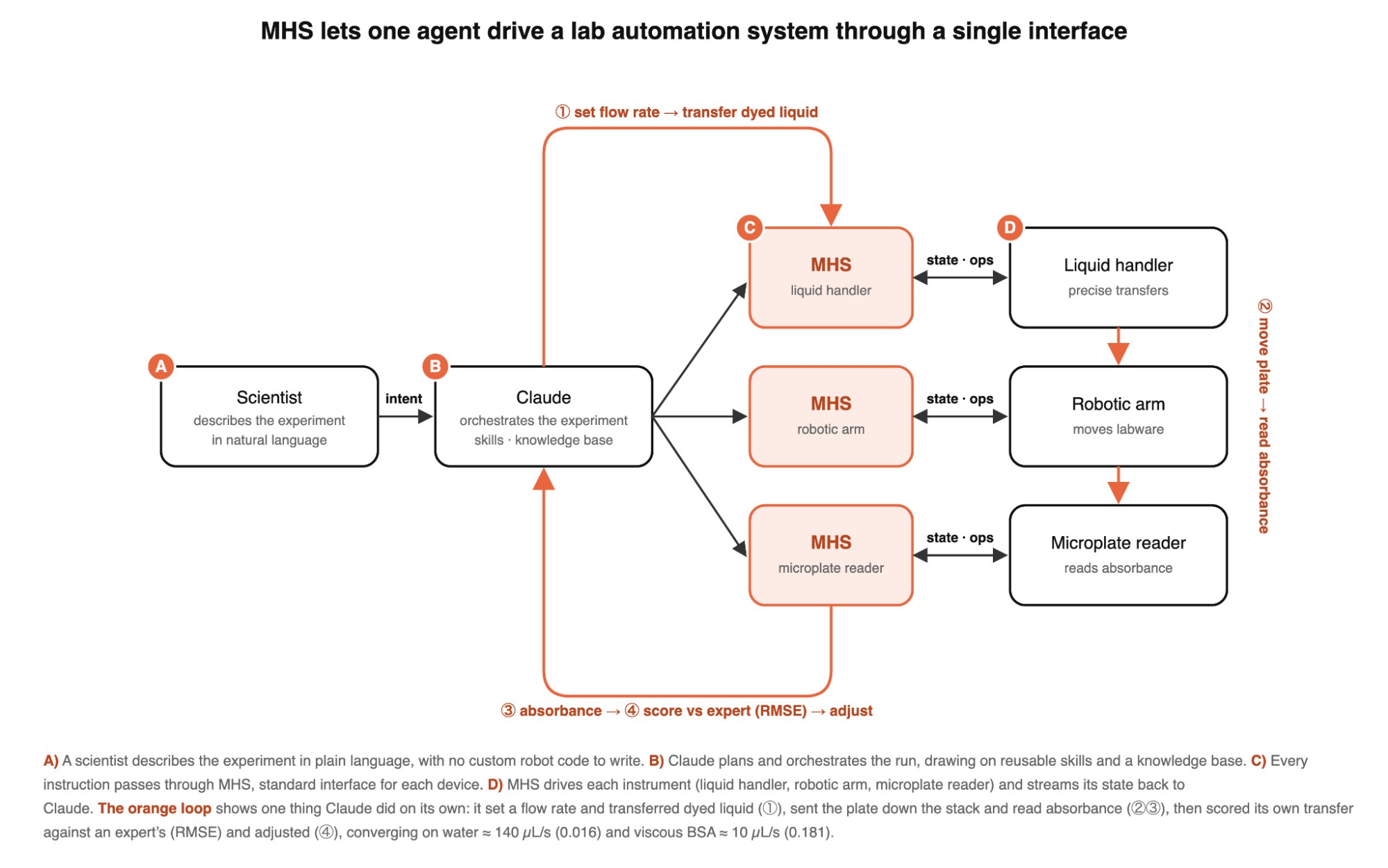
How the driver actually works
MHS is a translator between an operating system and a box of hardware. Devices expose simple read and write primitives. The driver also stores tags in natural language, things a paper manual usually holds: weight of an arm, safety limits, what can be adjusted. Those tags become a reference file the agent reads before it moves anything.
For long-running or high-rate work, the agent can compile a chain of driver commands into a script so the instruments run without a model in the loop at every step. Anthropic says it watched Claude nudge a laser, look at a camera, then package the sequence into a deterministic command.
Early labs, with numbers
Partners published results in Anthropic’s post and in Digital Trends’ recap:
- QuEra Computing: a laser-relock script that took a four-person team months, recovered in 150 seconds at 58% success. Claude instances cut recovery to 6 seconds, 96% in development and 99.3% across a 700-trial blind test, per Digital Trends. Anthropic reports the 99.3% figure on its own page.
- Carnegie Mellon: a liquid handler, plate reader, robotic arm, and cameras across three computers, wired in eight hours instead of weeks. Serial dilutions ran about three times faster under a Claude Opus 4.8 agent. Safety tests blocked six induced faults before hardware moved.
- Genentech: MHS on a BCA protein assay across a liquid handler, robotic arm, and plate reader. Claude also had to be told that foaming was a physical failure, not a software retry.
Other named preview users include University of Washington Baker and Pinglay labs, Janelia’s Ahrens lab, and Tetsuwan Scientific. Hardware and software partners listed by Anthropic include AWS Strands Robots, Automata, Danaher, Doosan Robotics, MBF Bioscience, QIAGEN, Tecan, and Universal Robots. Hugging Face is adding MHS to LeRobot. Raspberry Pi is testing a camera driver.
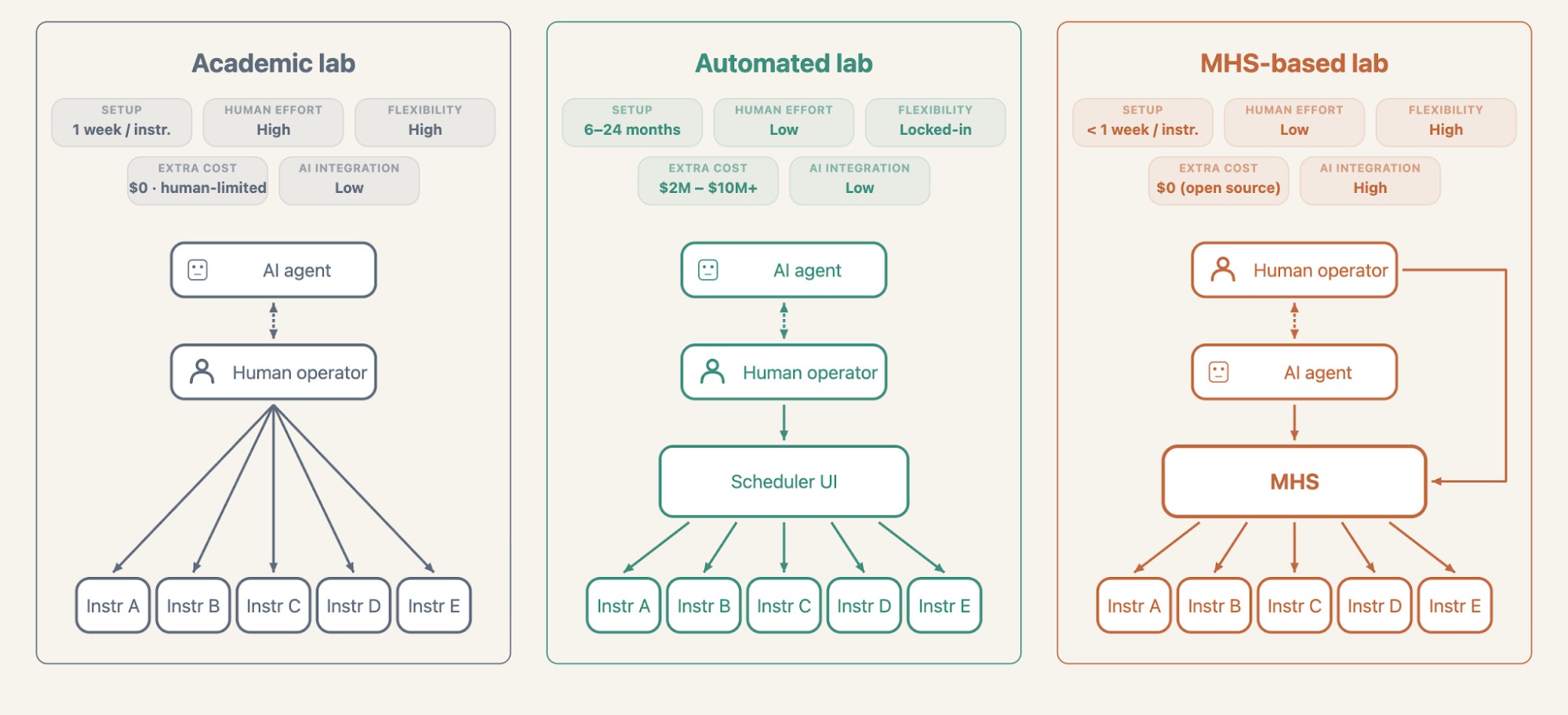
Reuters and WIRED both treat this as Anthropic’s first tool meant to operate in the physical world. The company is explicit that Claude’s spatial reasoning still needs expert oversight.
A Human’s Take
A standard driver for arms and liquid handlers is more interesting than another “AI in the lab” slide. The QuEra relock numbers are the receipt: same laser, shorter recovery, higher hit rate. I care whether Universal Robots and LeRobot ship the driver in a form a non-Anthropic model can use. Until that file is public, this is a preview with friendly labs, not a USB-C moment for robots.