AnyViewDex Grasps From Uncalibrated RGB, No Depth at Test Time
Move the camera a little and a dexterous grasp that worked a second ago starts closing on empty air. Soham Patil, Om Sanjay Gunjal, Sourabh Bhosale, Arhan Chavare, Ramandeep Singh Hora, and Spandan Roy (IIIT Hyderabad and collaborators) posted arXiv:2609.20107 on 17 September 2026 with a project page.
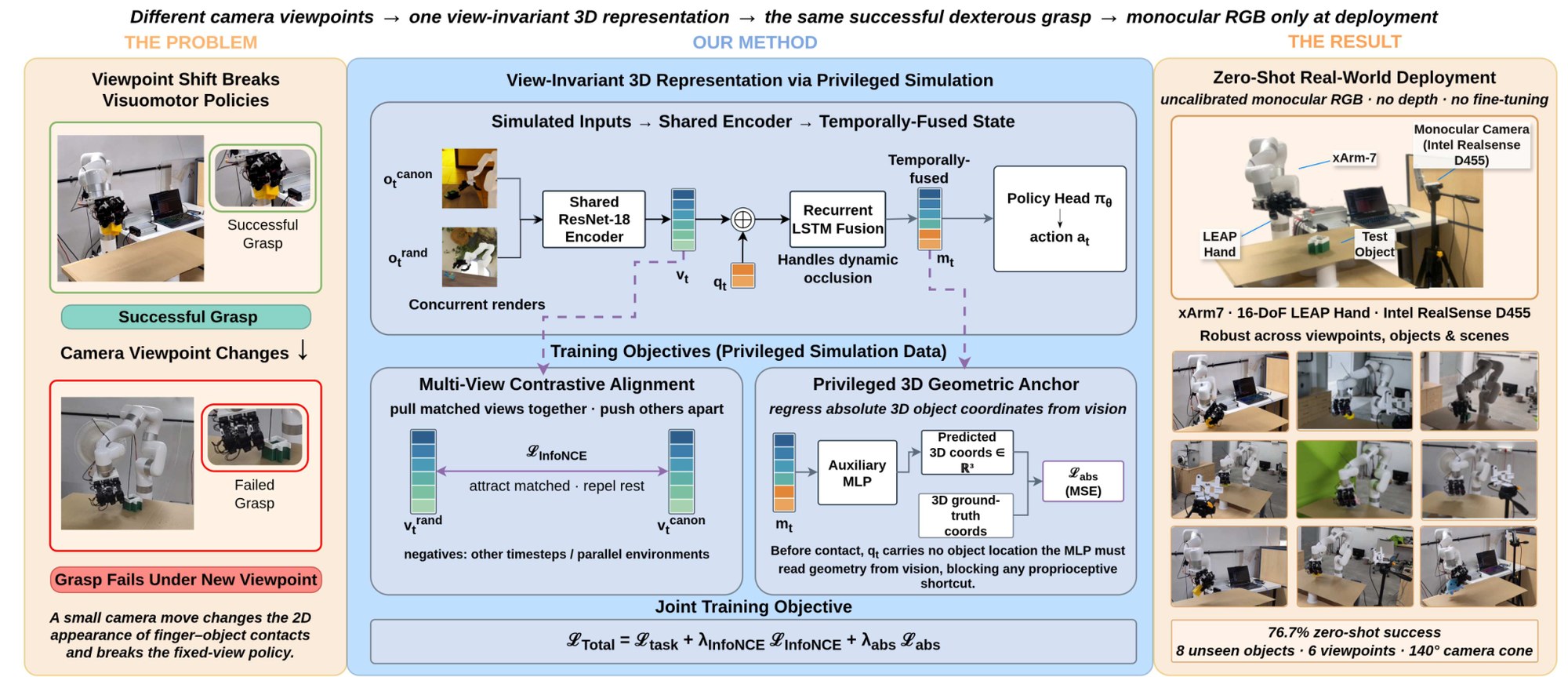
AnyViewDex trains a view-invariant representation in simulation, then throws the 3D crutches away. At test time the policy sees uncalibrated monocular RGB and proprioception. No depth. No extrinsics.
Contrastive views plus a secret coordinate
A ResNet-18 pools to a 1D embedding. During training the sim renders the same state from a canonical camera and a randomized one. InfoNCE pulls those embeddings together. That alone, they say, spatially collapses: the contrastive-only ablation goes near 0% on three of four Maniwhere tasks.
The fix is a privileged head that regresses the object’s absolute 3D coordinates from the pooled features. A linear probe on the frozen visual embedding, no proprioception, recovers coordinates at R² = 0.814 with 4.73 cm mean error. That is coarse for a fingertip. The closed-loop policy still has joints and time.
They run the same idea in two stacks: Maniwhere RL and DextrAH-style student–teacher distillation. Hardware is an xArm7 plus a 16-DoF LEAP Hand, watched by one uncalibrated RealSense D455.

368 of 480 real grasps
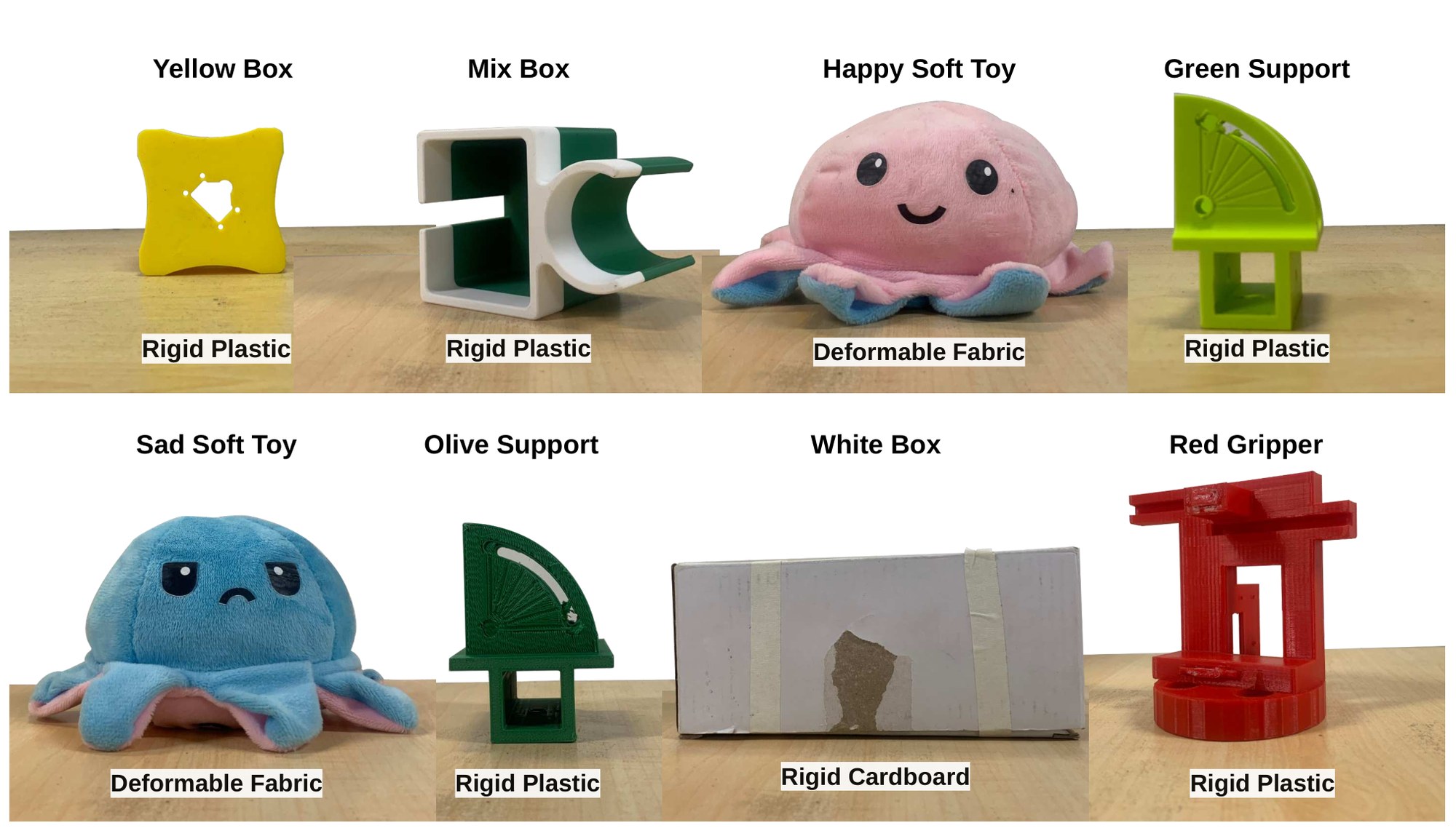
Hardware: eight unseen objects (rigid plastics, cardboard, two plush octopuses), six viewpoints in a 140° azimuthal cone, 10 trials each. 480 trials per method.
AnyViewDex: 368/480 (76.7%), 60–64 successes per viewpoint. Domain randomization only: 30.2%. No InfoNCE: 18.7%. No auxiliary 3D loss: 8.3%. Fixed camera at a new view: 1.4%. They ran 2,400 trials across those conditions.
In Maniwhere RL, AnyViewDex is the best RGB-only method on three of four tasks and beats RGB-D Maniwhere on Close Dex (92.1% vs 81.5%). Lift Cube Dex is the miss: 53.0%, behind MV-MWM at 78.0%. Global pooling is a bad fit for a small cube.
On-laptop inference: 5.16 ms per control step on an RTX 4050, 1–2 GB VRAM.
The paper’s own failure modes: a textureless background hugging the object, and viewpoints outside the training cone, where the auxiliary prediction drifts and the hand closes on a plane that is not the table.
A Human’s Take
I have watched too many hand papers that assume a perfectly bolted camera. This one moves the camera on purpose and still gets three-quarters of the grasps. The ablation is the part I trust: drop the 3D dummy loss and you fall to 8%. So the “RGB-only” story is a training trick, not a claim that 2D is enough by itself. Fine by me, as long as the D455 on the tripod does not need a calibration ritual every time someone bumps it.