ARGUS Canonicalizes Camera Views Before Visuomotor Policies Learn
Policies trained on wild multi-camera datasets often learn where the cup sits in the image, not where it sits on the table. ARGUS (Aligning Robot Scene Geometry Under Shifting Views), posted August 6, 2026 as arXiv:2608.05579 from UIUC and Harvard, with a project page, attacks that by preprocessing observations into one canonical view.
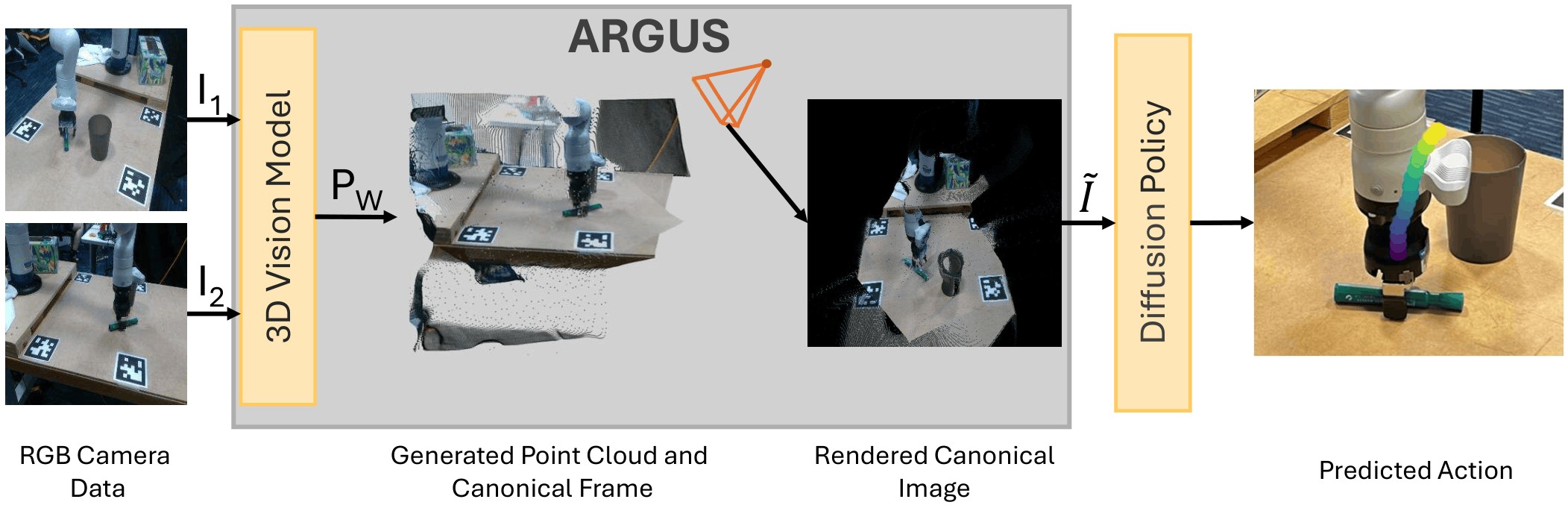
Pipeline in three steps
Given two calibrated external RGB cameras looking at the workspace:
- Build a 3D point cloud with a large vision model (VGGT in the paper).
- Recover metric scale from the real camera baseline vs VGGT’s estimated baseline, then transform into the robot base frame using known extrinsics (AprilTags in their lab setup).
- Re-render from a fixed virtual camera chosen for workspace visibility.
That canonical RGB (or, for 3D Diffuser Actor, the scaled point cloud) feeds a standard Diffusion Policy at train and test time. ARGUS is deliberately a preprocessor, not a new policy architecture.
Real-robot results
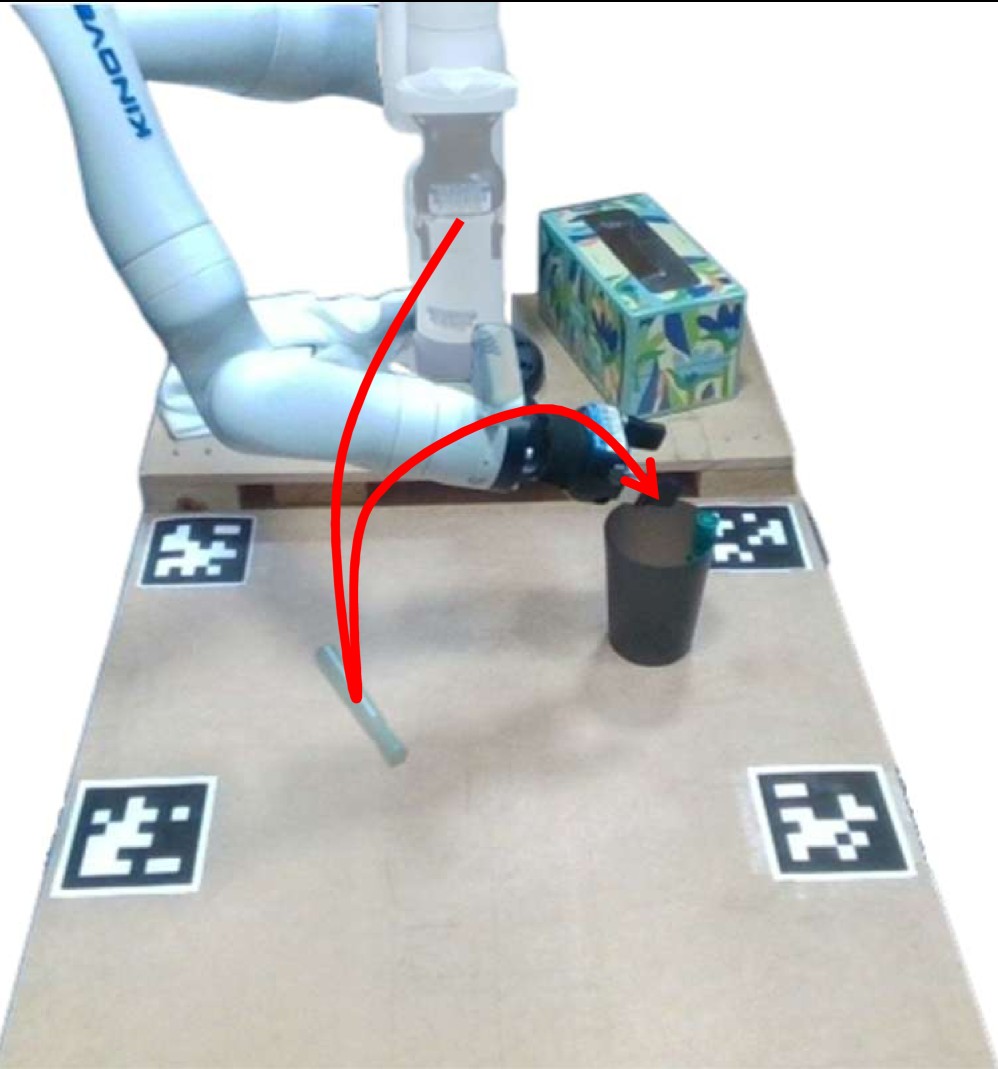
On four Kinova Gen3 tasks (marker-in-cup, towel unfold, brush-in-bowl, stack blocks), with 100 demos and evaluation across five novel multi-view camera regions (shifts up to about 135°):
- ARGUS beats classic Diffusion Policy, KYC (camera-ray conditioning), and VISTA (novel-view synthesis augmentation) under both fixed-view and highly diverse training sets.
- On the efficiency study (towel task, diverse data), ARGUS reaches ~90% success about 6× fewer dataset passes than KYC and 4× fewer than classic DP, and still hits ~70% with only 40 demos.
- Swapping depth for VGGT inside 3D Diffuser Actor is competitive with true depth sensing.
Limits they own: ~0.52 s per prediction on an RTX 3080 for VGGT, and reduced precision on tiny objects when reconstruction shifts or holes appear.
A Human’s Take
I like the honesty of treating viewpoint as a nuisance to kill before learning, not a virtue to drown in data. If your fleet cameras wander, canonicalization is the right first lever — just budget the 3D model latency, or this stays a research-table trick rather than a 30 Hz closed loop.