AthenaZero Throws 69 mph and Plays Catch on the Science Robotics Cover
AthenaZero is not a new robot. The Robotics and AI Institute in Cambridge has been using the same low-inertia bimanual platform for juggling. What is new this week is the cover of Science Robotics (16 September 2026, Vol. 11, Issue 118): a hardware paper on throwing, catching, and batting, with numbers the authors say beat any anthropomorphic arm they know of.
The arXiv copy is 2609.19194, submitted 15 September. Corresponding author is Andrew S. Morgan. Interesting Engineering picked it up the next day. RAI’s own design write-up and demo video match the same baseball tasks.
Low gear, low mass, no joint torque sensors
AthenaZero stands about 1.6 m with a 1.8 m wingspan. It has a 1-DoF torso, two 7-DoF arms, and two 6-DoF underactuated hands: 22 actuators over 27 joints. Most joints use 5:1 quasi-direct-drive actuators. Shoulder motors are 95 mm with 90 Nm peak. There are no force-torque sensors; torque is estimated from motor current.
The point of the gearing is effective mass. In a pendulum impact test, AthenaZero measured 0.83 kg at the wrist versus 3.3 kg on a Franka Research 3. Peak impact force was 124.1 N against 208.3 N. The paper’s model puts a human arm near 2.76 kg. The tradeoff is the one you expect: the arm is not a cobot for welding. Unloaded end-effector error averaged about 3 mm; with a 1.8 kg load it rose to about 12 mm. Motors trip software protection above 80°C, and the authors say they do not want long static holds over 2 kg at full extension.
The baseball numbers
Two robots stood 7.3 m apart. OptiTrack ran at 240 Hz.
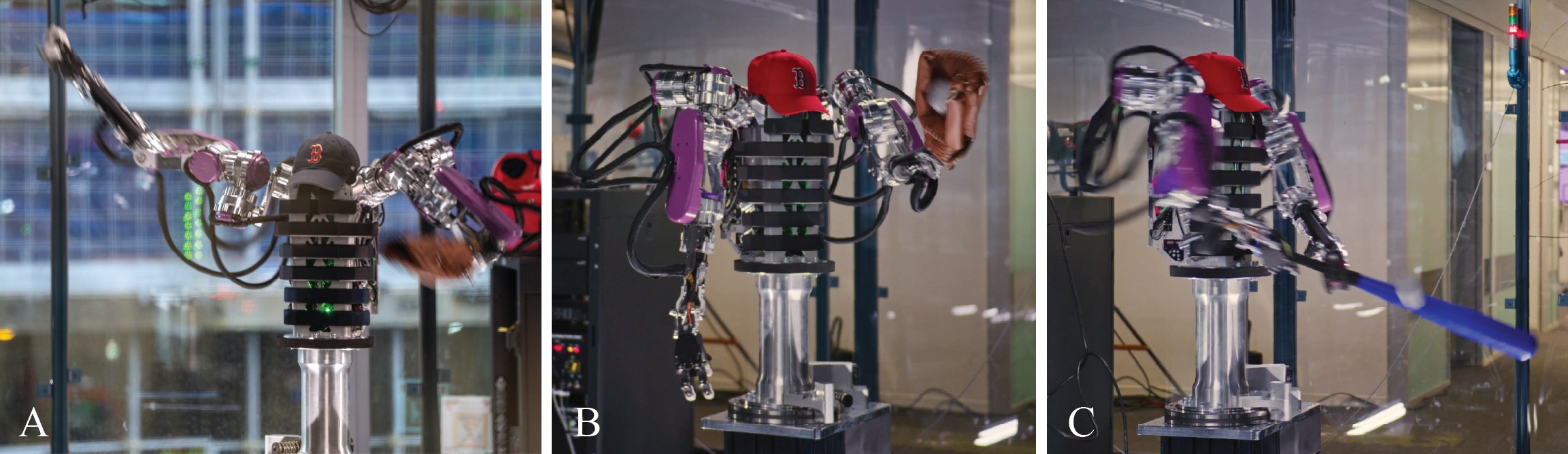
- Throwing: fastest tennis ball (~57 g) at 30.8 m/s (about 69 mph) one-armed. Accurate baseball (~145 g) throws at 21.4 m/s into a 0.25 m × 0.25 m window.
- Catching: baseballs up to 18.3 m/s with 0.398 s of reaction time. Reliable catch-and-return in the paper is quoted at 13.4 m/s.
- Batting: tennis balls at 13.9 m/s max in the skill table; 27 hits in 33 swings (>82%) at about 13.4 m/s into a 0.4 m × 0.7 m strike zone. Timing window: 2 ms.
Robot-to-robot catch volleyed up to 8 times with about 11 s catch-to-throw. A human in the loop reached 12. Batting practice ran about 3 minutes. Failures on catch often came from a bad transfer out of the glove, which then sent the return throw wide. At the high end of catching speed, the ball left the palm before the fingers closed.
The mound-distance numbers in the paper (46.1 m/s catch, 35.0 m/s bat at 18.4 m) are extrapolations that hold reaction time fixed. They are not throws from a real mound.
A Human’s Take
I already believed AthenaZero could juggle. This paper is the one that tells you why the arm is built that way: if the endpoint mass is closer to a person than a cobot, you can take a baseball hit without the object bouncing off like it hit a wall. Sixty-nine miles an hour with a tennis ball is a real number. The thermal limit and the 12 mm sag under load are also real numbers. I would not put this on a weld cell. I would put it on any task where the first millisecond of contact decides whether you keep the object.
Sources
- Science Robotics — AthenaZero (DOI 10.1126/scirobotics.aee1868)
- arXiv:2609.19194 — AthenaZero: A low-inertia, bimanual robot for dynamic manipulation
- RAI Institute — AthenaZero design blog
- YouTube — A Dynamic Robot That Can Throw, Catch, and Hit a Baseball
- Interesting Engineering — AthenaZero baseball coverage