Attune Asks Operators Why Their Eyes Left One Robot for Another
Fleet interfaces are usually six camera tiles and a prayer. Attune, from George Mason University, is a pre-deployment tool that records an operator’s eyes on two robots, then helps that person explain the glances. The paper is arXiv:2608.12650 (12 August 2026) and is headed to UIST ’26 in Detroit (2–5 November). Authors: Puqi Zhou, Sungsoo Ray Hong, and David Porfirio.
The claim is narrow and useful. Designers already fiddle with feed layout. They have less data on feed content: which robot motions steal attention, and from whom.
How the session works
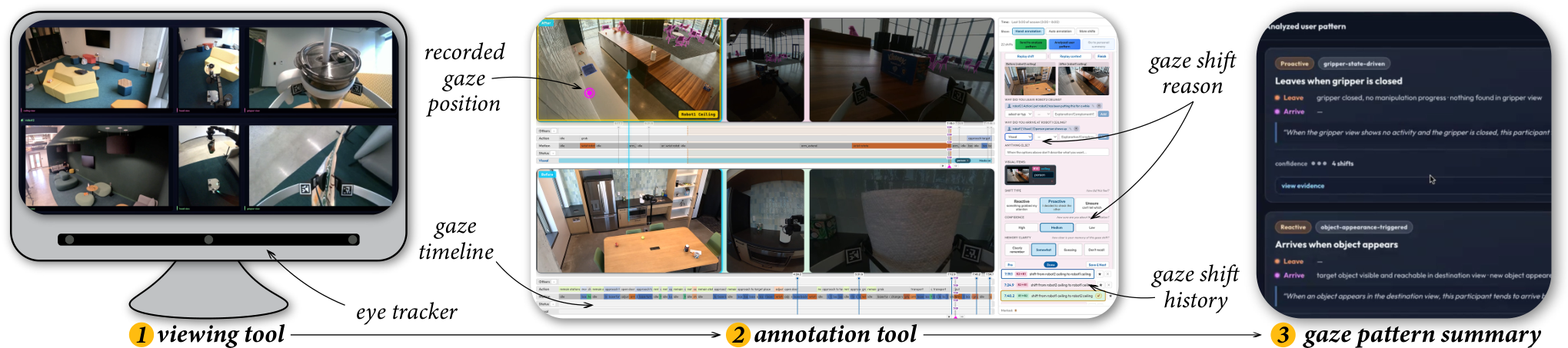
The operator watches two robots at once. Each robot has three synced views: ceiling, head, gripper. A Tobii Pro Spark at 60 Hz logs gaze. After the watch, Attune curates cross-robot and cross-view shifts (100 ms dwells; 200 ms if gaze left the tiles) from the last five minutes, so novelty and memory rot are both reduced.
The operator replays a shift, then fills why leave and why arrive, plus reactive vs proactive, confidence, and memory clarity. A Gemini-2.5-Flash pass clusters those explanations into candidate patterns. A faster Llama-3.3-70B (via Groq) drafts labels for leftover shifts. The operator can edit everything. The last page is a personal summary.
Videos in the study were of a physical Hello Robot Stretch 3 in a kitchen, a living room, and a hallway missing-person search. Pair lengths were 35 to 83 minutes. Each participant watched eight minutes.
What twelve people did
12 campus recruits (8 male, 4 female), paid $30/hour. None had used a gaze-annotation tool before. Four wore lenses. They were told to talk to the robots so they would not zone out. The authors warn that talking may have changed where they looked.
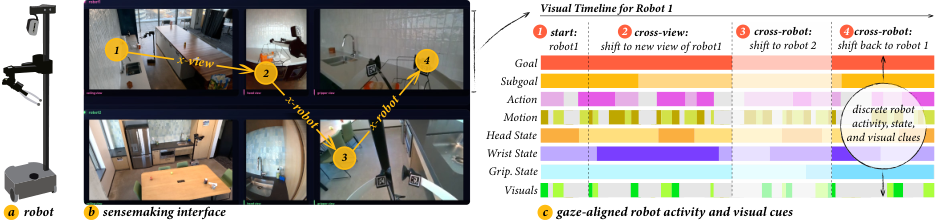
Attraction scores (shift-ins versus how long a motion lasted) were higher for fine manipulator work and goal-directed actions than for walking around or sitting idle. Agreement on which actions drew looks was modest overall (Kendall W = 0.24) and stronger inside a scenario (W = 0.54–0.70). Motion agreement was weaker.
Participants rated the personal summary “reflective and helpful” at M = 5.92 on a 7-point scale. SUS averaged 75.21. Robot context ranked first in a Borda count of what drove shifts, then visual context, then task context. Several people said they could not tell genuine recall from a story they invented after seeing the clip end.

Code and prompts: ari-lab-gmu.github.io/Attune_UIST26. This version is two robots and pre-recorded video.
A Human’s Take
I would not ship a fleet UI from twelve students talking to a Stretch. I would steal the replay card. “Why did you leave this gripper view?” is a better design question than another heatmap. If a hospital desk operator confirms they only glance over when the other robot starts a precise grasp, that is something you can actually turn down in software.