Bench2Dex Puts 12 Robot Hands on One Tactile Benchmark
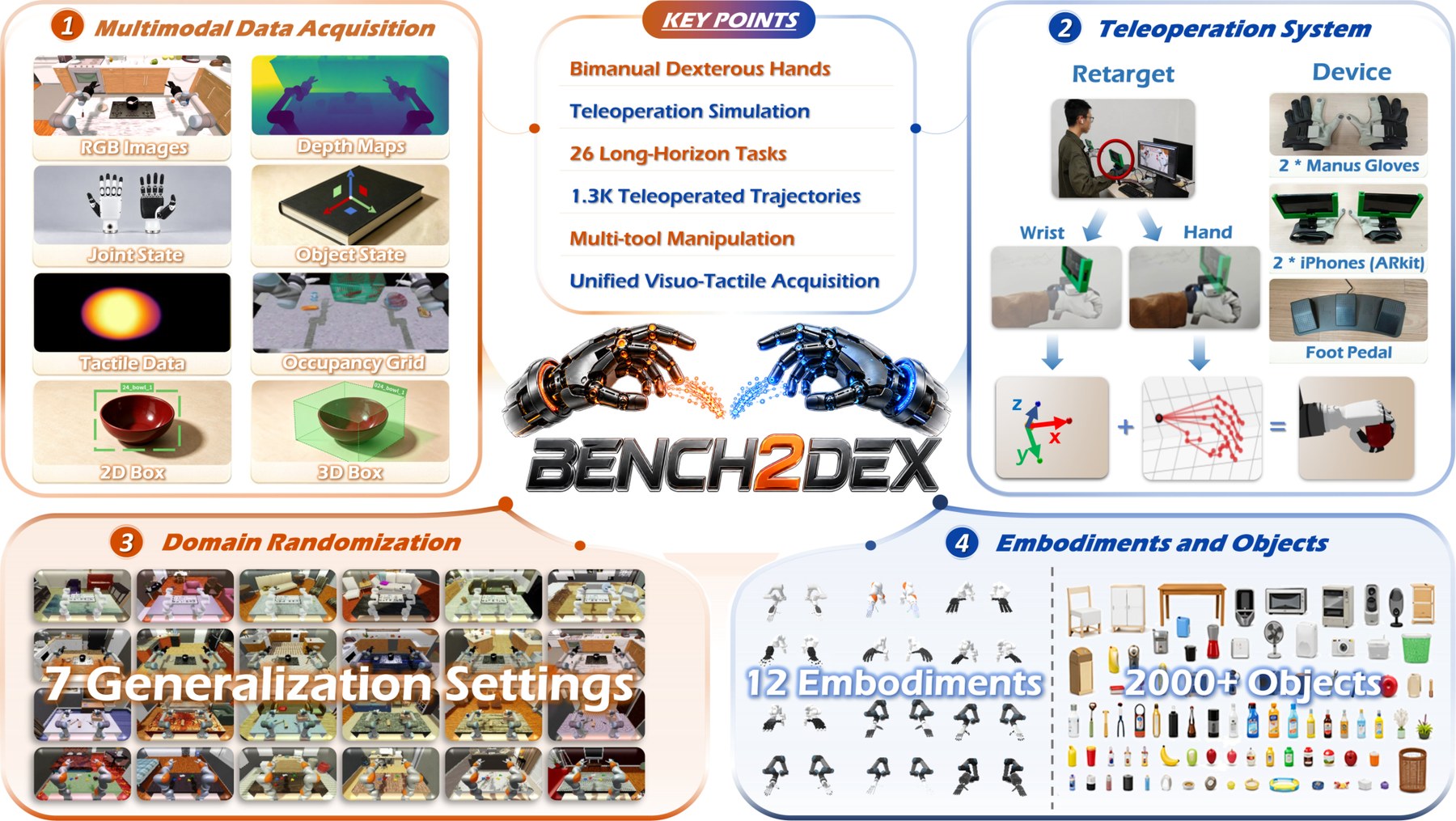
Bench2Dex landed on arXiv on September 14 as a simulation benchmark for visuo-tactile bimanual work across 12 dexterous hands. The authors, including groups at Fudan and Shanghai AI Lab among a long list, built it in Isaac Lab. Code for training, inference, and teleop is open. The project page is bench2dex.github.io.
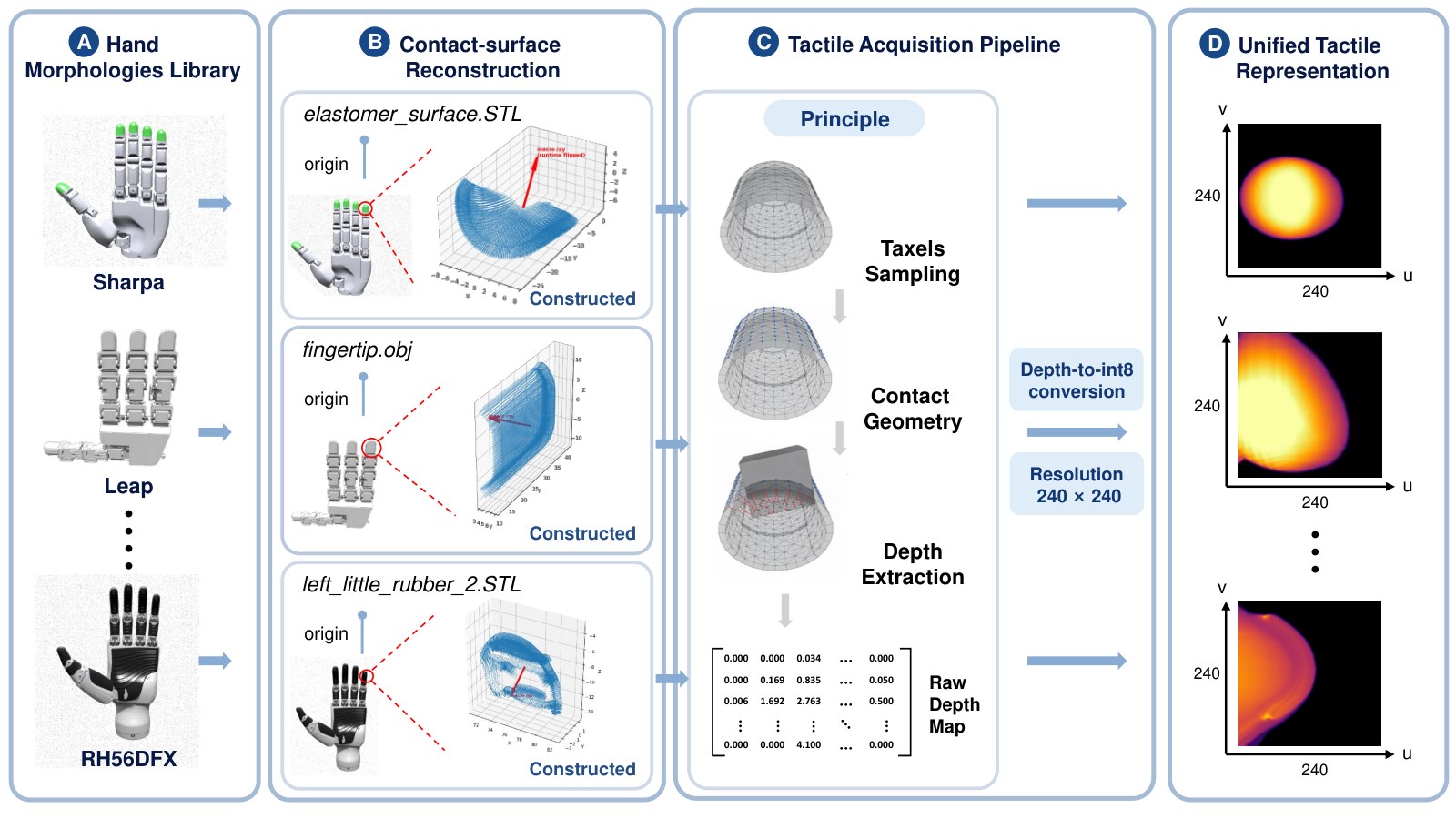
The point is not another 100-task table with one gripper. Most manipulation benches still lock you to one hand or skip touch. Dexterous hardware has not converged, so tactile signals from one fingertip do not mean the same thing on another. Bench2Dex fakes a shared image-like tactile map from contact geometry instead of pretending to clone GelSight or DIGIT.
What is in the box
- 26 long-horizon bimanual tasks: tool use, articulated objects, multi-stage household work
- ~1.3K human-teleoperated demos
- Eight synced modalities: RGB, depth, joints, object state, the shared tactile map, 2D/3D boxes, occupancy grids
- Teleop: Manus glove (25-node skeleton) plus ARKit wrists, DexPilot retargeting, Pinocchio IK
Hands in the eval table include Sharpa, DexHand021, Orca, Allegro, Revo2, Ability, LEAP, RH5DG2, RH56DFX, Shadow, Schunk, and Wuji, on arms such as IIWA7, Panda, xArm7, and UR5.
The tactile pipeline rebuilds a contact surface per fingertip, ray-casts inward, and writes an 8-bit 240×240 map. Near contact, each gray level is 0.005 mm; farther out it stretches to 0.03 mm, saturating near 5.15 mm.
The policies mostly lose when the scene moves
They ran ACT, Diffusion Policy, π0.5, and GR00T N1.5 for 20,800 rollouts (26 settings × 4 channels × 50). Success is “reach and stop”: the terminal predicate has to hold for 0.5 s, not a lucky frame.
On matched scenes (None), GR00T is ahead at 48.5% stable success, then ACT 29.5%, π0.5 27.3%, Diffusion Policy 12.9%. Under the combined Full shift (new lighting, camera, clutter, and new object pose and table height), GR00T and π0.5 are basically tied at 19.8% and 19.7%. Three tasks — jigsaw assembly, fridge fruit sorting, soup serving — go to zero Full successes for every policy.
The paper splits robustness on purpose. Invariance factors (texture, lights, background, camera, distractors) should not change the right action. Equivariance factors (object pose, table height) should. Reporting those separately is the useful bit.
The authors are explicit that the tactile maps are not a substitute for real sensors, and the hands are not calibrated to matching hardware.
A Human’s Take
A shared fake GelSight across 12 hands is the experiment I wanted. The scores say the obvious thing: GR00T looks strong when the scene is the one it trained on, then the table moves and everyone is back under 20%. If you are shipping a tactile VLA, this is the bench that will embarrass the “we added touch” slide. Just do not confuse a 240×240 depth cartoon with a real fingertip.