BICPO-VLA Smooths the Handoff When the Next Chunk Is Late
BICPO-VLA is a vision-language-action policy built for the ugly moment when the robot is still running the last action chunk and the next one is not ready. The paper is arXiv:2608.13924.
That gap has a name here: the request-to-handoff problem. The new chunk was asked for in one pose and takes over in another. A semantically correct plan can still snap the wrist.
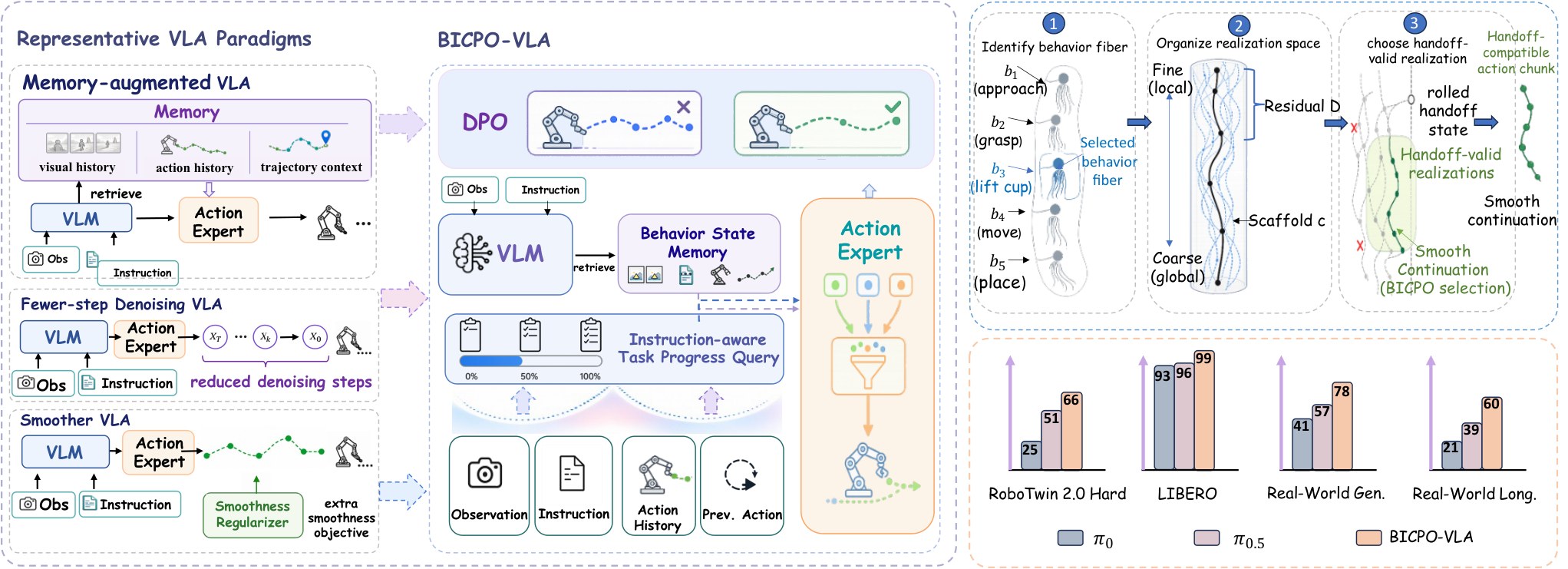
Identify the behavior, then pick a continuation
The stack has three parts:
- An instruction-aware encoder decides which behavior the command and current progress actually support, and freezes that identity.
- A one-level Haar transform splits each action chunk into a pairwise scaffold and a residual. Both reconstruct exactly. Generation is two short flow stages instead of a long refine in raw action space.
- BICPO rolls the outgoing commands to the real handoff state and uses reference-relative Flow-DPO to prefer the candidate with the smaller jump and trend mismatch.
The DPO piece is meant to be portable. The authors drop the same continuation objective onto π0.5 flow matching, Legato, and RTC without attaching BICPO’s encoder or Haar head.
Where the numbers moved
On CALVIN ABC→D, BICPO-VLA reaches 4.52 average completed length and 80.7% five-subtask success, against 4.36 and 77.3% for the strongest listed baseline.
On ten RoboTwin 2.0 Hard tasks, overall success goes from 60.4% to 65.8%, with 4–8 point gains on every task.
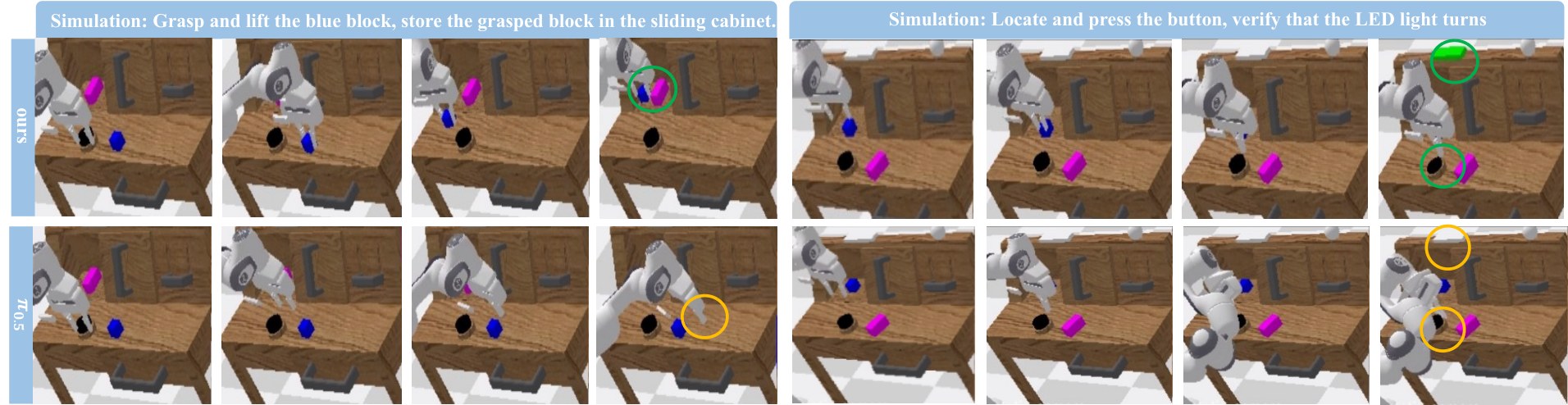
LIBERO is already near the ceiling, so they score the seam. DPO cuts jump cost 21.3% and trend mismatch 20.7%, while success only rises 0.3 points (99.1% vs 98.8% without DPO). The same DPO on host policies trims jump 15.8–40.3% and trend 11.5–21.2%, with 0.1–0.2 point success bumps. Direct continuity supervised fine-tuning hurts success. On π0.5, chosen-only SFT drops success from 96.9% to 49.1%.
Delay robustness on LIBERO is flat across k = 3, 4, 5 and random k: success 98.8–99.1%, jump 2.37–2.50.
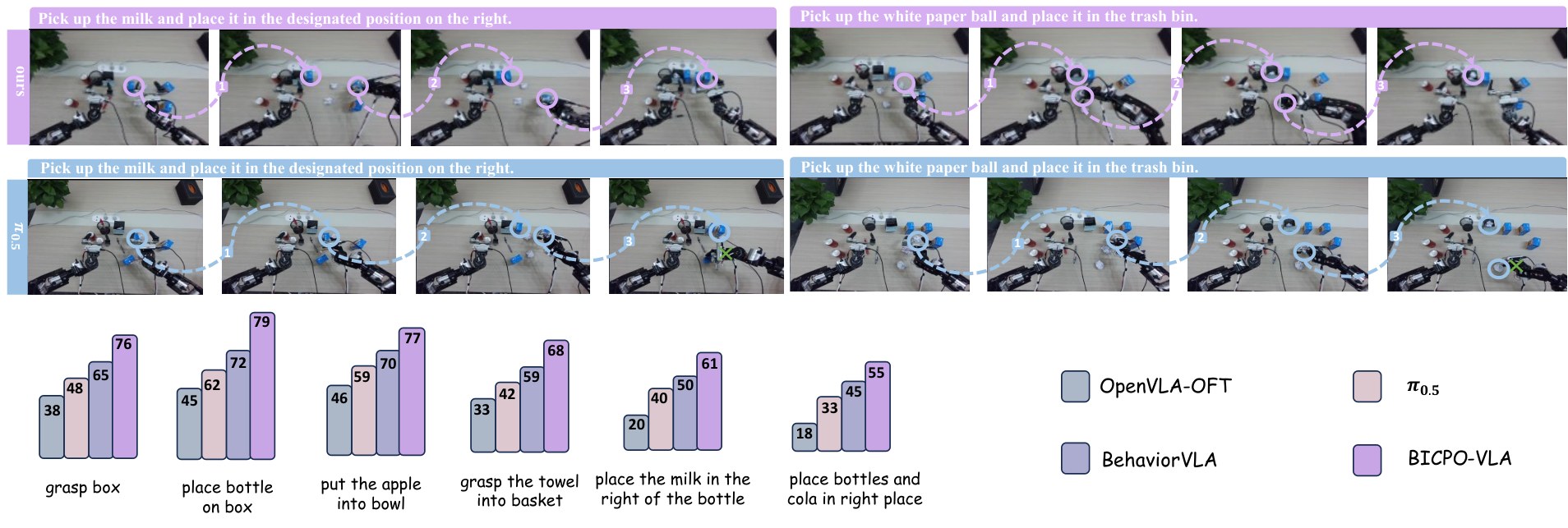
Six limited-data real-world tasks average 69.3% for BICPO-VLA, versus 60.2% for B-VLA, 47.3% for π0.5, and 33.3% for OpenVLA-OFT. The paper says it leads every task by 7–11 points over the next-best listed method.
A Human’s Take
Chunked VLAs fail in a very specific way: the next clip does not start where the last clip ended. Ranking two legal continuations is a nicer fix than telling the policy to move less. The LIBERO table is the tell. Smoothness SFT nuked π0.5. Preference did not. That is the result I will steal for other stacks.