BifrostUMI Bridges Robot-Free Demos to G1 Whole-Body Skills
Another answer to “how do we collect humanoid whole-body demos without parking a robot in every room”: BifrostUMI from the Beijing Academy of Artificial Intelligence (BAAI). It records portable VR–UMI demonstrations as sparse keypoints, retargets them onto a Unitree G1, and runs a hierarchical controller in the real world.
Paper: arXiv:2605.03452 (v2 July 7, 2026). Project: baai-aether.github.io/BifrostUMI.
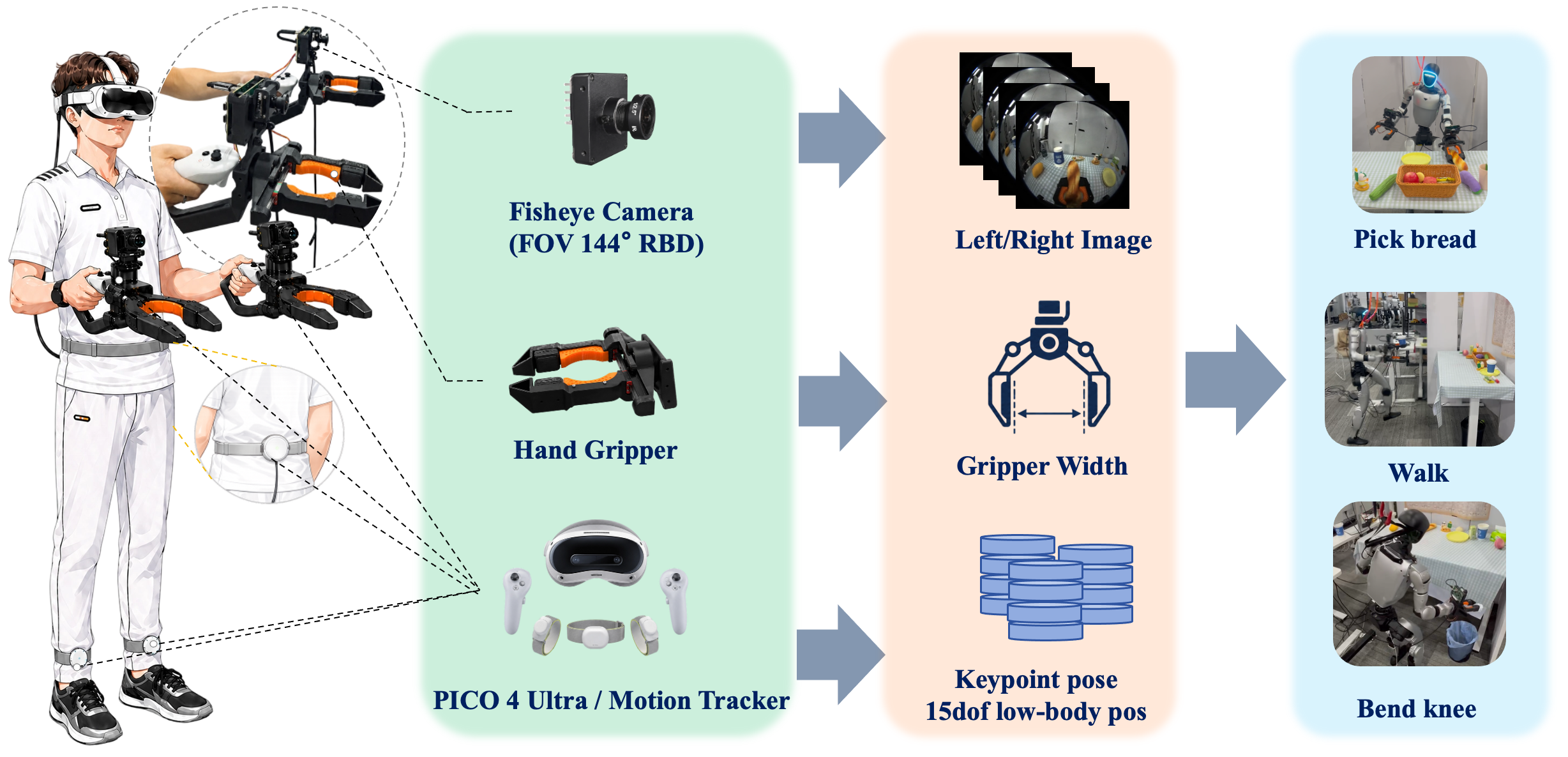
Hardware without the humanoid present
Collection uses a Pico 4 motion-capture setup (headset, controllers, two foot trackers, one waist tracker) plus two instrumented handheld grippers with fisheye cameras and magnetic-encoder aperture. Streams include wrist-view RGB, five whole-body keypoints (pelvis, two gripper TCPs, two feet; knees optional), and gripper width. Online Spatial Keypoint Retargeting (SKR) maps human keypoints into robot-native references during capture so operators can see whether the motion stays kinematically sane.
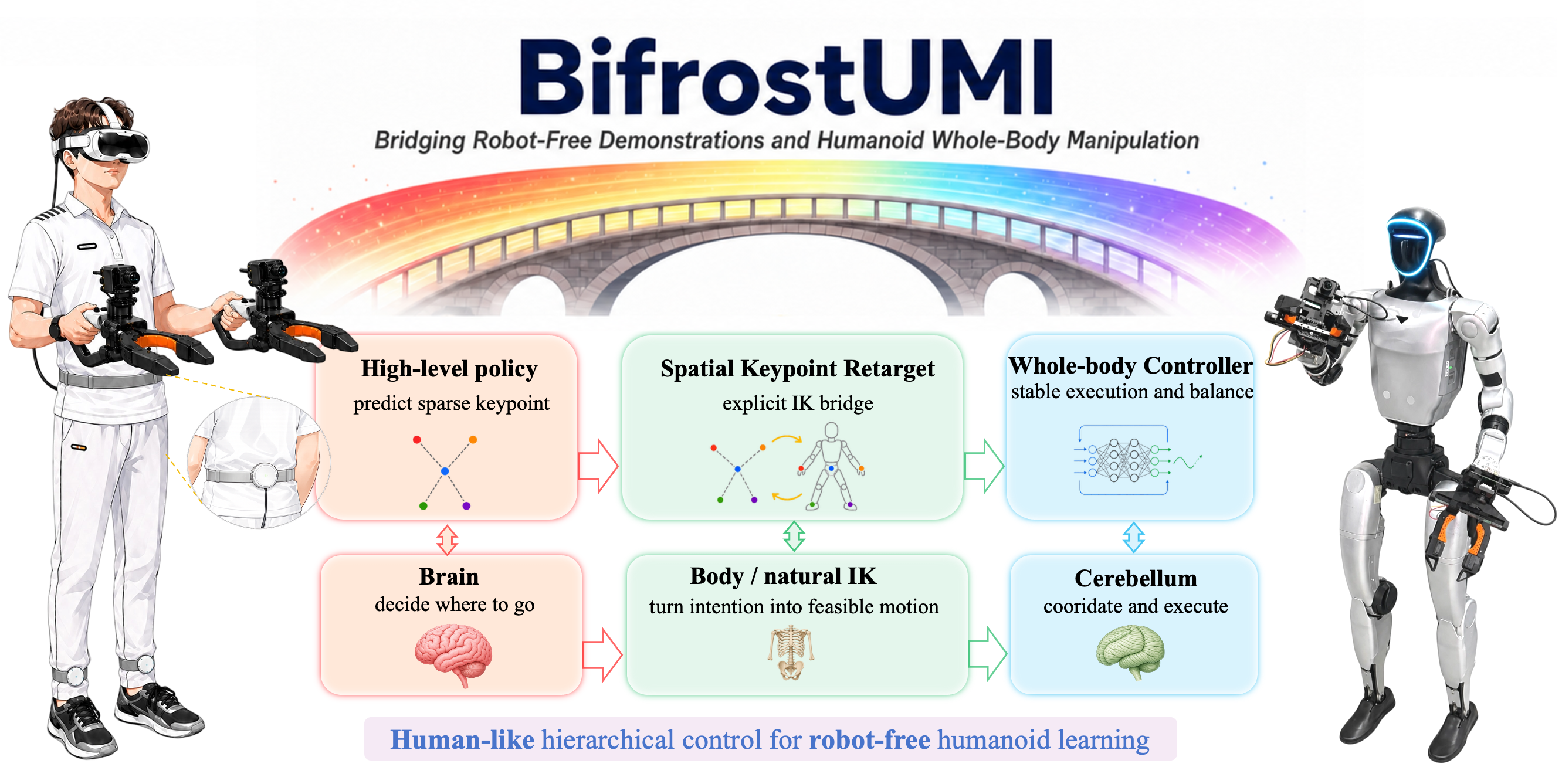
Three-stage control
- High-level diffusion policy — DINOv2-encoded wrist views + 15-D lower-body proprioception → 47-D action (five keypoints × 9 + two gripper widths), horizon H = 48.
- SKR — preserves metric spatial structure; only scales vertical pelvis-to-foot distance (λ_leg = 0.75 in the paper) for G1 height mismatch; solves constrained whole-body IK.
- Low-level whole-body controller — 50 Hz residual joint tracking trained in MJLab.
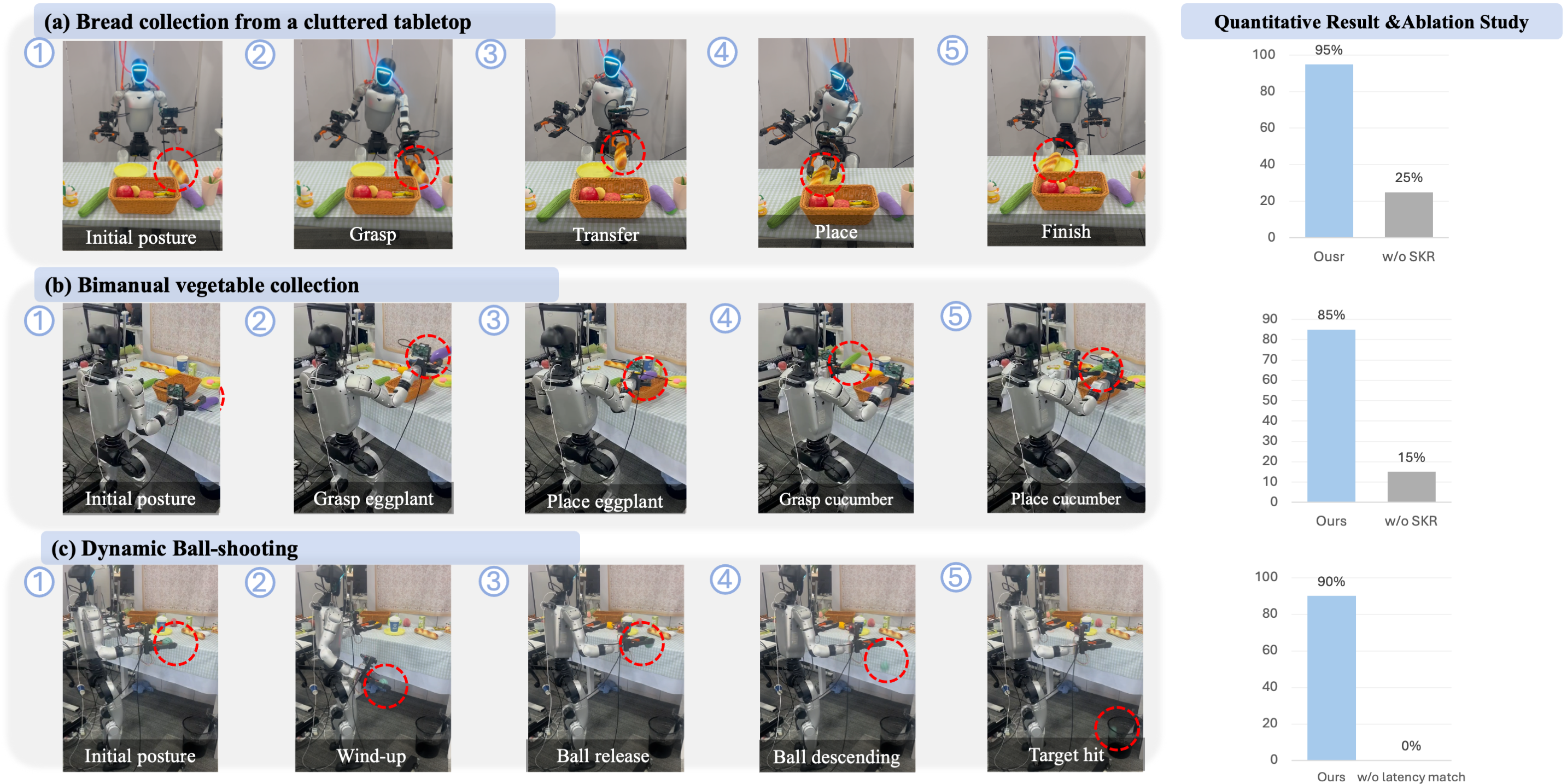
Five real G1 tasks
Project demos cover cluttered tabletop pick-and-place, bimanual vegetable collection, dynamic ball shooting, under-table waste disposal, and walking coffee delivery. Ablations on the first three tasks (20 trials each in the paper figures): replacing SKR with GMR hurts pick-place and bimanual success; dropping latency matching hurts timed throws. Seven-keypoint mode (adding knees) matters for deep bends and loco-manipulation.
Throughput vs TWIST2 teleop in 10-minute windows (paper Table I):
| Operator | Task | BifrostUMI | TWIST2 | Speedup |
|---|---|---|---|---|
| Novice | Bimanual | 55 | 25 | 2.2× |
| Novice | Throw trash | 43 | 17 | 2.5× |
| Novice | Walk + coffee | 61 | 1 | 61× |
| Experienced | Walk + coffee | 62 | 5 | 12.4× |
Average ~2.2× on non-locomotion tasks; loco-manipulation is where robot-free collection opens the widest gap.
A Human’s Take
HuMI and BifrostUMI are racing the same bottleneck from different labs: whole-body data without babysitting the robot. The novice coffee-walk number is the one I keep. If your teleop stack cannot teach walking handovers, your training set will never look like a shift.