BooST Moves Franka Skills Onto a UR3 From Five Demos
Skill libraries usually learn either the what (language and pixels) or the how (joint trajectories). BooST, from Seoul National University and Georgia Tech, trains one codebook on both and then distills it into a small policy. The paper is listed as IEEE RA-L 2026 and went up on arXiv August 11.
The transfer stunt is the hook. Skills are pretrained on DROID — 76k Franka teleop trajectories in joint-velocity space — then dropped onto LIBERO, which is commanded in Cartesian end-effector space, with no LIBERO data in pretraining. The same prior later adapts to a UR3 from five demonstrations per kitchen task.
One codebook, two pathways
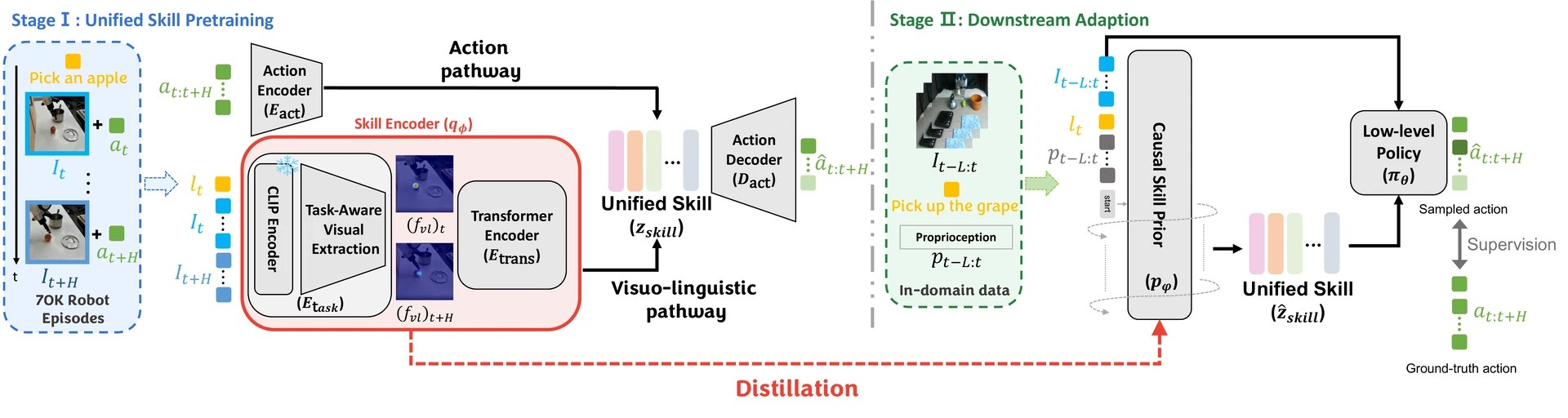
Stage I is a cross-modal VQ-VAE with a shared codebook:
- A visuo-linguistic path fuses CLIP ViT patch tokens with the language instruction
- An action path encodes the trajectory
- The two train alternately so neither owns the codes
- The only reconstruction target is actions, not pixels
That last choice is why the authors say moving distractors do not poison the codes.
Stage II freezes the encoder. A small causal skill prior learns its codes as pseudo-labels. A low-level policy is behavior-cloned on top. Both are small Transformers. The project page says the deployed stack runs about 60 Hz.
Few-shot, then a different arm
On LIBERO, mean success over five seeds, 50 rollouts per task. On LIBERO-90, BooST hits 0.91 / 0.82 / 0.70 at 50 / 20 / 10 demos. Relative gain over the second-best method is +41%, +59%, and +140% as data shrinks. Similar gaps show up on Goal, Object, and Spatial.
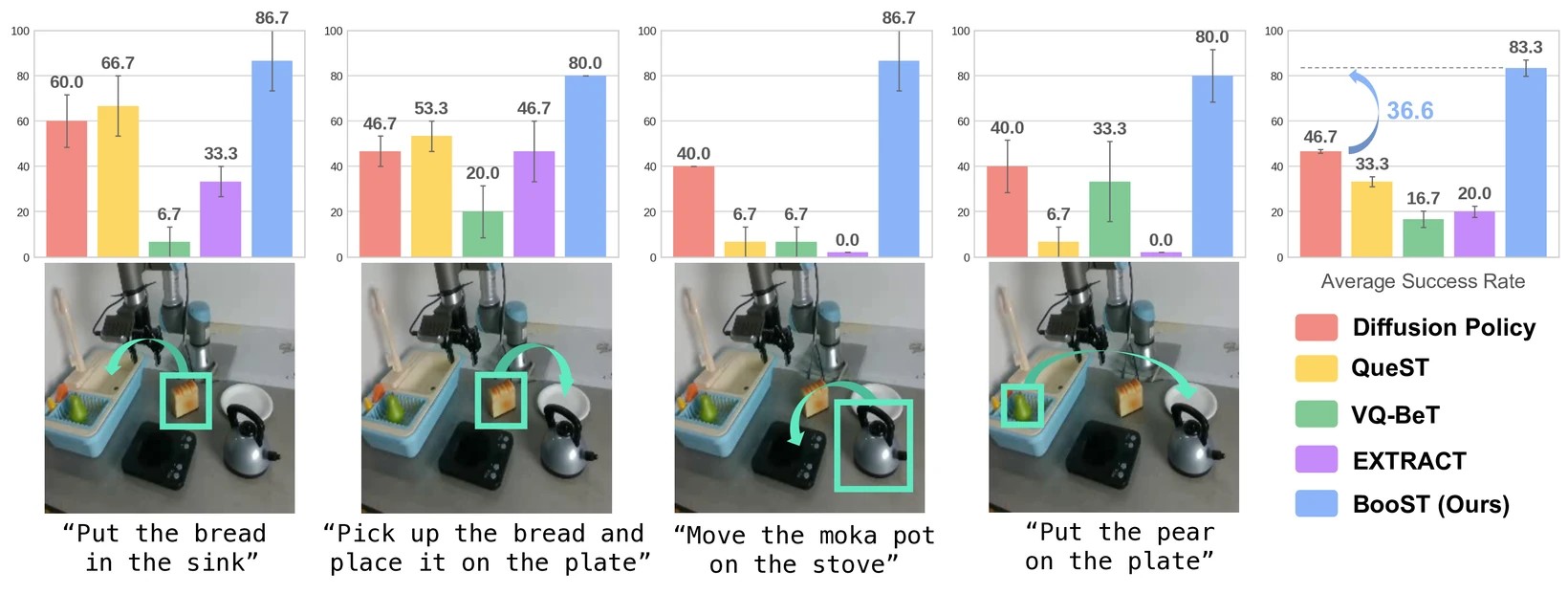
Low-level baselines that locked to Franka joint velocity (QueST, VQ-BeT) “fail outright” on the UR3, according to the project page, because the action space changed. BooST’s UR3 bars sit well above Diffusion Policy, EXTRACT, and those two.
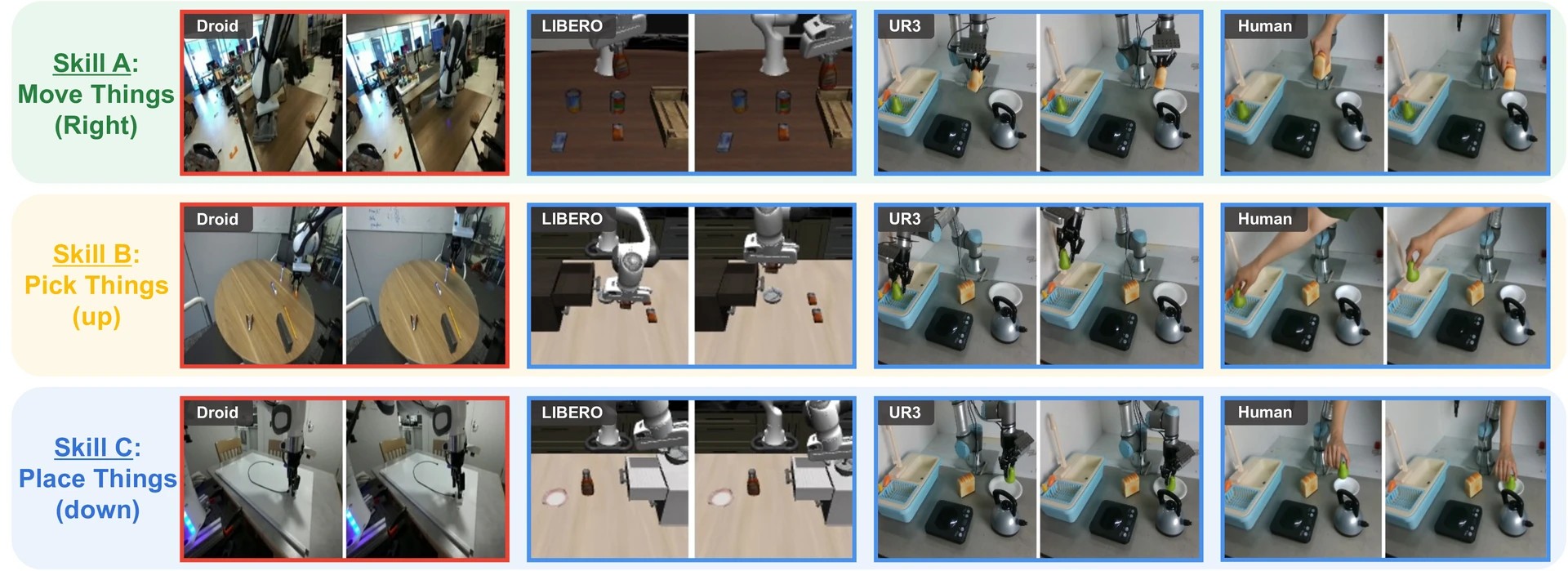
They also pretrained on a LIBERO-90 variant with animated human distractors in every episode. Evaluated on clean LIBERO, BooST averages 0.90 vs 0.79 for LAPA and 0.70 for UniVLA. The encoder keeps picking the same skill for a given sub-behavior when unseen distractors show up at test time.
A Human’s Take
Five demos on a different arm, after pretraining in a different action space, is the receipt I wanted. Reconstructing actions instead of pixels is a small, stubborn design choice that shows up in the distractor table. I still want someone else to train this codebook and hit a UR3 I have not seen in their figure. Until that replication, BooST is the cleanest “what plus how” skill paper in this week’s pile.