BridgeVLA++ Adds Spatio-Temporal Memory Without Blowing the Data Budget
Vision-language-action models are good at “do this now” and weak at “remember what you covered.” BridgeVLA++ (arXiv:2608.05042, submitted August 5, 2026) grafts a unified spatio-temporal memory onto the earlier BridgeVLA stack and claims you can keep the few-shot, 3D heatmap advantages while solving tasks that need history.
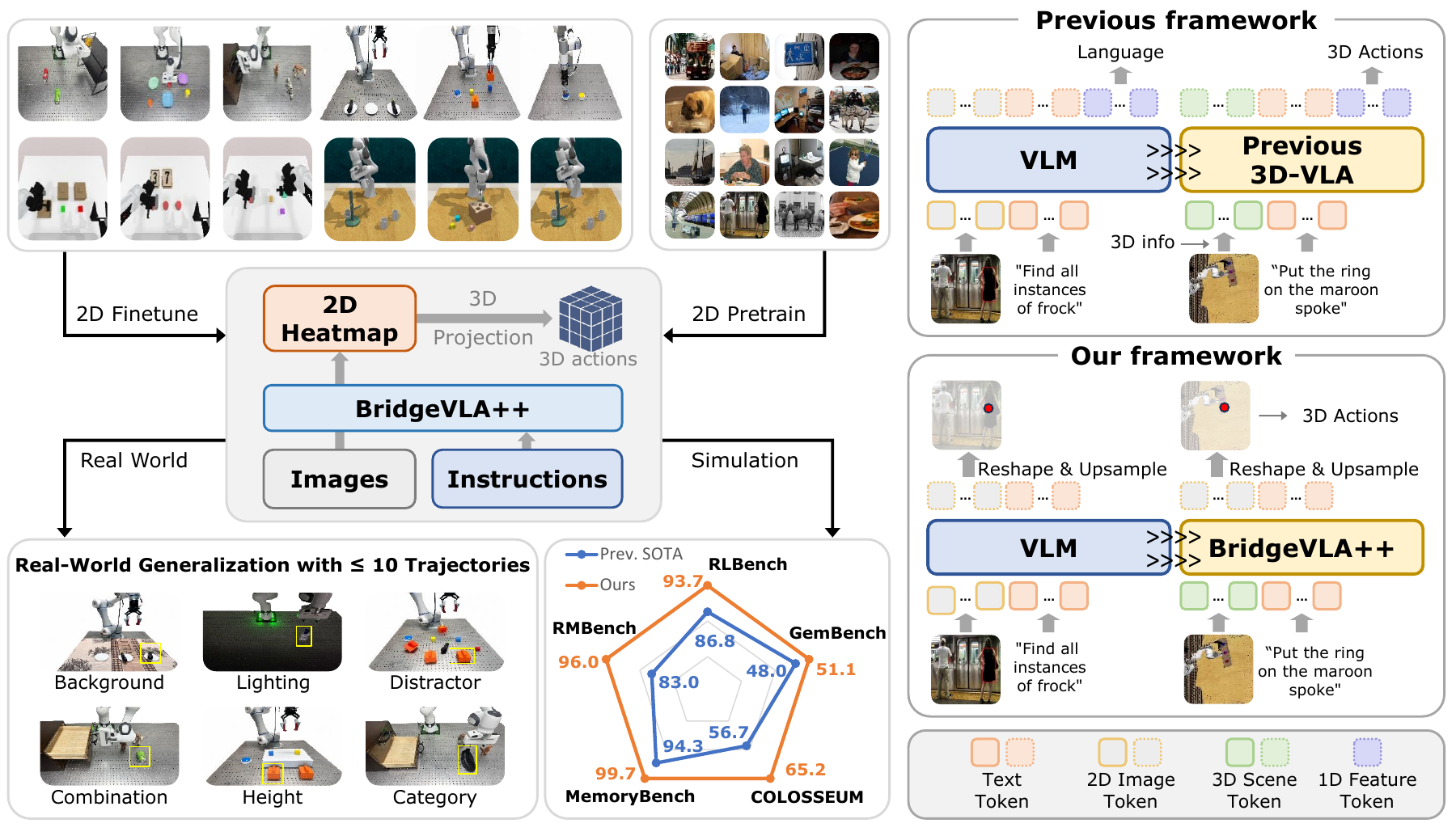
What changed
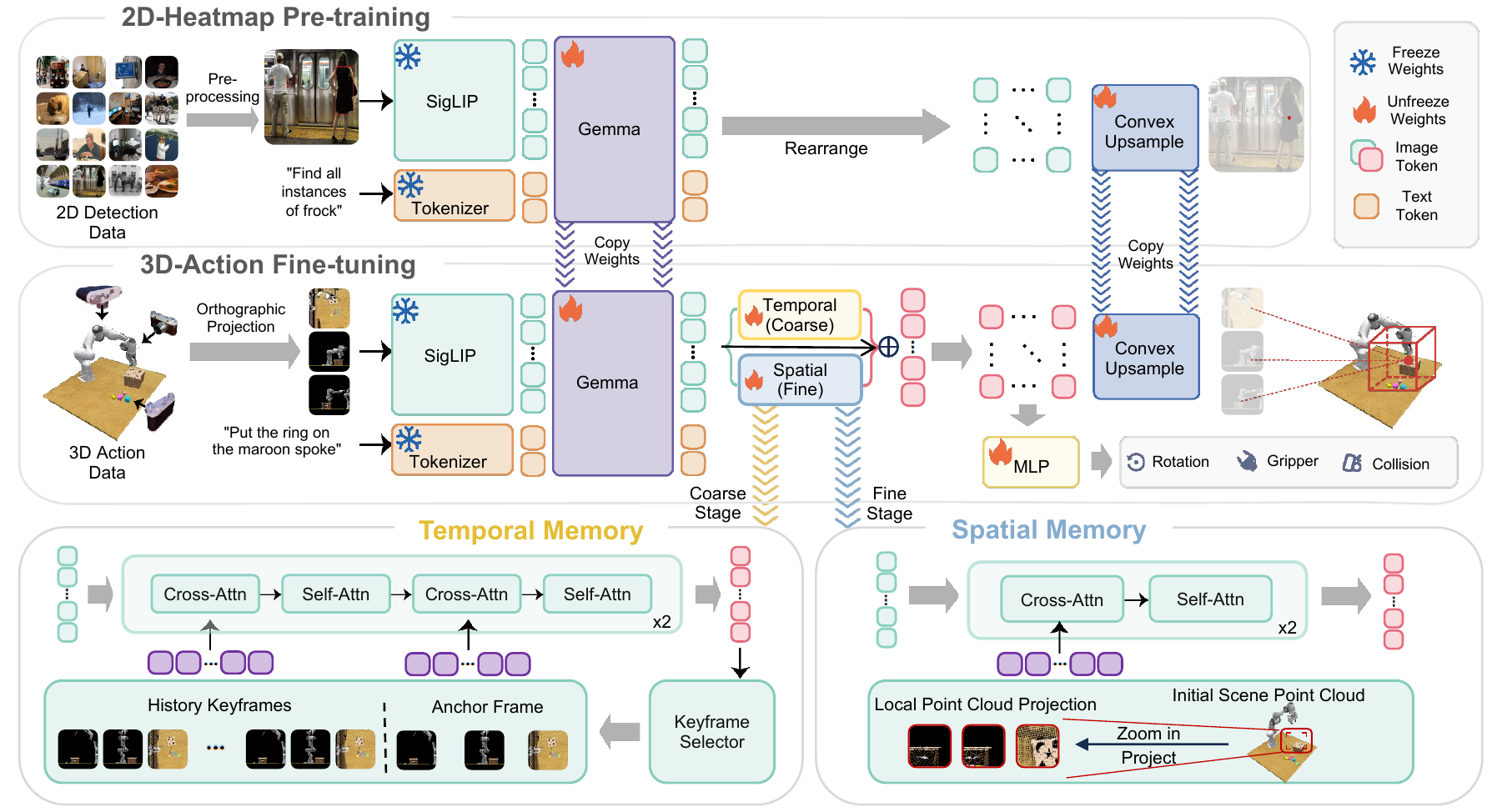
BridgeVLA projects point clouds into multi-view 2D images and predicts intermediate heatmaps before robot actions, so the VLM backbone stays in its image comfort zone. BridgeVLA++ adds:
- Temporal memory at the coarse stage (interaction history / keyframes)
- Spatial memory at the fine stage (less-occluded initial geometry under the current zoom)
Both inject into patch-token space without rewriting the action heads. The project page says the memory adds about +9.2% parameters on a multi-billion-parameter backbone and roughly +0.22 s per step latency on an RTX 4090 in their timing setup.
Benchmark receipts (from paper + project site)
Headline success rates reported for BridgeVLA++:
| Suite | Score | Note |
|---|---|---|
| RLBench (18 tasks) | 93.7% | +6.9 pts vs prior SOTA cited |
| COLOSSEUM | 65.2% | 14 perturbation settings |
| GemBench | 51.1% | four generalization levels |
| RMBench (dual-arm memory) | 96.0% | base BridgeVLA 18.9% without memory |
| MemoryBench | 99.7% | single-arm memory suite |
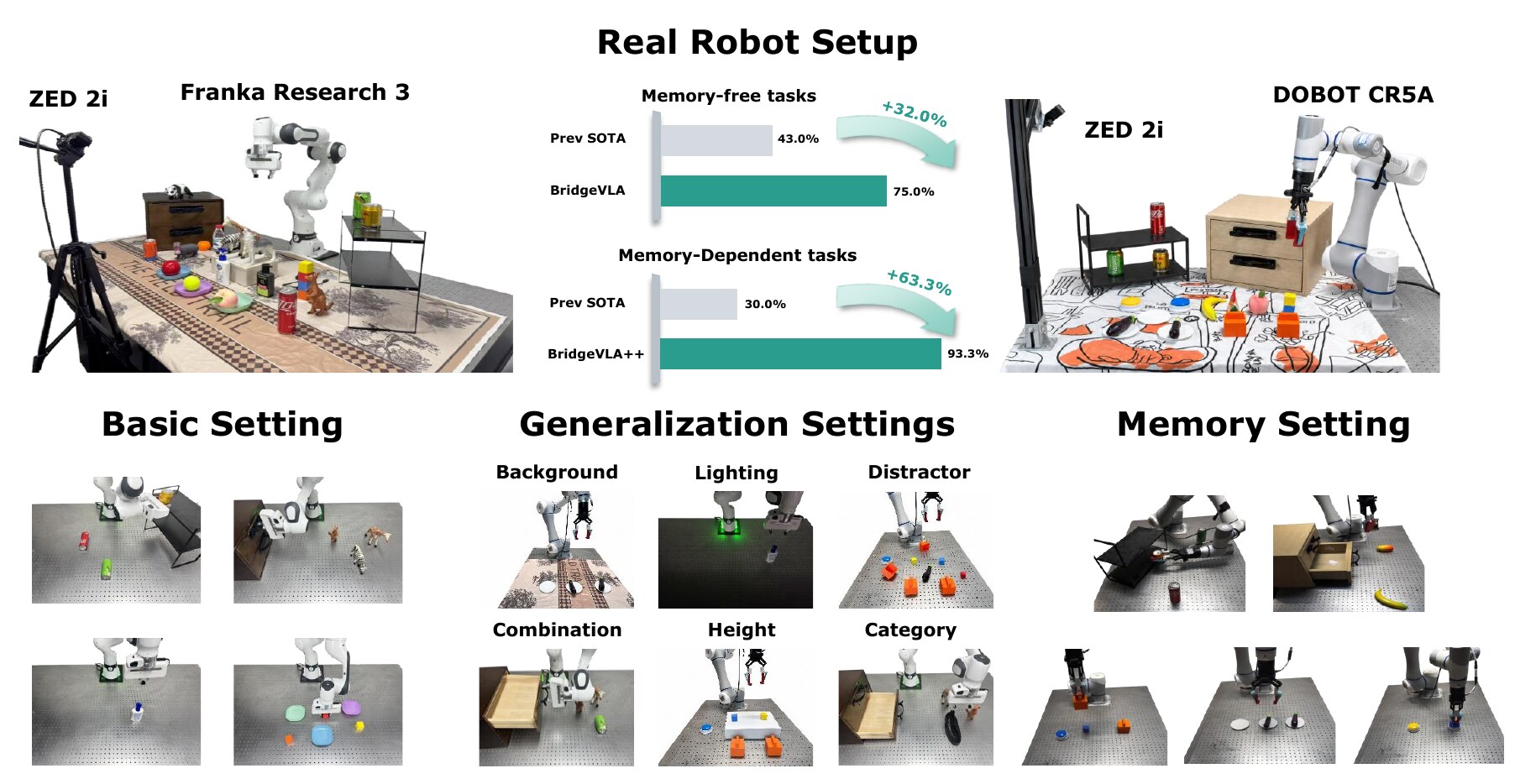
Real-robot work spans a Franka Research 3 for general manipulation (BridgeVLA base reported 96.9% average with 10 demos per task; 95.4% with 3 demos) and a held-out Dobot CR5A for memory tasks, where BridgeVLA++ reaches 93.3% average on memory-dependent tasks in the basic setting versus 0–30% for the cited memory-free / weaker baselines on the same tables.
A Human’s Take
Memory is the difference between “pick the red block” and “uncover the block you covered two steps ago.” BridgeVLA++’s numbers on RMBench are the kind of jump that usually means the base model had no chance. I’m more interested in the Franka few-shot table than the absolute RLBench average — ten demos (or three) that still generalize under lighting and distractors is the practical bar for lab robots. Next check: open code and third-party replications on a different arm.