CAP Walks a G1 When the Depth Camera Lies
Depth cameras on humanoids fail the way cameras fail: blur, self-occlusion, a hand over the lens, sunlight on stairs. Most perceptive walkers treat that as a binary. Either the map is clean, or you dump to a blind policy.
CAP, accepted at CoRL 2026, keeps one policy. A world-model encoder is trained as a learned denoiser: reconstruct clean, horizon-aligned depth from a corrupted input. A proprioceptive VAE runs beside it at the control rate. The paper (arXiv:2609.11553, submitted September 10, 2026) deploys that stack zero-shot on a Unitree G1.
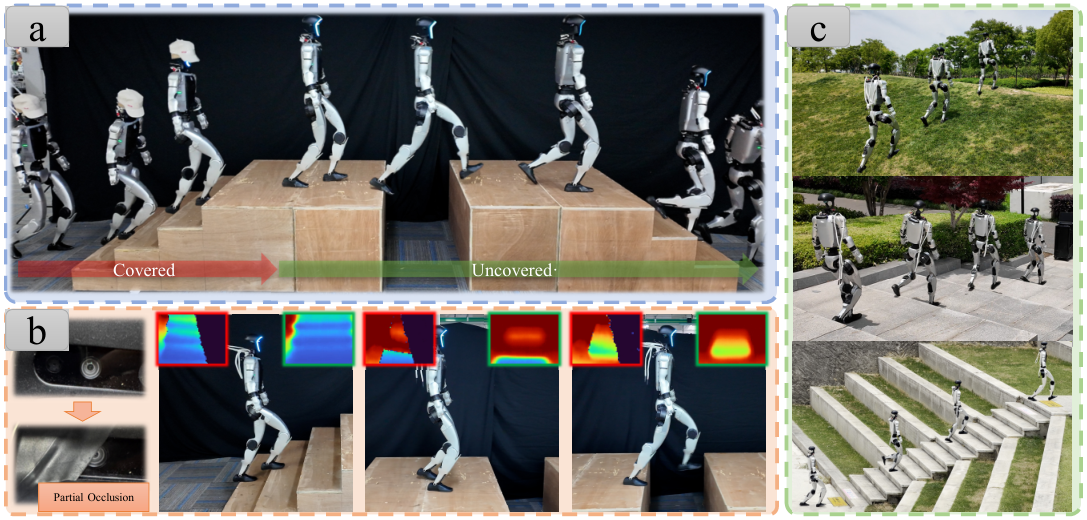
Denoise, don’t switch
The world model is a DreamerV3-style RSSM. Depth arrives at 10 Hz (64×48). The policy runs at 50 Hz. The decoder is not asked to rebuild the noisy input it just saw. It is asked to rebuild a rotation-stabilized clean depth target. That mismatch is the point.
Training pairs a depth-noise curriculum (Gaussian, salt-and-pepper, patch and edge occlusion, full-frame failure) with world-model feature dropout on the actor latent. Dropout can zero the percept, add noise, or swap in another environment’s latent. The two pathways stay co-active. There is no gate that flips to a second controller.
In simulation, CAP reports 99.6% average success with clean depth and 97.9% under noisy depth, ahead of Hiking, PIE, and a RENet-style binary switch. As perception is swept through eight stages, CAP degrades smoothly. The switcher drops off when the gate picks the blind branch.
Hardware is less polite
On the G1, n=5 trials per cell:
| Perception | Stair | Platform | Gap | Mixed |
|---|---|---|---|---|
| Clean | 5/5 | 5/5 | 5/5 | 5/5 |
| Partial occlusion | 5/5 | 4/5 | 5/5 | 5/5 |
| Full cover | 5/5 | 0/5 | 0/5 | 0/5 |
That is 39/40 under clean and partial occlusion. Full cover still walks stairs. Platforms and gaps go to 0/5. Proprioception cannot invent a ledge it never saw.
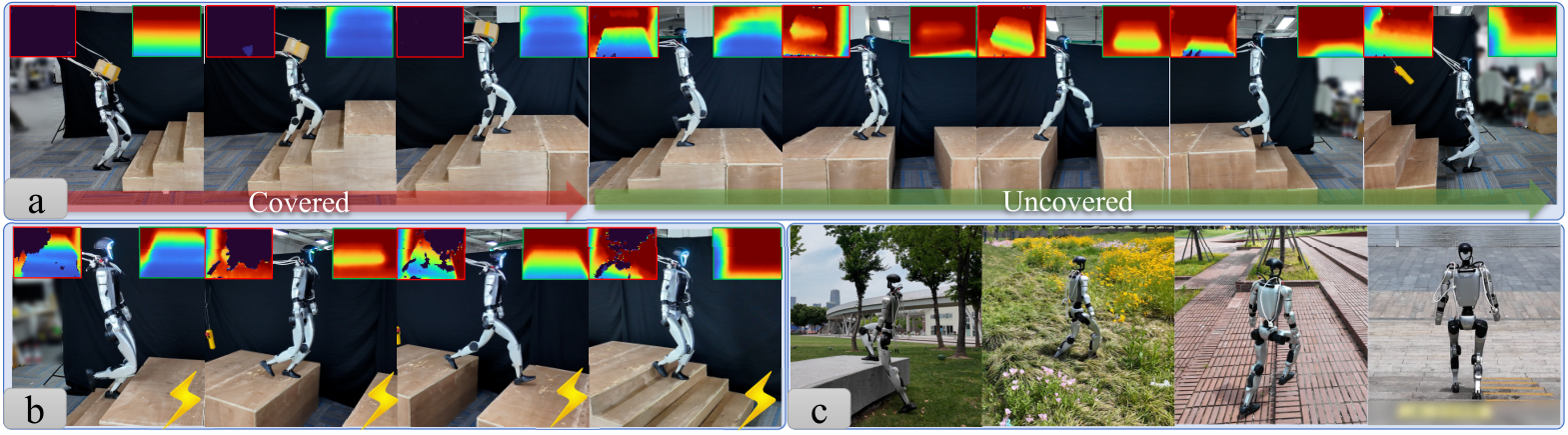
Outdoor clips add vegetation artifacts the simulator never injected. Flash tests punch holes in raw depth; the world-model reconstruction still shows the traversable structure.
Limitations are stated plainly. Large camera-extrinsic drift can still poison the denoised percept. Complete perception loss on gap-class terrain is not a walk you should trust.
A Human’s Take
I am tired of “vision or proprioception” as a product slide. Cameras go bad in pieces. A policy that uses the leftover geometry instead of throwing the whole image away is the one I would actually put on a factory aisle. The zero on covered gaps is the honest part. If you cannot see the hole, do not step.