A Capstan Surgical Snake That Feels Cable Tension From the Motor Mount
A team at the Chinese University of Hong Kong posted a paper on August 13 that solves a small, mean problem: how to measure tendon tension on a capstan-driven continuum surgical robot when there is no room for a load cell in the drum.
Lead authors include Gang Zhang, Yufu Qiu, and Junyan Yan, with corresponding author Shing Shin Cheng. The work is also supported by Curve Robotics Limited. The HTML version of the paper is the primary source.
Why the mount, not the cable
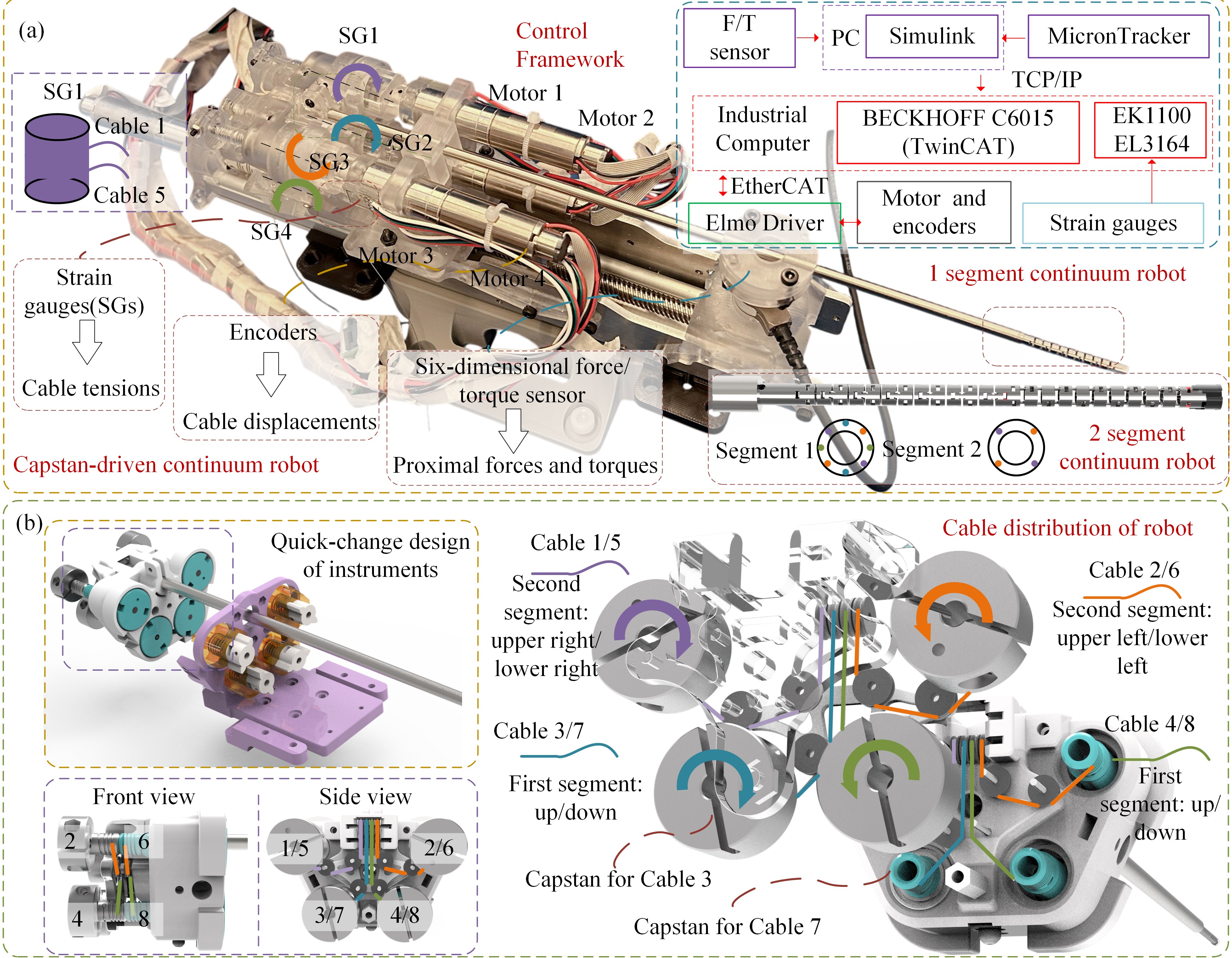
Lead-screw drives make it easy to bolt a tension sensor on each tendon. They are also bulky. Commercial surgical platforms prefer capstans because they are compact, swap instruments fast, and survive sterilization. The tradeoff is that the winding drum is too tight for those sensors.
The authors machine thin-walled beams into each Maxon DCX14 motor bracket. Cable reaction force bends the beam a little; a BF1K-3EB strain gauge reads it. They map strain to tension with a neural net. Over 0–9.5 N, they report 0.12 N mean error and 0.4 N max. Sampling goes up to 1000 Hz.
The instrument itself is a 3.5 mm notched Nitinol tube. Eight 0.27 mm cables are staggered so each rigid ring only needs four channels, not eight, inside a wall thinner than 0.4 mm.
A short-thick-beam model that actually runs
Because the notches are short and fat, Euler–Bernoulli and Cosserat rod models underestimate shear. The paper uses a short-thick-beam static model and batches all beam elements as a matrix so the update can run in parallel.
They report >200 Hz model updates, more than ten times a non-parallel version. Combined with a proximal ATI Nano 17 force/torque sensor, the system estimates tip pose plus contact force and location.
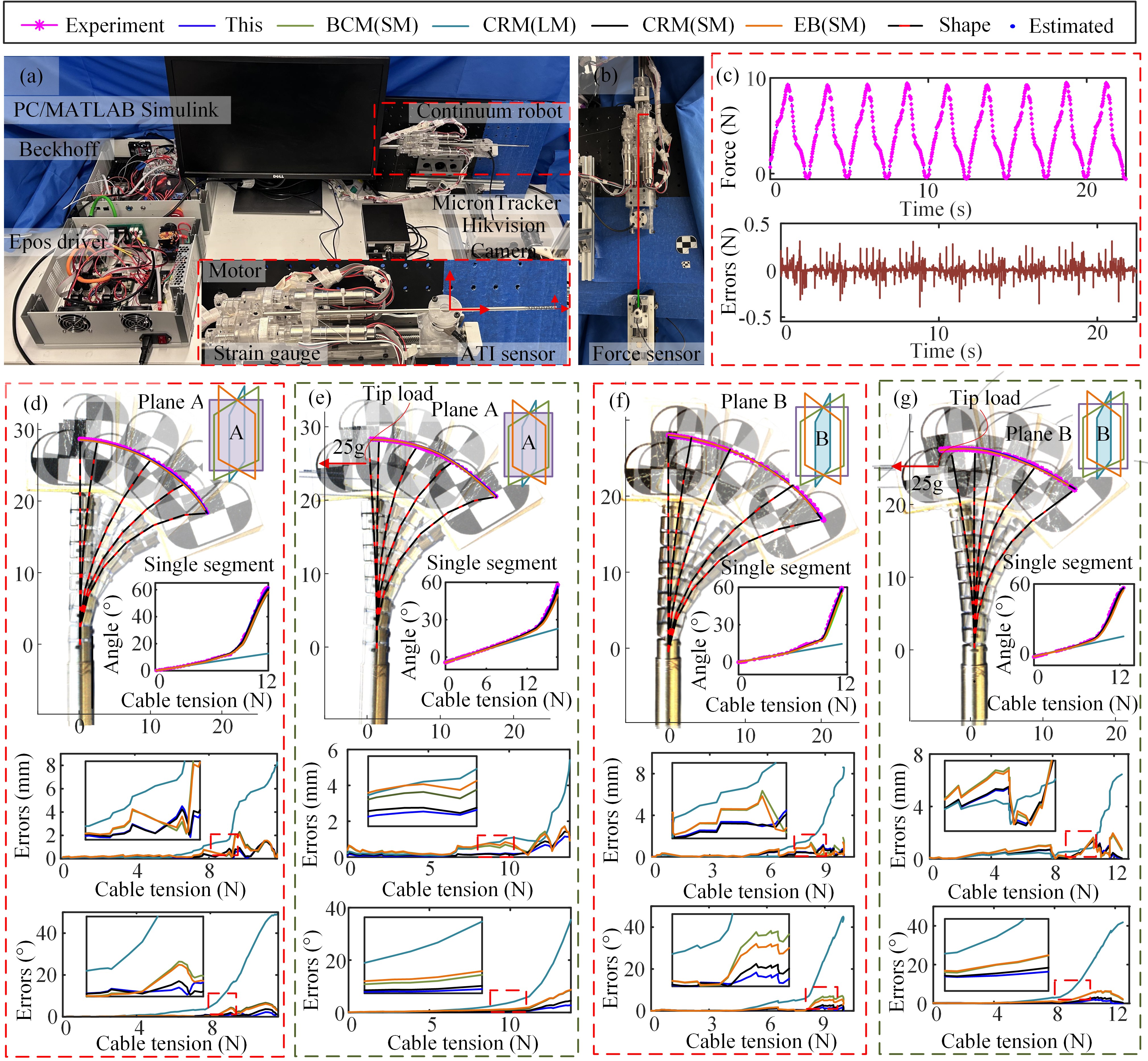
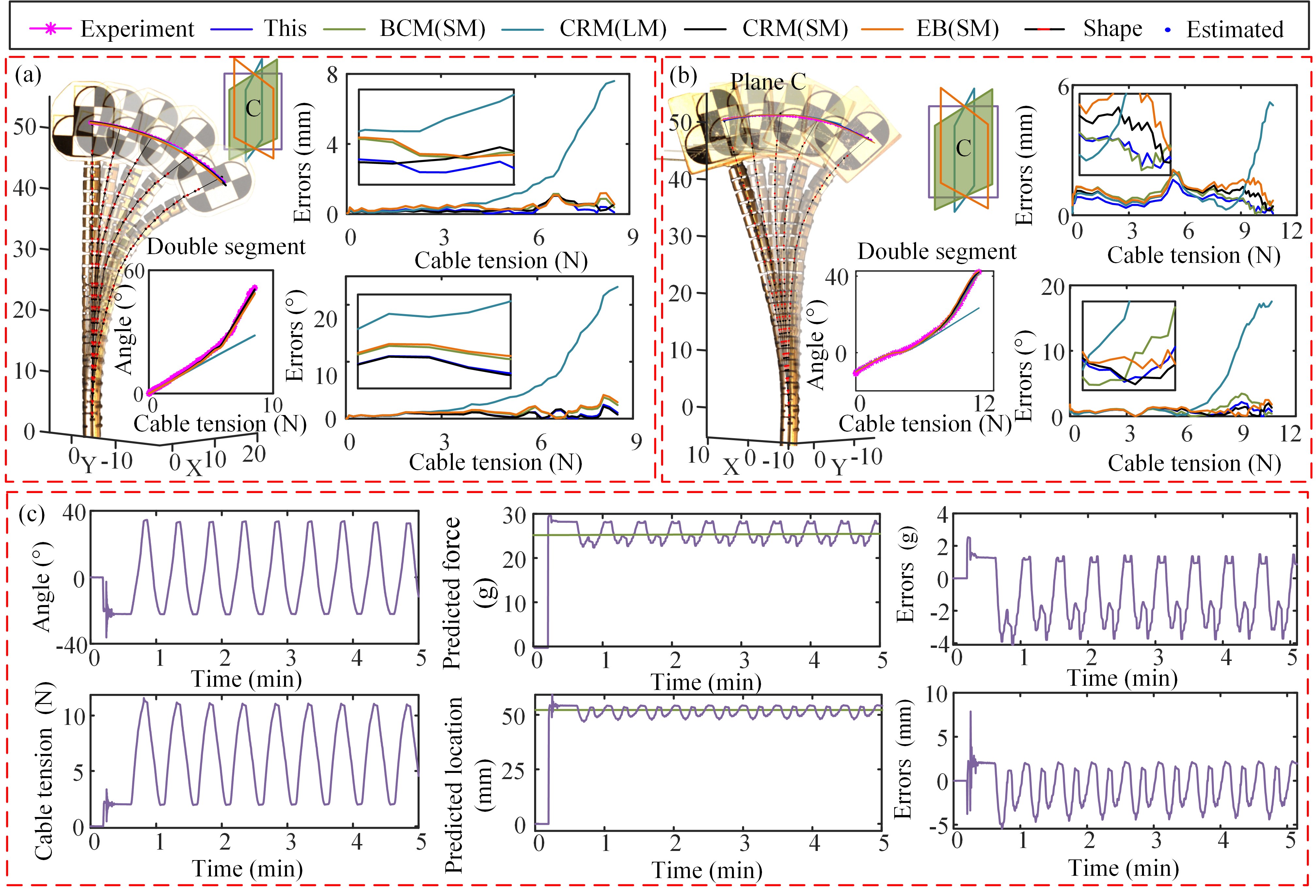
On a single segment, mean tip position error is 0.34 mm at 326 Hz with no load, 0.36 mm at 218 Hz with 25 g. Two segments: 0.48 mm / 296 Hz unloaded, 0.62 mm / 207 Hz loaded. Contact-force error on the two-segment unit averaged 1.89 g (max 4.09 g); location error averaged 1.93 mm (max 7.87 mm).
The authors are honest about the hardware: 3D-printed brackets, cyanoacrylate-glued gauges, zero drift between trials. They call it a lab proof, not a sterile product.
A Human’s Take
This is the kind of paper I want more of: a real packaging constraint, a mechanical trick, and numbers on a bench. Sensing tension from the motor mount is a clever way to keep the capstan small. I will not call it OR-ready until they stop recaling after every run. Show me a machined bracket that holds zero for a week, then we can talk about ESD.