CLAP Trains Video World Models Across Robot Bodies, Including G1
CLAP, posted to arXiv on 27 August 2026, is a cross-embodiment action-conditioned video world model. Most video-for-robots systems train on one arm. CLAP’s bet is that bottles tip and drawers slide under the same physics whether a Franka, a WidowX, a human hand, or a Unitree G1 is doing the work.
Authors Kechen Liu and Ola Shorinwa train on mixed Open X-Embodiment datasets plus EgoDex for 100K steps. Code and checkpoints are on GitHub and Hugging Face (omni-CLAP/CLAP). The project page says inference fits under 12 GB of VRAM on an RTX 3060, using a Stable Video Diffusion backbone.
Three action languages, one curriculum
Robot action spaces do not match. Human videos usually have no action labels at all. CLAP talks three dialects:
- End-effector (
ee): 7-D Cartesian pose plus gripper, or joint angles on joint-space robots - Latent action (
lam): a 32-D embedding learned from video, including unlabeled human footage - Language: per-frame CLIP captions of the action
Stage 1 learns physical priors from unlabeled video with latent actions. Stage 2 grounds those priors in end-effector space so the model can run on a real robot without a latent decoder at deployment.
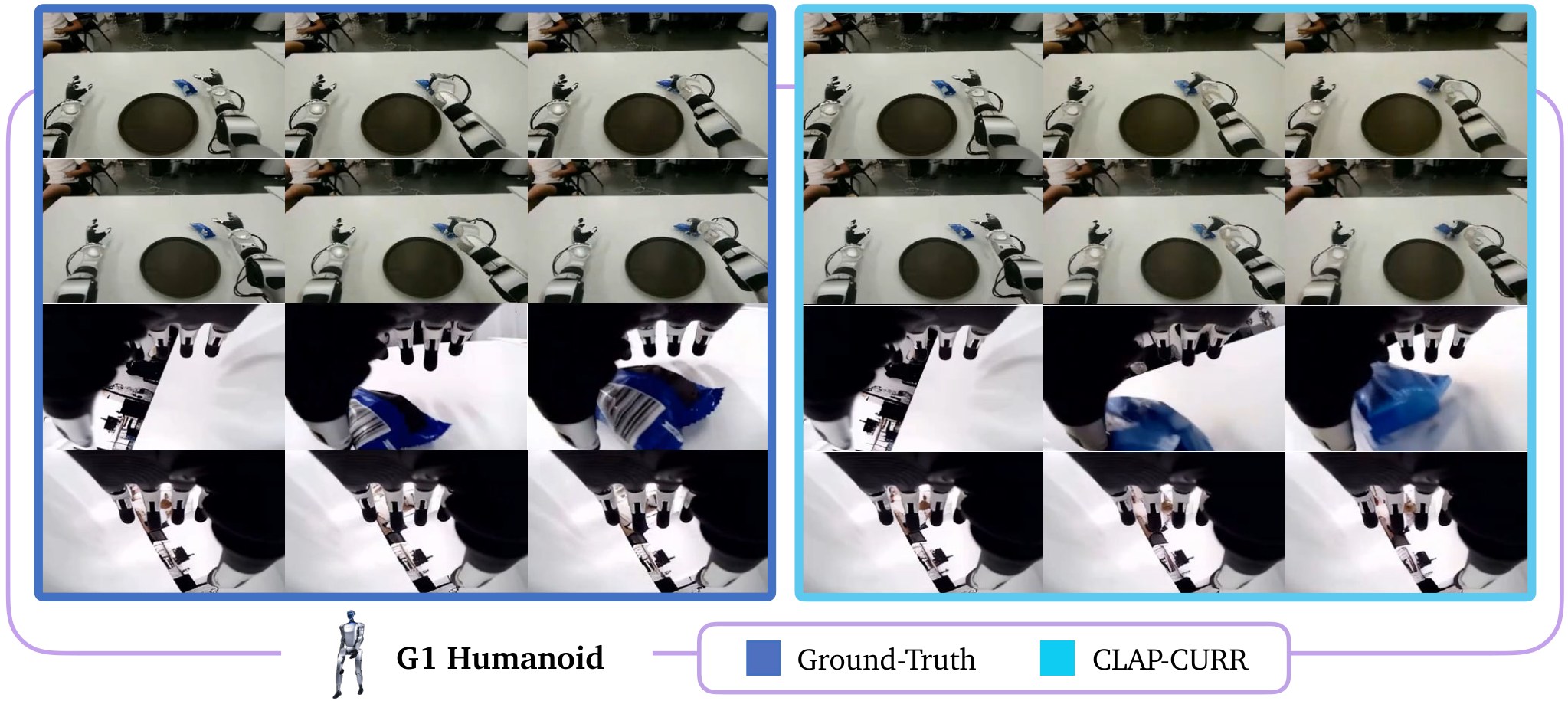
The public suite covers DROID, Bridge, a 14-DoF bimanual YAM, and a 26-DoF G1. Default checkpoint is clap-curr. The authors say a single gradient step of adaptation already produces meaningful video on YAM and G1, unlike training a raw SVD backbone from scratch.
What they claim against single-body models
On DROID, CLAP matches a Ctrl-World single-embodiment baseline at the same architecture and step count, with fewer domain-specific samples. On Bridge, they say the gap to a strong single-body baseline is mostly qualitative. Zero-shot, the cross-embodiment model is used for inference-time planning and RL fine-tuning of policies such as π0.5 and MolmoAct-2 on DROID and YAM. The page is explicit that the planner still hallucinates.
That last clause is the useful one. A video world model that plans is only as good as its refusal to invent a drawer that is not there.
A Human’s Take
Training one video model on mixed bodies is the scaling story robot-video people have been circling. The G1 grid is the part I can actually look at: same table, same plate, predicted frames that are in the neighborhood of the real hand. Matching Ctrl-World without a DROID-only silo is the quantitative claim. Hallucination is still the deployment tax. I want the Hugging Face checkpoints to run on a 3060 the way the page says, not only on the authors’ cluster.