CLASP Rolls Ripe Blueberries Off the Cluster, Leaves Green Ones
Fresh-market blueberries ripen on the same stem at different times. Shake-and-catch machines bruise 16–26% of fruit versus 1–4% for hand picking, which is why those machines stay on the processing side. Per-fruit robot pickers also fight cluster geometry: berries are small, packed, and occlude each other.
CLASP (Cluster-Level Autonomous Selective Picking) is Georgia Tech’s answer, with University of Georgia and University of Florida co-authors. A paper dated 16 September describes a Soft Active Rolling-Band Gripper that wraps a cluster and rolls ripe berries off while a current loop keeps pull below the green-berry detachment force. End-to-end field trials grasped 23 of 25 presented clusters (92%). Parts cost about $3,326.
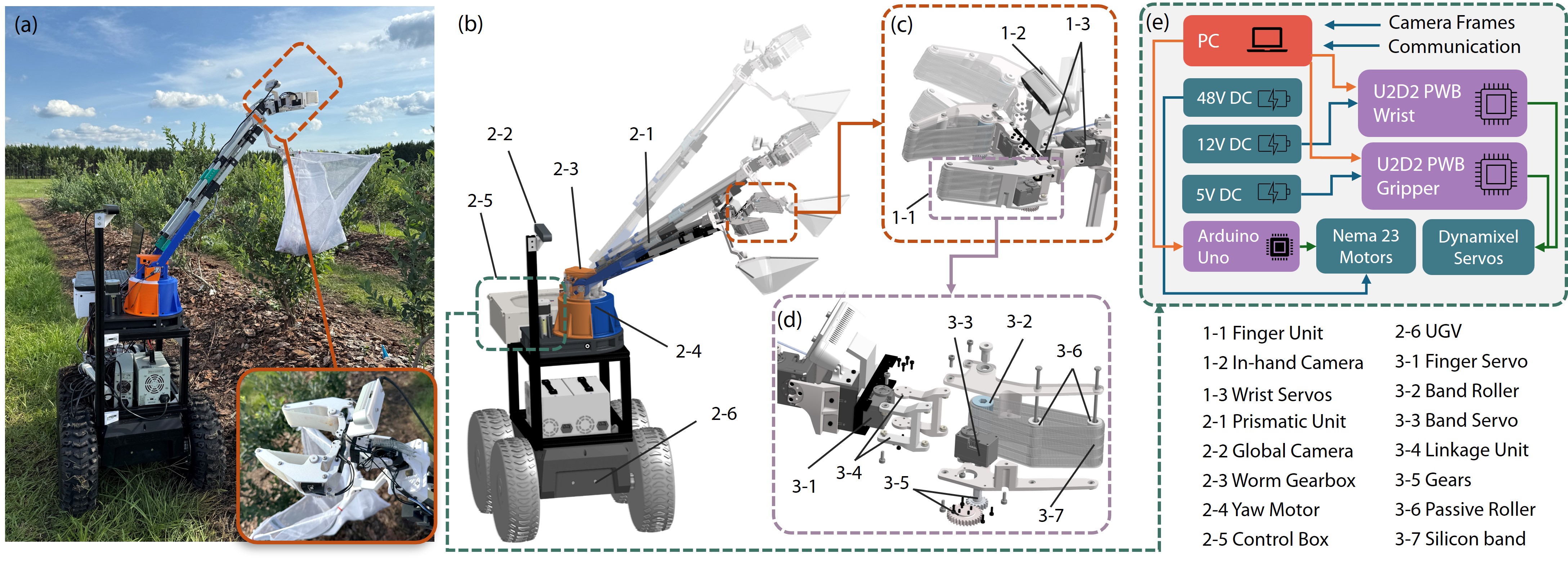
Bands, not fingers on one berry
The gripper copies a picker who uses a thumb to roll berries against the stem while the other hand catches. Two Dragon Skin 20 silicone bands, each driven by a Dynamixel XC330 through a 0.6:1 gear, close around the cluster. Finger opening is 100 mm; band contact length is 100 mm. A net between two aluminum rods catches what comes off. An Intel RealSense D435 sits above the gripper.
There is no force/torque sensor. Finger motors run current-based position control. Unloaded current is calibrated, then a threshold plus a sliding average detect contact. During harvest an adaptive baseline tracks the load so the fingers nibble open and closed around the threshold at 50 Hz while the bands roll. Commanded pulling force matched a Nano17 sensor to within 3.7%. Field clipper tests confirmed a detachment-force gap between mature and immature fruit.
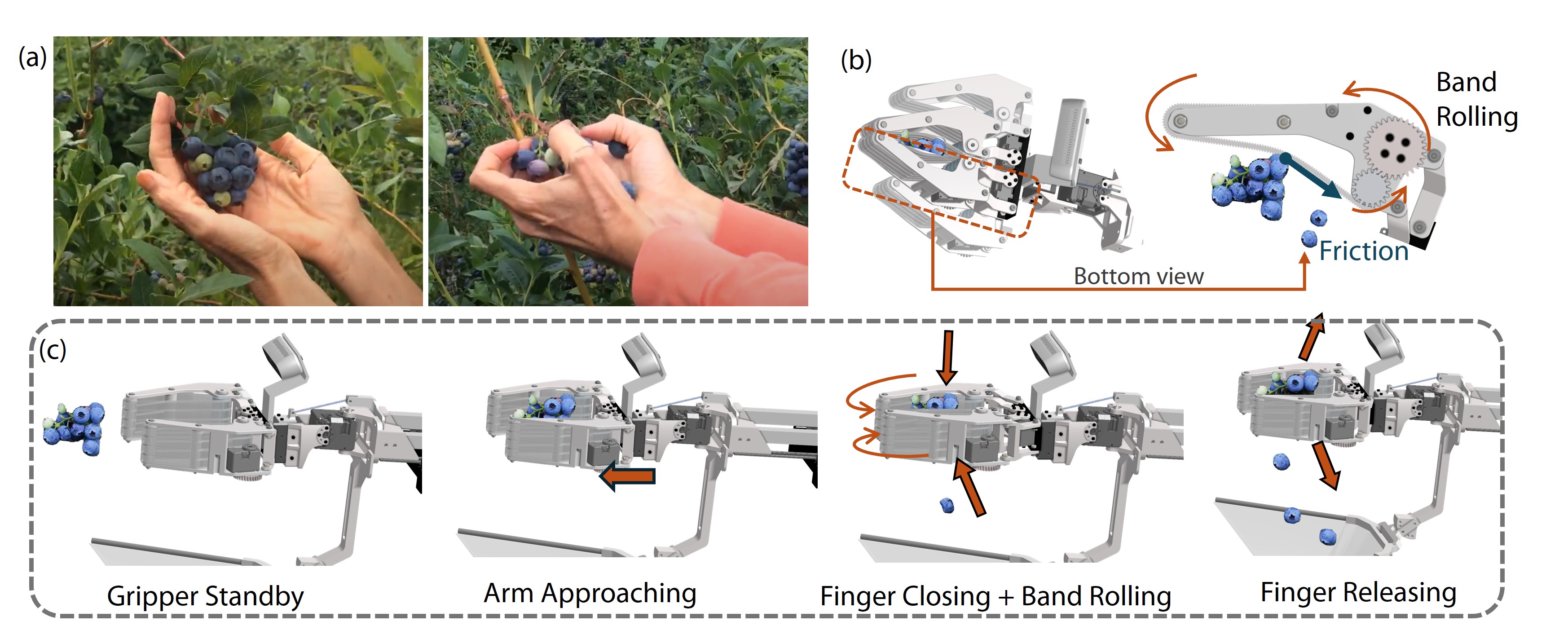
Arm and eyes
The manipulator is a 6-DoF RRPRRR chain: stepper azimuth and elevation (self-locking worm on elevation), a prismatic reach from 937 mm to 1333 mm, then a three-axis Dynamixel wrist. A ZED 2 does global cluster search. The D435 does close-range pose. YOLO26n, trained on a 672-image multi-season set from Mississippi and Georgia farms, detects mature vs immature berries. On the held-out test split, mAP50 is 0.767. Harvest stop uses either motor current falling back toward unloaded, or a vision count of remaining ripe berries.
The paper is honest about missed detections: 20% of mature berries and 25% of immature ones go to background on a single frame, so the controller takes the max count over several frames before it quits a cluster.
A Human’s Take
Selectivity in the contact, not in a bounding box, is the right fight for this crop. 92% of 25 clusters is a small field card, but the 3.7% force tracking and the $3,326 BOM are the kind of numbers a farm can argue with. Next I want bruise rates on the berries that actually went in the net, next to a hand-picked tray.