CLIFT Fine-Tunes Closed Gemini Robotics On-Device into Near-Perfect Humanoid Skills
The strongest robot foundation models are often closed-weight. You get a managed supervised fine-tuning (SFT) API: ship data, get a tuned policy, no gradients, no weights, no RL knobs. That setup is great for imitation—and a brick wall for classical on-robot reinforcement learning.
A team spanning UC Berkeley, Google DeepMind, and NVIDIA Research just posted CLIFT (Closed-Loop Iterative Fine-Tuning) on arXiv (2607.29172, 31 Jul 2026): a way to push closed Gemini Robotics On-Device (GROD) toward task mastery on a real Unitree G1 without opening the model box.
The problem in one sentence
Demonstration-only SFT trains on human teleop; deployment runs under the policy’s own closed-loop distribution—especially ugly on humanoids where VLA actions couple tightly to a whole-body controller, latency, and contact.
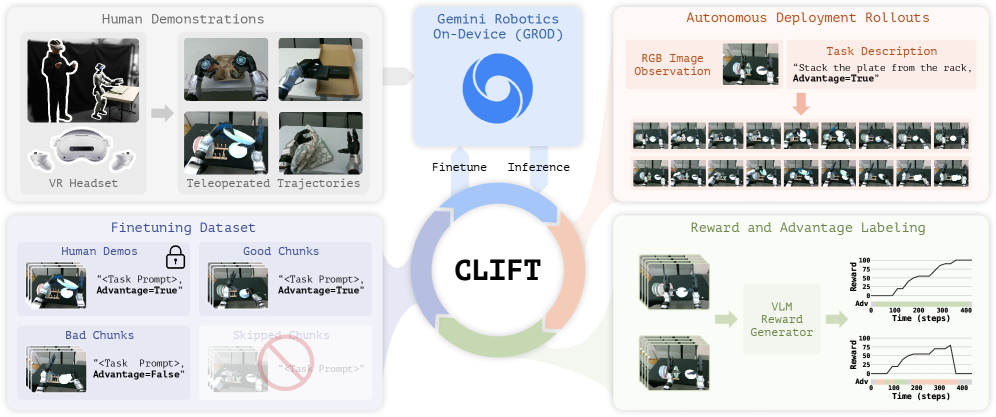
What CLIFT does
- Bootstrap π₀ by SFT on teleoperated demos through the managed API.
- Deploy the policy; score rollouts with a preference-calibrated dense reward (human pairwise prefs select VLM reward candidates, then distill into a reusable reward model).
- Label action chunks with retrieval-based positive/negative advantage tokens (compare returns against chunks from visually similar states).
- Submit the relabeled data back through the same SFT API; repeat for flywheel cycles.
No access to weights, losses, or action likelihoods. The reward signal lives entirely in the data you send.
Hardware and tasks
- Robot: Unitree G1, dual arms, dexterous hands, head RGB cameras.
- Control: Hierarchical whole-body scheme (upper-body joint targets + lower-body planar velocity/yaw) tracked by an RL whole-body controller.
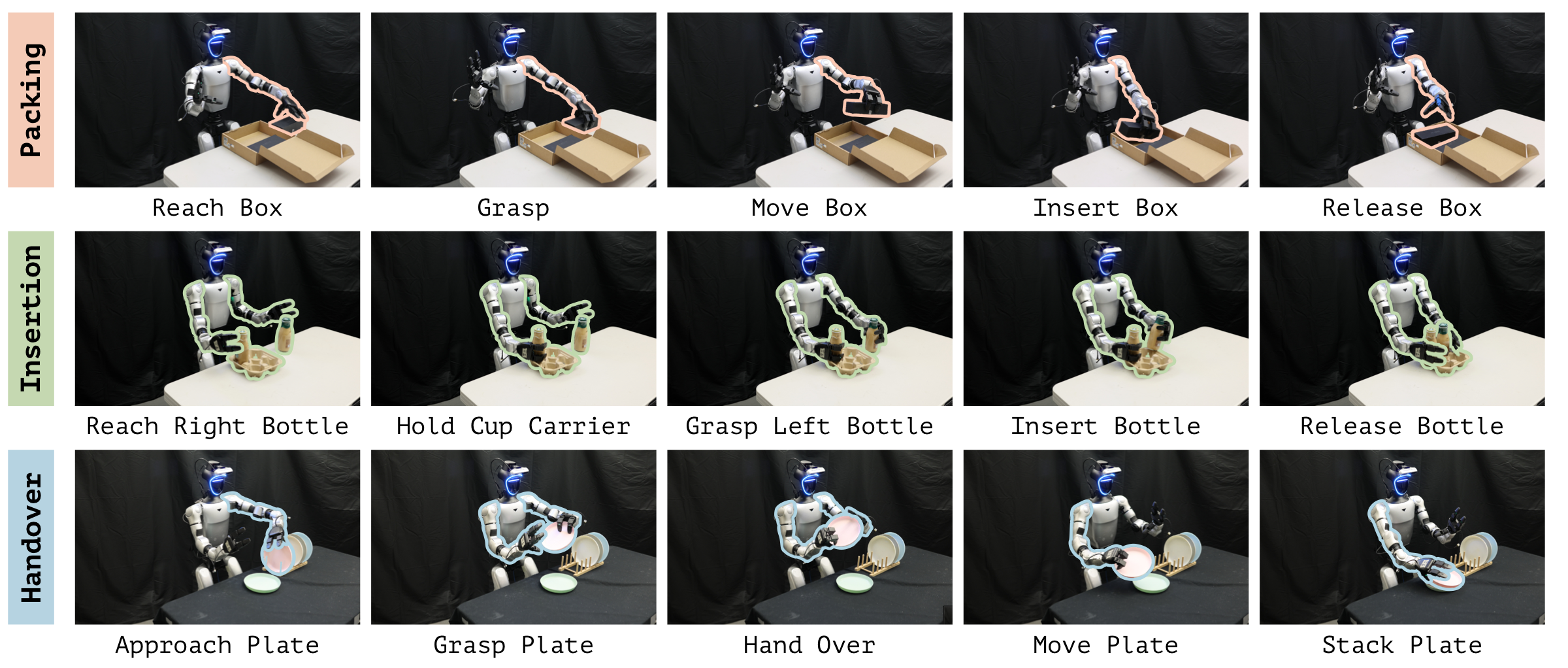
- Tasks: Box packing, cup insertion, bimanual plate handover—all contact-rich, with balance shifting the camera and contact geometry continuously.
- Demos: ~2 hours of whole-body VR teleop per task.
Results (authors’ reported success rates over 100 trials)
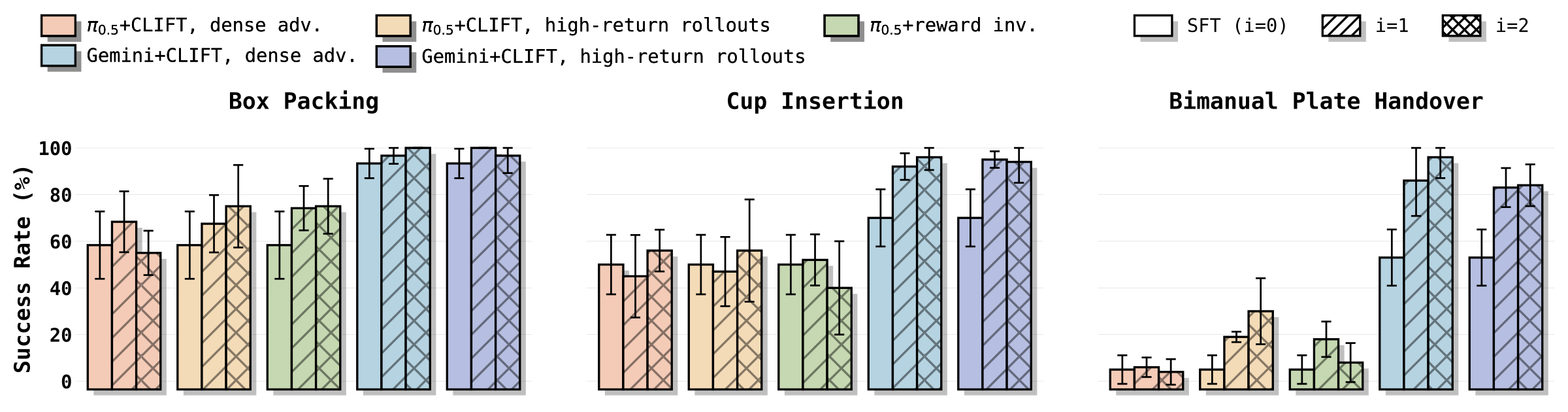
Dense advantage-conditioned CLIFT on GROD after two flywheel cycles:
| Task | Demo SFT → after CLIFT |
|---|---|
| Box packing | 93% → 100% |
| Cup insertion | 70% → 98% |
| Bimanual plate handover | 53% → 96% |
Same pipeline on open-weight π₀.₅ also improves (e.g. plate handover 5% → 30%), but absolute ceilings stay far below GROD. An invasive FiLM-style adaptation of π₀.₅ still trails API-only GROD on the hard tasks—evidence the authors use for “base model strength matters even under a narrow interface.”
The paper also reports emergent behaviors absent from demos: reorienting a box before grasp; retrying a failed cup insertion.
A Human’s Take
Here’s what I care about: closed models are not a dead end if the API accepts the right training tuples. CLIFT is less “magic RL” than a careful cookbook for turning on-device rollouts into preference-shaped SFT. The G1 numbers are lab tasks with fixed eval layouts—not a shift on a factory line—but near-perfect success after two cycles, with retries that weren’t in the demos, is a real signal. Watch whether managed robot APIs start supporting this flywheel as a first-class workflow, and whether third parties can reproduce the GROD numbers on their own fleets.