Context-Aware Motion Priors Teach Humanoids Which Reference Clips Matter
Motion priors make physics-based humanoids look less like crash-test dummies — until the prior starts “helping” with the wrong clip. Context-Aware Motion Priors (CMP) (arXiv:2608.03234, submitted Aug 4, 2026) adapts a general prior to the current task context without manual skill labels, dataset partitioning, or a separate skill-discovery stage.
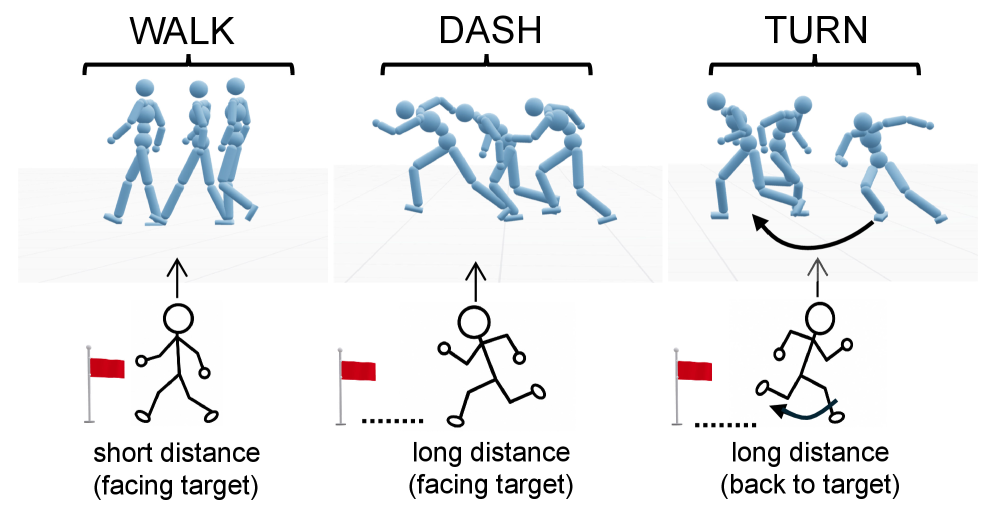
The problem they name
Existing methods typically train one task-agnostic prior on the whole reference set and apply it uniformly during policy learning. That prior cannot tell whether a walking clip, a sprint, or a sharp turn is relevant right now — so it can inject irrelevant or conflicting guidance.
CMP’s answer, per the abstract:
- Learn context–motion compatibility from high-advantage policy rollouts.
- Keep a demonstration-based objective so relevance stays grounded in the reference distribution.
- Use relevance scores to reweight reference supervision for a lightweight context-conditioned adapter.
The authors instantiate CMP with both Adversarial Motion Priors and Score-Matching Motion Priors. Across five humanoid control tasks, they report better task performance and sample efficiency, meaningful context–motion alignment, and robustness to imbalanced reference distributions. Code is stated as forthcoming publicly.
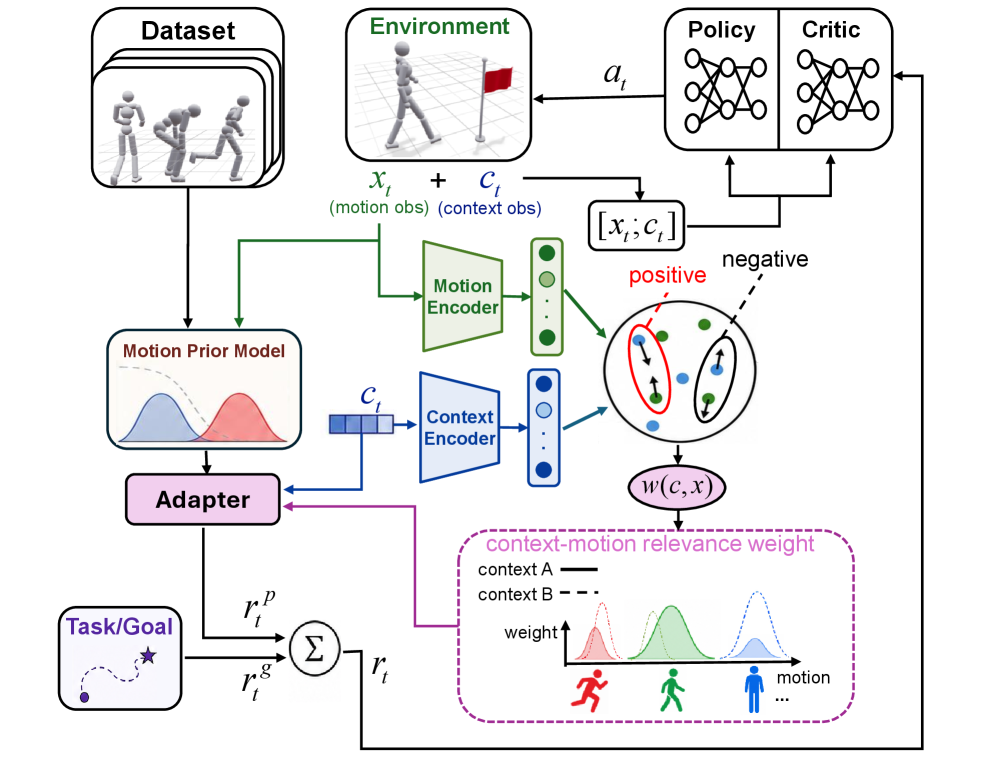
Why this is more than a training trick
Humanoid datasets are messy mixes: locomotion, sports, dance, failures. A frozen global prior is a blunt instrument. Context-conditioned reweighting is closer to how you’d coach a robot in the moment — “right now you need a dash, not a stroll.” The paper’s claim is that you can get that behavior without hand-labeling every clip.
A Human’s Take
I’m curious whether CMP still holds when the reference library is internet-scale and dirty, not a curated five-task suite. The “no skill labels” pitch is the part worth stealing for open stacks. If the public code lands with adapters that drop onto AMP and score-matching priors people already run, this becomes a practical upgrade rather than a paper-only idea.