ConsJump Sends a 22 kg Aliengo Through a Body-Sized Gate
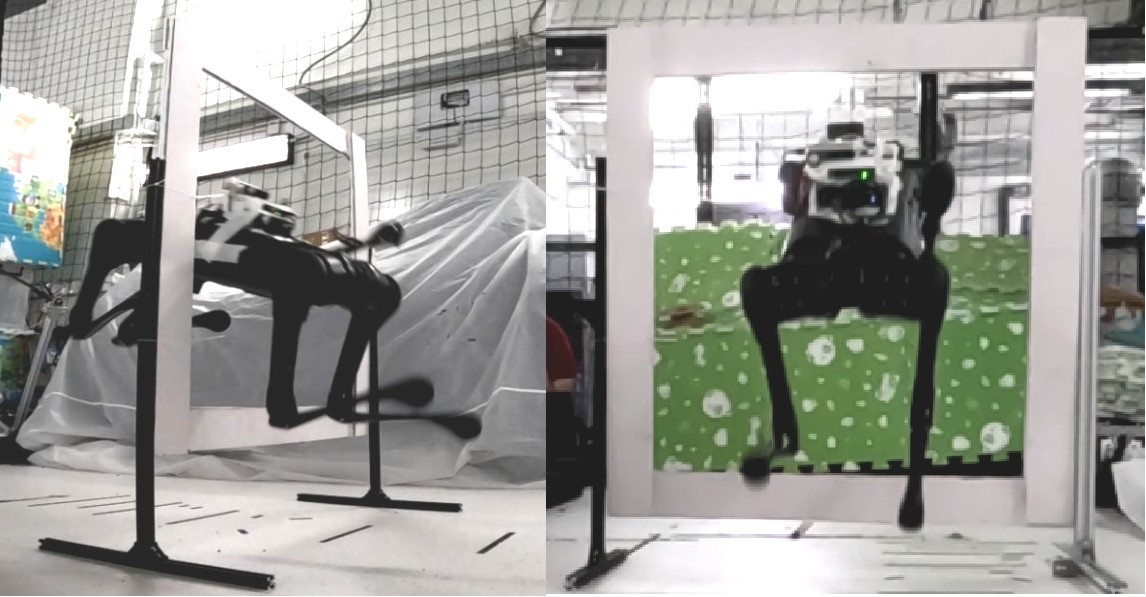
A 22-kilogram Unitree Aliengo sprints at a rectangular frame, tucks, and flies through a gap about as wide as its own body. The controller is ConsJump, a hierarchical reinforcement-learning stack from the University of Hong Kong’s Adaptive Robotic Controls Lab and the Oxford Robotics Institute. The paper went on arXiv on 20 August 2026 and is listed in Advanced Robotics Research. Interesting Engineering covered the hardware result on 1 September.
There is no scripted jump. A high-level policy watches the gate and picks a velocity command. A frozen low-level policy turns that command into animal-like gaits, including the aerial phase.
Two loops, one jump
The low-level policy imitates retargeted animal clips: pace, canter, jump, and steer. Jump frames are sampled 6× more often than slow gaits so the network actually learns the hard part. Training ran 5,480 agents in parallel in Isaac Gym for 25,000 episodes. Forward command range is 0.0–2.4 m/s; yaw is ±1.57 rad/s.
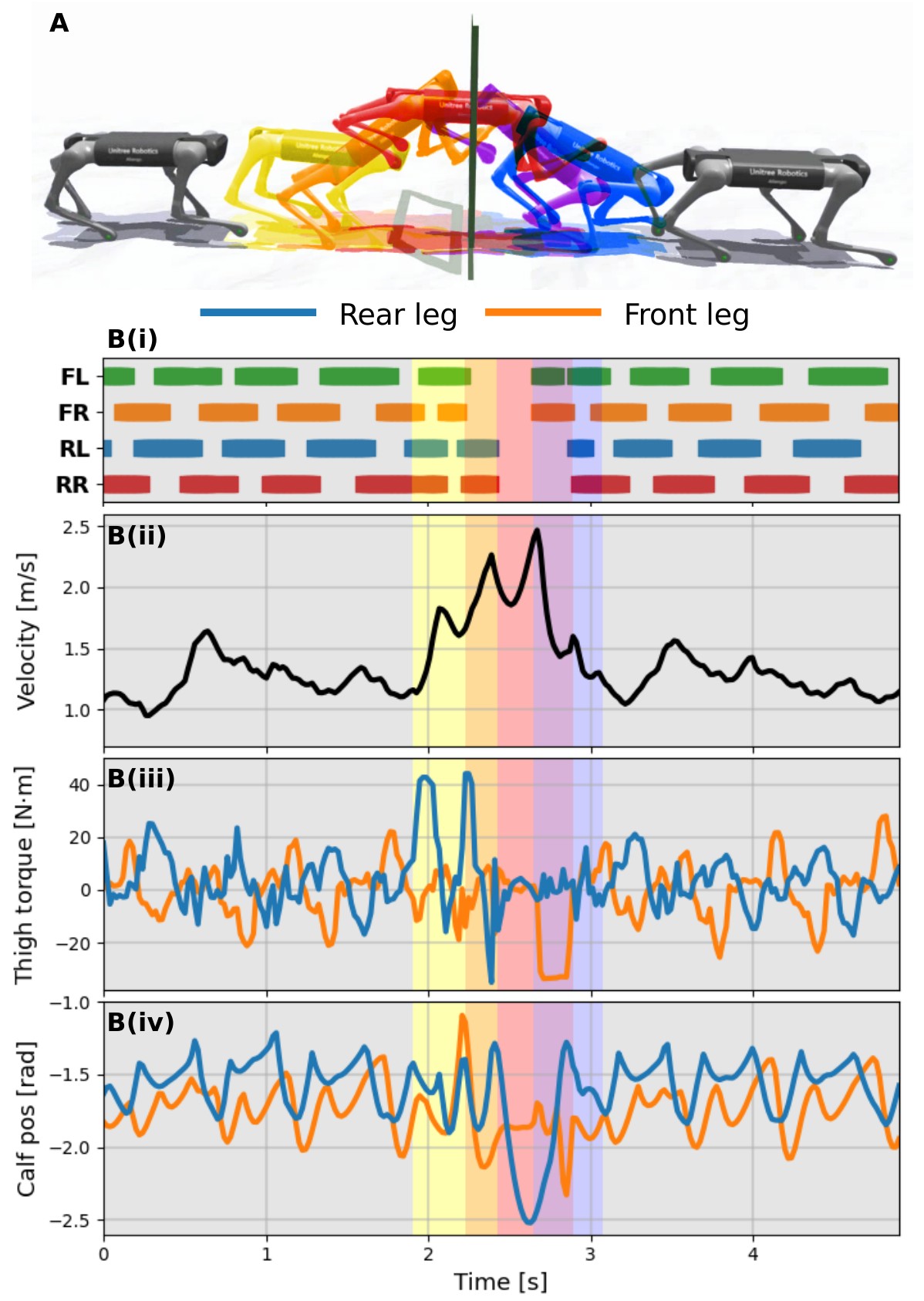
On the trained policy, low commands stay in a pace (0.25–1.57 m/s). High commands trigger a running jump (1.42–2.40 m/s). The high-level module sits on top at 10 Hz and outputs only forward speed and yaw. The locomotion loop runs at 50 Hz.
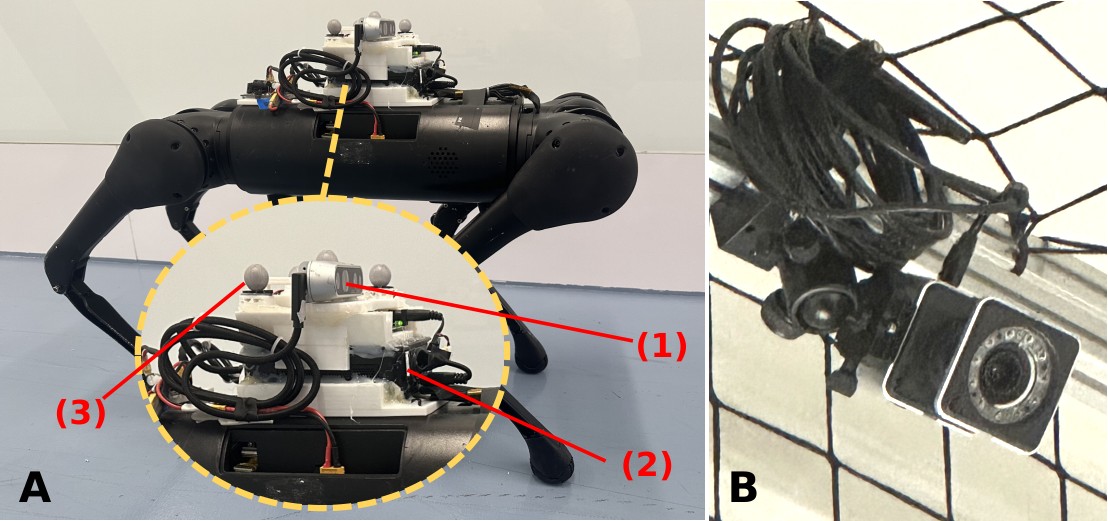
On hardware, the robot used an onboard Intel D435i RGB-D camera to find the black square frame, an Intel NUC for both controllers, and a VICON hall of 6.0 m × 3.0 m for pose. Peak thigh torque on Aliengo is about 45 Nm.
Numbers from the run
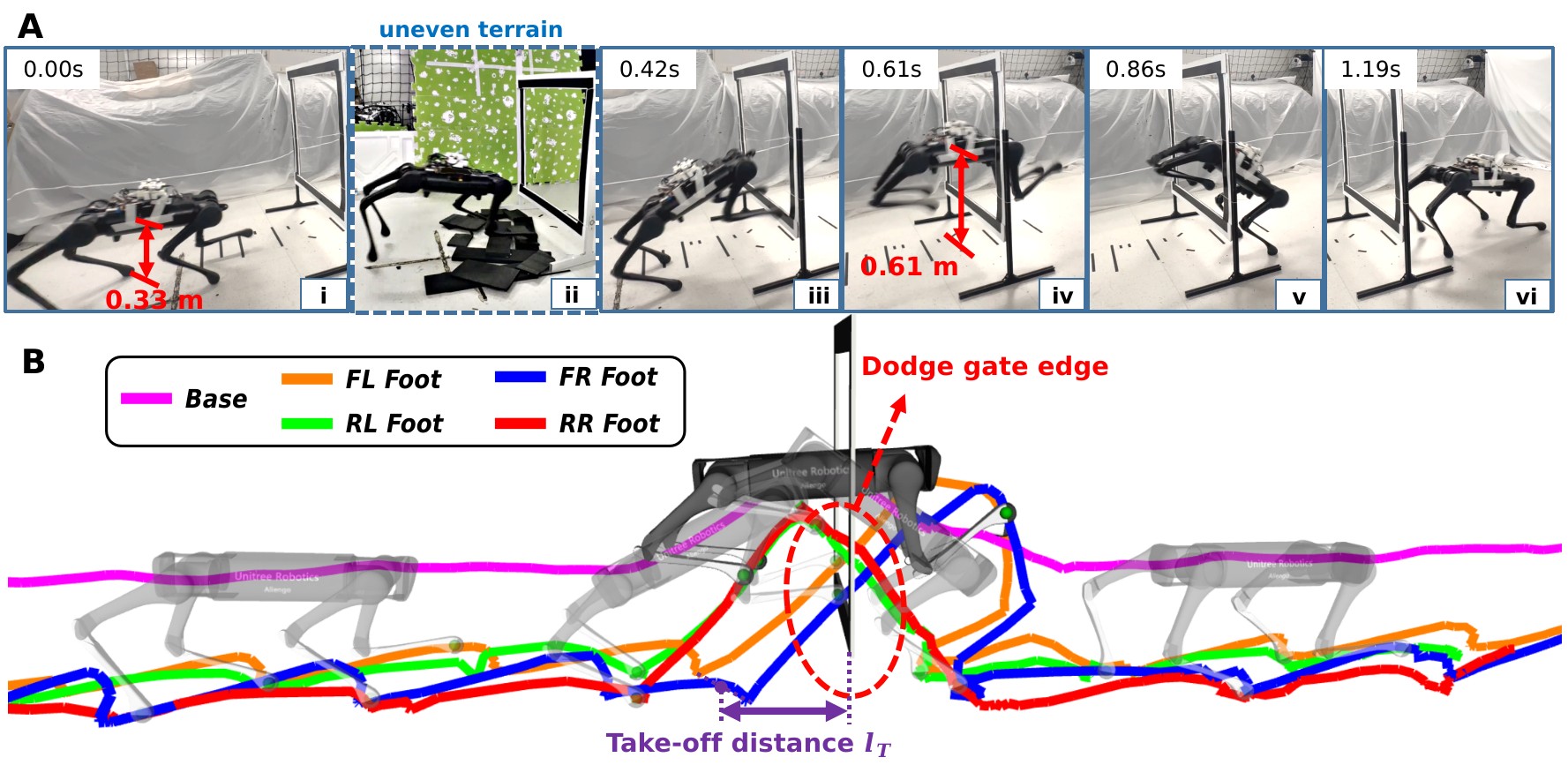
Interesting Engineering and the paper agree on the flight: the robot hit as much as 2.5 m/s, then braked hard for landing. Airborne time is about 0.44 seconds. Rear calf joints folded more than 140° so the feet missed the frame.
Gate randomization in training put the center anywhere from 1.2–6.0 m ahead, ±1.8 m sideways, and 0.5–0.63 m high, with outer size 0.7–1.0 m. The team also ran the same stack over stairs, gaps, a slope, and a moving gate. Lateral tests stepped the gate from +1.4 m to −1.4 m in 0.4 m steps; the paper says those trials finished without a failure.
End-to-end baselines that tried to learn the whole task from scratch either jerked through the gap or collapsed in training. ConsJump’s bet is a small, semantic command space on top of a skill library, not a new joint-level acrobat for every obstacle.
A Human’s Take
A dog-sized robot clearing a dog-sized hole is the right demo for hierarchical control. The VICON hall still does a lot of the localization work, and the gate is a high-contrast square, not a random doorway. What I want next is the same takeoff logic on a construction catwalk with a cheap camera and no motion-capture ceiling. If the high-level policy still picks the jump when the frame is dirty and the floor is wet, then the 0.44-second flight counts as a skill, not a lab stunt.