ContactGuard Aborts a Bad Grasp Before the Fingers Close
Wrist cameras are great at showing you the moment a grasp fails. They are late. ContactGuard, from Vanderbilt and the University of Sydney (arXiv August 13), tries to call the miss before the gripper hits the object.
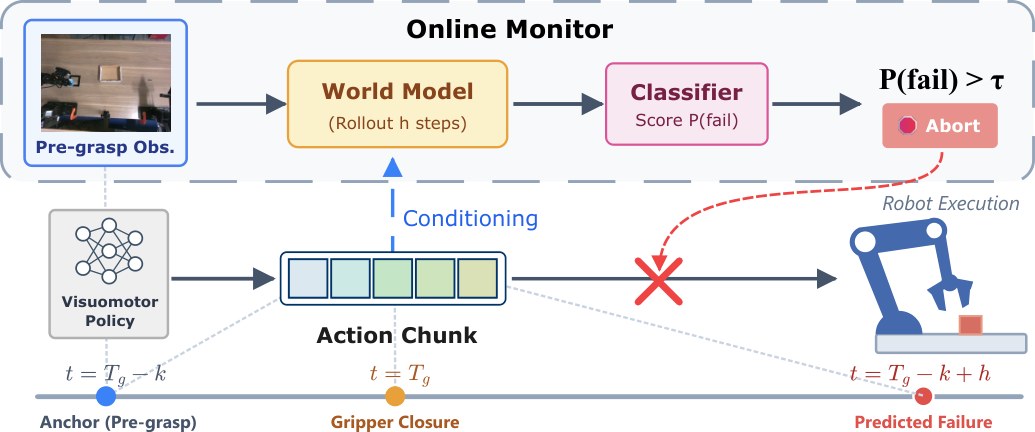
It sits beside an existing chunked visuomotor policy and does not retrain it. The policy proposes an action chunk. ContactGuard finds the planned gripper close, anchors a few steps earlier, rolls a latent world model forward under those same actions, and aborts if a small probe says the predicted post-contact latent looks like a failure.
Latents, not future pixels
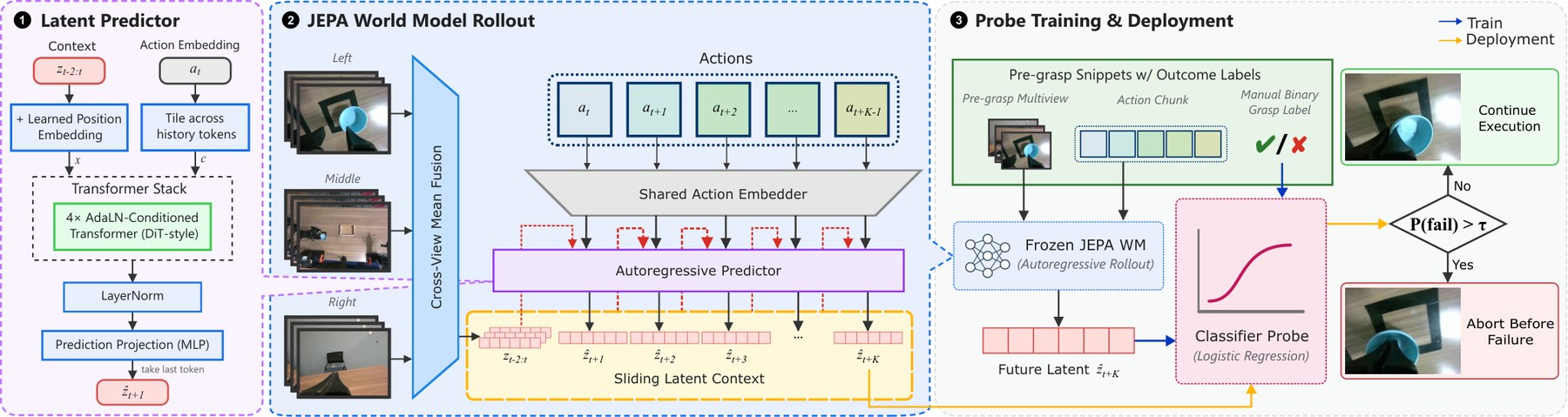
The world model follows a JEPA-style next-embedding predictor, close to LeWorldModel. Multi-view images go to a compact embedding. A causal predictor steps that embedding under the planned joints. No photorealistic video.
Training splits in two. Unlabelled robot trajectories teach the dynamics. A smaller labelled set of pre-contact clips teaches a logistic-regression failure probe on the predicted future latent only. Encoder and predictor freeze before that probe is fit.
At runtime the policy is a black box. ContactGuard consumes the current views and the chunk the policy already emitted. If P(fail) clears a threshold, the robot stops short of contact.

What they measured
The paper evaluates real contact-rich picks (the figures show a cup, a box, a pencil, a towel). Predicted future latents beat two obvious cheats: a probe on the current latent, and the same world model rolled under a corrupted action chunk. Multi-view fusion helps. The authors also attach the frozen monitor to a live robot and get pre-contact aborts without searching over alternate chunks.
They are careful not to claim imagined-future monitoring as a new idea. SIRIUS and Sirius-Fleet already do related work. The pitch here is the interface: an off-the-shelf chunked policy, a pre-contact veto, no joint training.
A Human’s Take
I care less about another world-model architecture than about when it is allowed to speak. A monitor that only screams after the cup is on the floor is a logger. One that can stop the last two centimeters of a bad approach is a supervisor. The ablation I will watch in a third lab is the corrupted-action test: if swapping the chunk flips the score, the model is actually reading the plan, not just the scene.