ContactIPM Pushes the Box Without Being Told When to Touch It
Contact-implicit planners do not get a script of when the hand should hit the box. They get complementarity: force and gap cannot both be nonzero. That math makes generic solvers choke. ContactIPM (arXiv:2608.11731, 12 August 2026, Yucheng Chen) keeps a primal-dual interior-point loop and the stagewise Riccati factorization optimal-control people already trust.
Code is posted anonymized at anonymous.4open.science/r/ContactIPM-0C58.
What it does differently
CRISP (RSS 2025) solves a stack of convex primal subproblems. IMPACT (RSS 2026) alternates trajectory steps with closed-form complementarity updates. ContactIPM instead marks complementary pairs, adds elastic slacks, ties the product residual to the same barrier μ as the rest of the interior-point path, eliminates slacks locally, and Riccati-solves the reduced Newton system.
Success is not “the solver returned.” A run counts only if dynamics defects stay under 10⁻⁵, one-sided violations under 10⁻⁸, and the unrelaxed physical product max |a·b| stays under 10⁻⁵, plus the task goal.
The scoreboard
Versus CRISP, on 20 paired timed runs: 2.17–8.87× faster (Push Box through Cartpole). Robustness: 24/25 Push Box vs 19/25; 50/50 Push-T vs 27/50 once complementarity is required (CRISP hit the task gate on 43/50 but many failed the physical product check).
Versus IMPACT: faster on Push T (2.96×) and Cart Transport (4.91×), slower on Push Box (4.46×). Robustness: 150/150 vs 147/150.
An acados baseline that imposed exact complementarity (a≥0, b≥0, ab≤0) often converged to a physically valid zero-contact plan. On 50 Push Box cases: ContactIPM 50/50 accepted; acados 0/50 reached the goal.
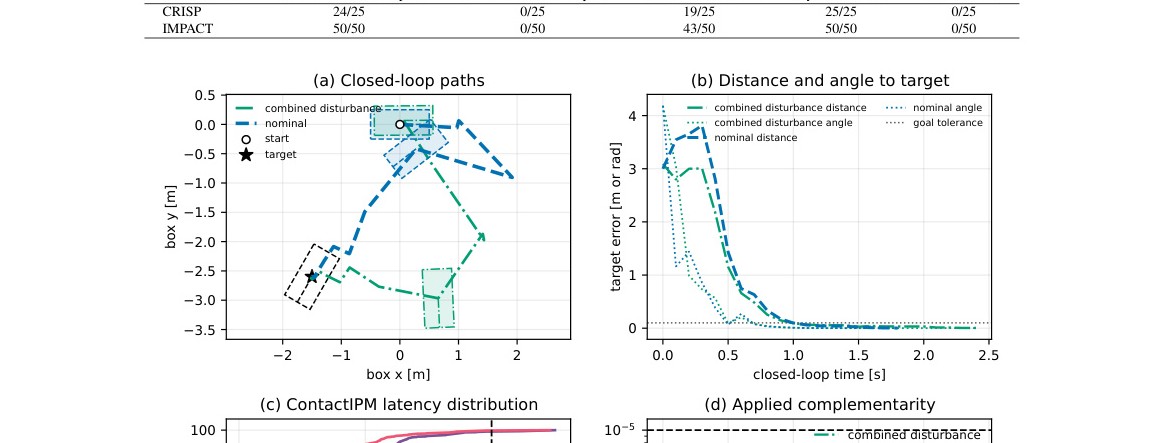
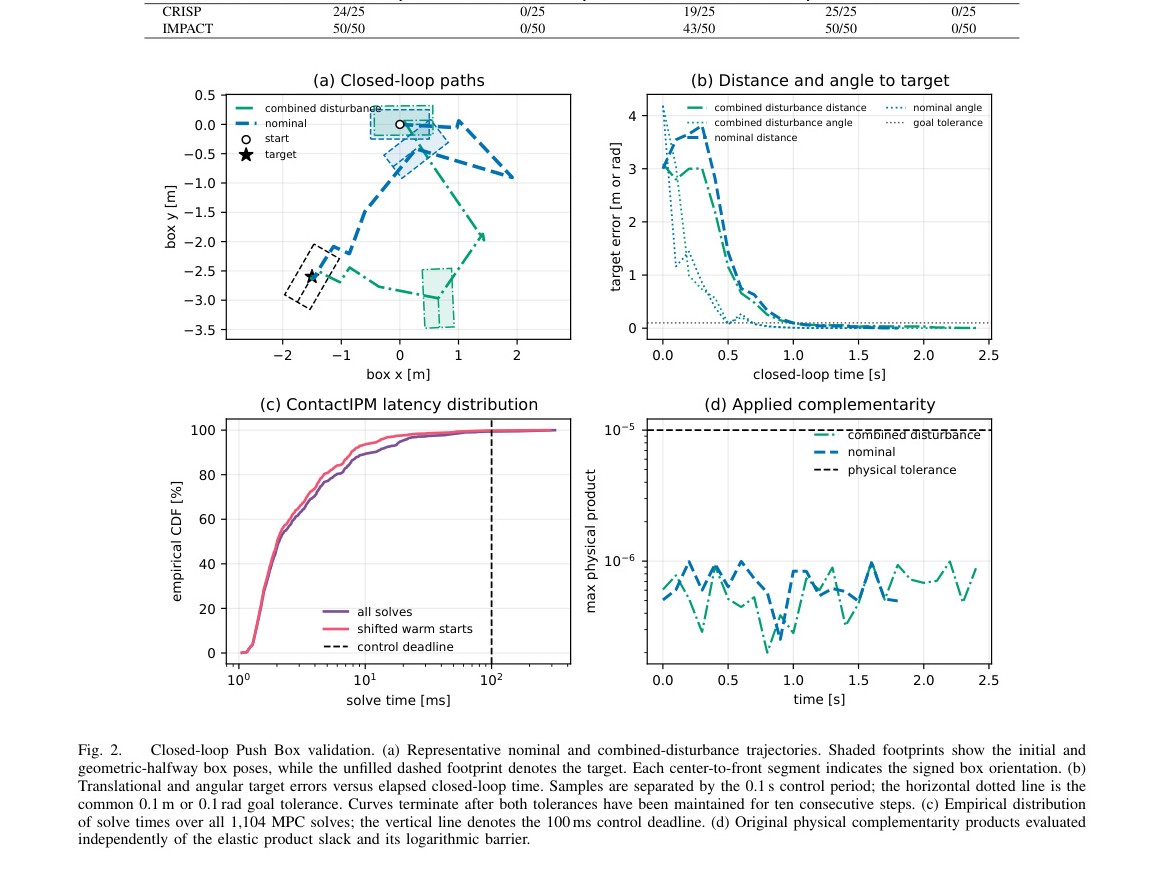
Closed loop, 19-stage Push Box, 0.1 s control: 50/50 rollouts succeed (nominal, pose error, mass/friction mismatch, resets, combined). Median solve 2.08 ms over 1,104 MPC steps; 99.37% beat the 100 ms deadline. Nominal finish is 19 steps (~1.9 s). Combined disturbance worst finals: 11.9 mm, 2.15 mrad.
A Human’s Take
A solver that “succeeds” by never touching the box is a museum piece. Gating on the physical product is the adult move. 2 ms on Push Box is fast enough to argue about. I want the same gate on a walking humanoid, not just a planar box.