Cross-View Consistency Makes Flow VLAs Survive Camera Moves
Move the scene camera a few centimeters and a fine-tuned VLA can fall apart — same task, same objects, same language, same robot state. That is a lab problem that becomes a factory problem the first time someone bumps a mount.
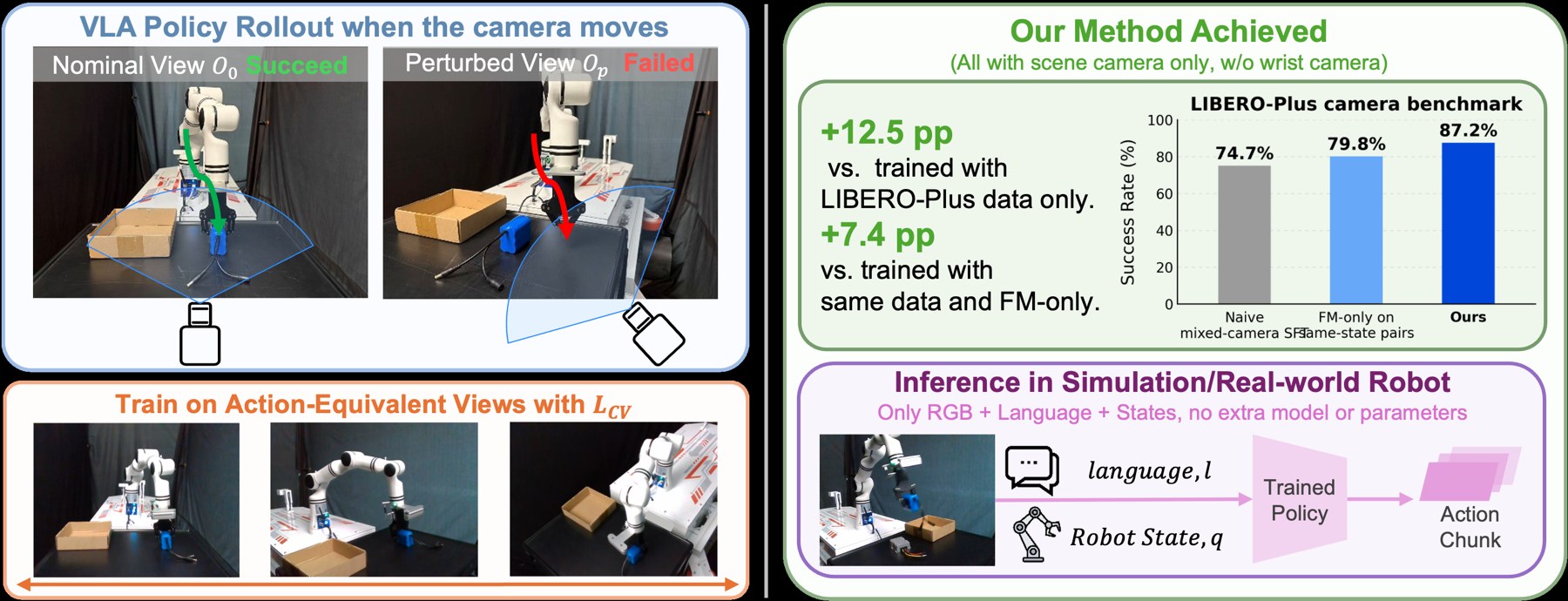
Huang, Wei, Wang, Cai, and Wang (arXiv:2608.06965, submitted Aug 7, 2026) study scene-camera viewpoint robustness for flow-based vision-language-action policies. Inputs are only a scene RGB image, language, and proprioception. No camera labels, extrinsics, depth, or point clouds. The wrist stream is masked so the model cannot cheat with an unperturbed second view.
The training trick
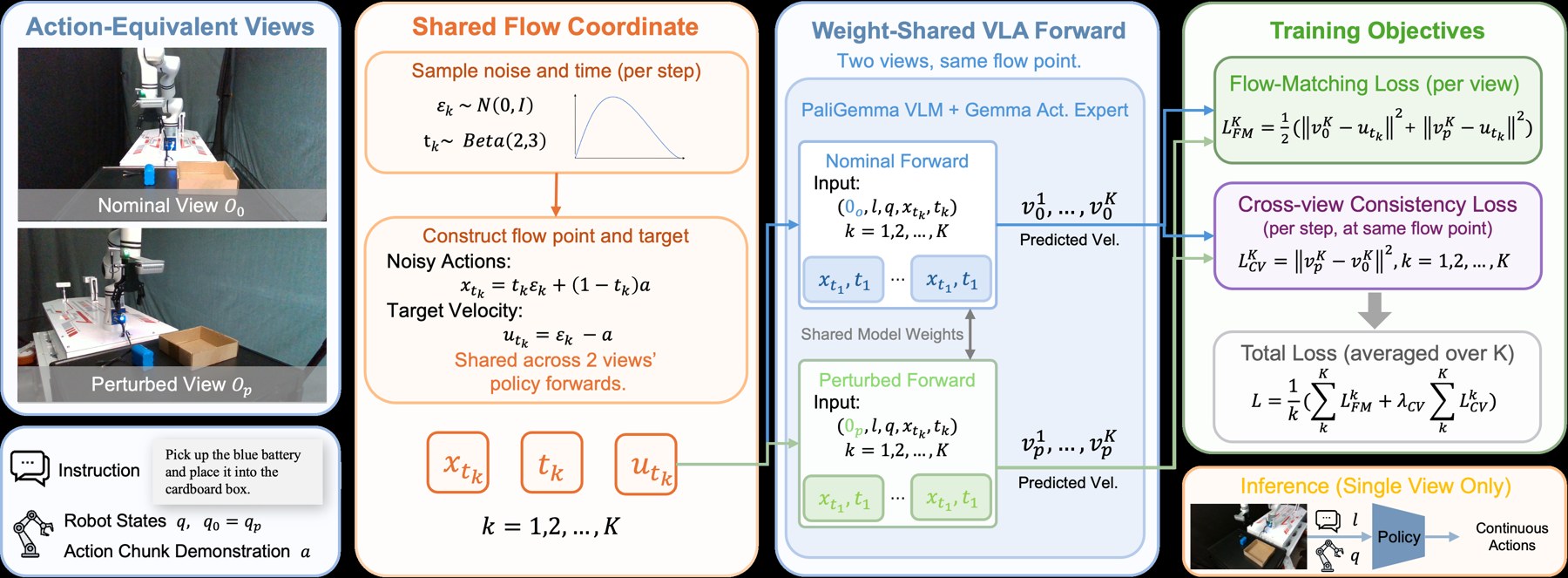
They regularize the action-flow velocity field — the quantity integrated to produce continuous action chunks — not just final poses.
Method sketch:
- Reset original LIBERO demos to the same MuJoCo state.
- Render a nominal scene-camera view and a perturbed view.
- Supervise both with flow matching.
- Add a cross-view loss so predicted action-flow velocities agree at the same sampled flow coordinates.
A shuffled-pair control collapses performance, showing the gain needs true action-equivalent pairing, not generic multi-view noise.
Results
On the LIBERO-Plus camera-perturbation track (4,797 rollouts per seed, 3 training seeds):
| Method | Success |
|---|---|
| Cross-view consistency (theirs) | 87.2 ± 0.4% |
| Flow-matching only on same paired data | 79.8 ± 0.8% |
| Naive mixed-camera SFT | ~74.7% (+12.5 pp gap cited) |
| Shuffled-pair control | 25.8% |
Nominal-camera in-distribution performance stays high at 95.0 ± 0.8%. On a real robot (three tabletop tasks, 10 rollouts per task and camera placement), held-out-camera success improves from 53.3% to 74.4% under the same single-scene-RGB inference interface.
A Human’s Take
I’m so here for training that assumes the camera will move. Extrinsics-free, wrist-masked evaluation is the honest stress test for any “just fine-tune π₀ on our cell” pitch. If cross-view flow agreement keeps delivering double-digit recovery when someone re-mounts a cam after maintenance, that is the kind of robustness factory integrators will actually pay for.