CrossTracer: One Semantic Path, Residual Fixes per Robot
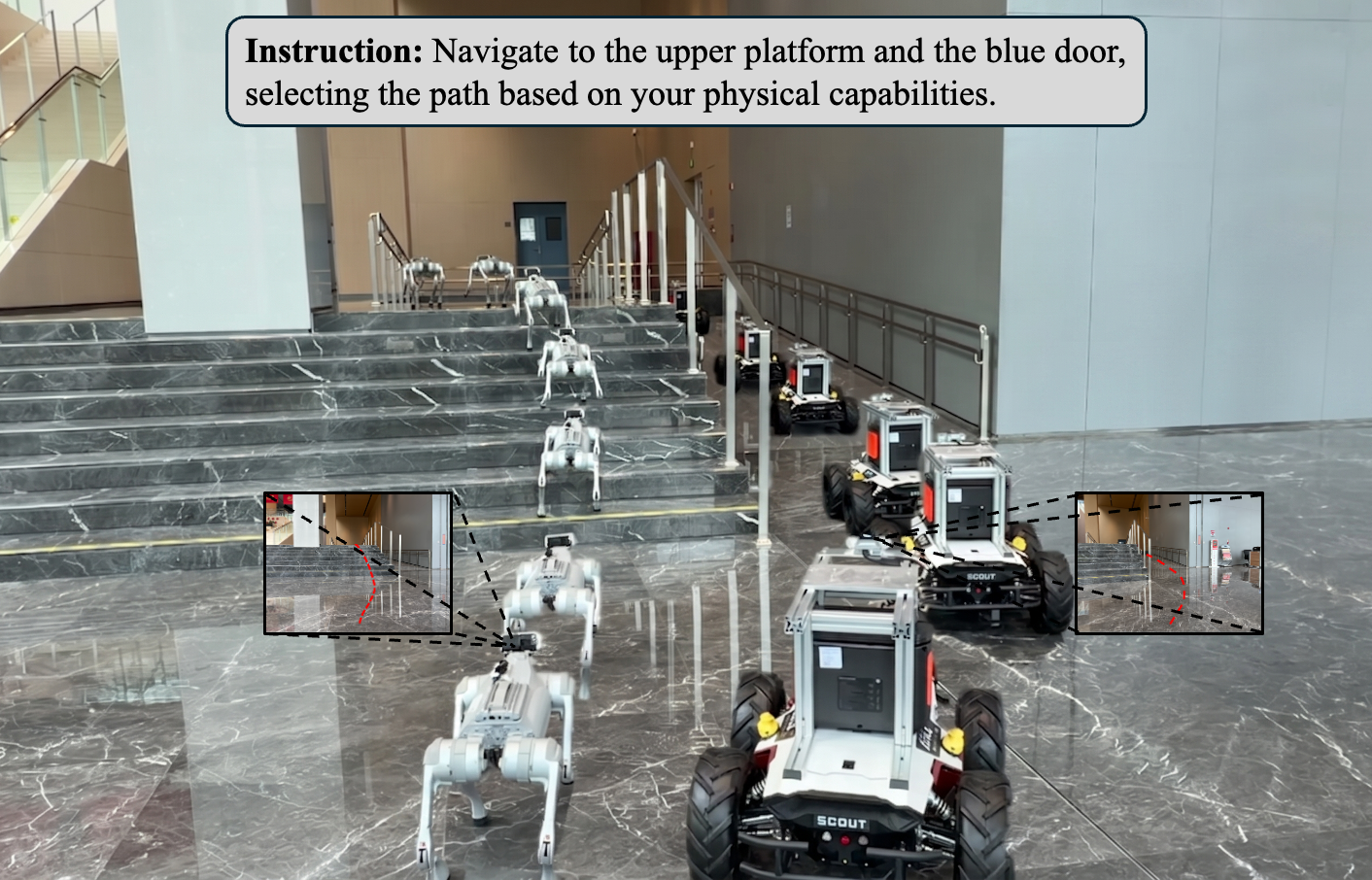
A path that makes sense for a dog-like robot can strand a wheeled Scout at the bottom of the stairs. CrossTracer (arXiv:2608.06688, Aug 7, 2026) treats that as the whole problem: keep one semantic pixel-space plan, then add embodiment-specific residuals.
Authors from Peng Cheng Laboratory, SUSTech, and collaborators evaluate on NaviTrace and deploy on wheeled and legged platforms. Project site: lilduckkk.github.io/CrossTracer-Nav.
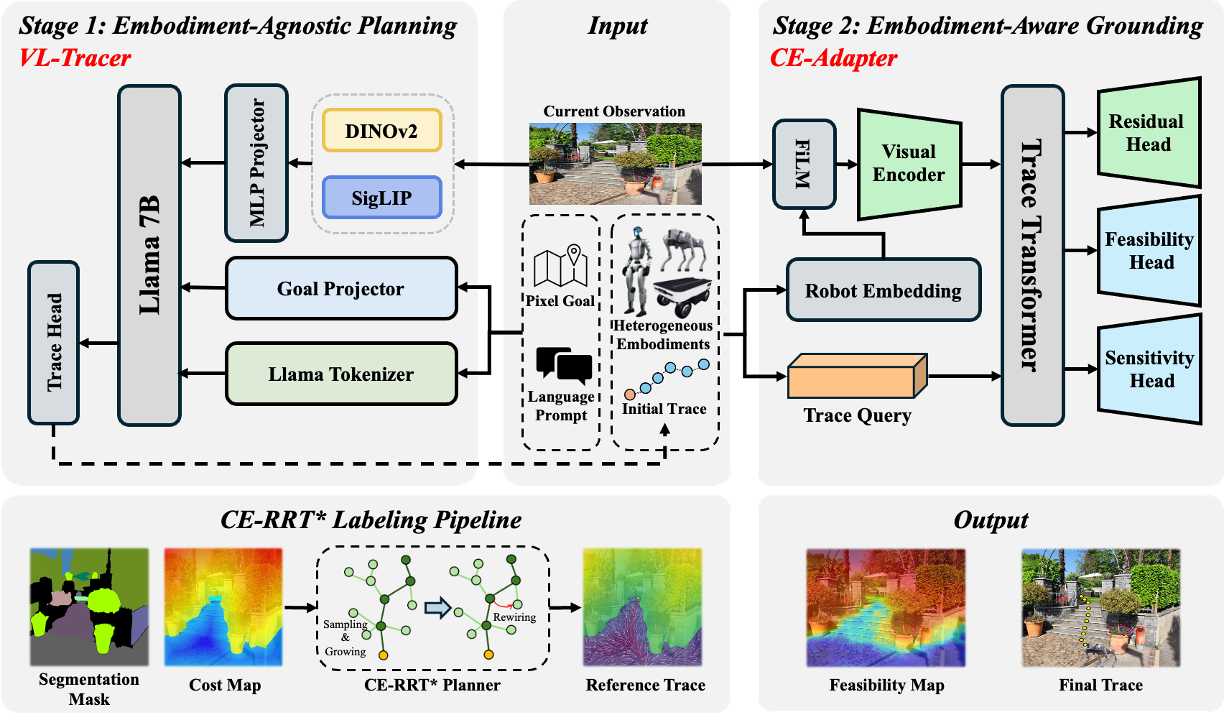
How it works
- VL-Tracer — adapts a pretrained VLA (OmniVLA-style) to propose an initial 8-point normalized image-plane trace from RGB + language and/or pixel goal. Embodiment is not injected here.
- CE-Adapter — predicts residual corrections using robot identity (embeddings + FiLM), visual features, and cross-attention from the initial trace.
- CE-RRT* — training-time labeler only: Mask2Former panoptic maps → robot-conditioned cost maps → RRT* pixel traces, so the adapter does not need hand-drawn embodiment paths.
At inference, no segmentation planner is required—just observation, goal, and robot type.
Scoreboard
On NaviTrace (official total score; higher is better):
| Model | Total score |
|---|---|
| CrossTracer-8B | 45.68 |
| Gemini-2.5-Pro | 35.67 |
| Robobrain-2.5-8B | 27.96 |
| CrossTracer w/o CE-Adapter | 22.56 |
That is a +10.01 absolute gain over Gemini-2.5-Pro (~28.1% relative). Ablating CE-Adapter drops the total by 23.12 points—especially on accessibility, social norms, and stationary obstacles.
With an extra goal-pose input, CrossTracer reaches 63.91. Embodiment scores stay balanced (bicycle / human / legged / wheeled all ~42–46).
Real-world tests use Jetson Orin on-robot, RTX 4090 offboard inference over Wi-Fi, comparing against OmniVLA under matched tasks; the paper reports improved success and paths closer to human expert references.
A Human’s Take
Pixel-space residuals are a clean interface: language understands “go upstairs to the blue door,” kinematics decide whether that is legal for this chassis. Beating a giant generalist VLM on an embodiment-sensitive benchmark with an 8B stack is a fun receipt. I’d love open weights plus outdoor mud next—not only marble lobbies.