Differential Direct-Drive Gripper Chases Torque Without Killing Transparency
High gear ratios give grippers force and take away backdrivability. Pure direct-drive flips the trade: transparent, weak. Quasi-direct-drive sits in the middle and still often lacks finger DOF.
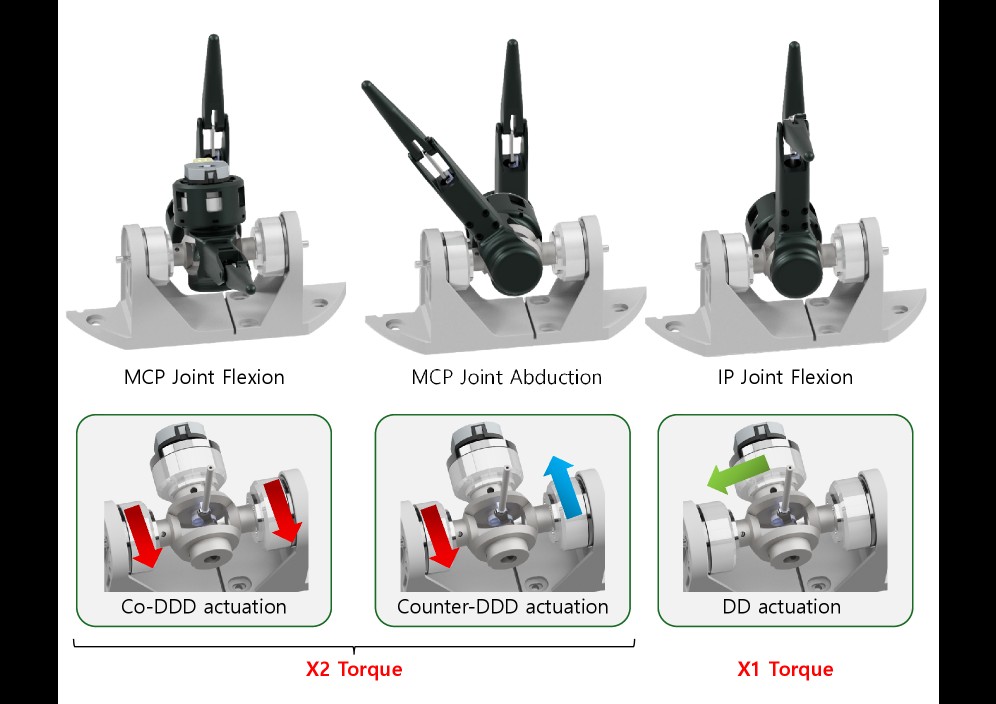
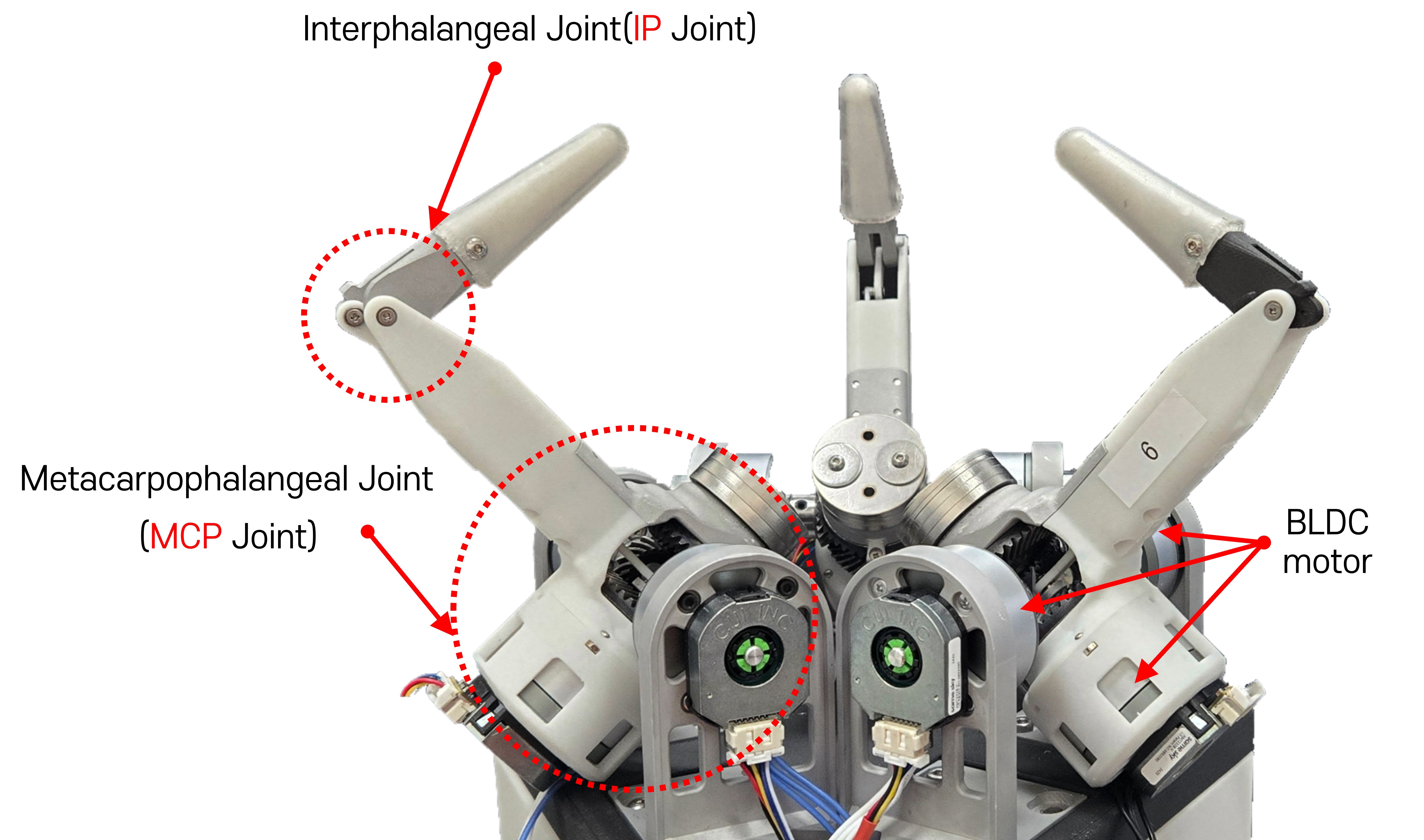
Sogang University authors propose a Differential Direct-Drive (DDD) 9-DOF, three-finger gripper (arXiv:2608.09198, Aug 10, 2026; ICRA 2027 late-breaking poster). Each finger gets three CubeMars GL35 DD motors: two coupled through a 1:2 differential for MCP flexion/abduction, one four-bar for IP flexion. Motors sit at the base so moving-link inertia stays low; co-directed differential drive gives 2× torque on MCP flexion.
Hardware numbers
From the paper’s prototype measurements:
- ~18 N nominal three-finger grasping force
- 4.7 N fingertip force per module
- ~2 kg payload class in three-finger grasp
- Motor contribution to system inertia: 0.236%
- Passive mechanical impedance (motors unpowered), max measured: 50.1 N/m (MCP abduction); 15.6 N/m MCP flexion; 9.5 N/m PIP flexion
- Closed-loop −3 dB position bandwidths: 8.1 Hz MCP flexion, 11.38 Hz MCP ad/abduction, 13.91 Hz PIP flexion
- Mass: ~800 g per finger module, 2.4 kg total gripper
Frame is Formlabs-printed; mechanism is patent pending (KR 10-2026-0005274; PCT/KR2026/005769).
A Human’s Take
I’m watching the impedance and bandwidth numbers more than the marketing torque. If motor-current force estimation works on this stack without a wrist F/T sensor, that is the practical win — fewer cables, fewer calibration rituals. Next paper needs contact-rich tasks and a comparison against a geared commercial three-finger under the same force-control bandwidth budget.