DeCAL Lets a Dexterous VLA Feel Before It Commits
Vision-language-action models go blind the moment five fingers wrap an object. DeCAL, from Peking University and the Beijing Academy of Artificial Intelligence, is a CoRL 2026 attempt to stop guessing through that occlusion. The policy unifies understanding, imagination, and action, and it only turns the tactile channel up when the fingers actually touch something.
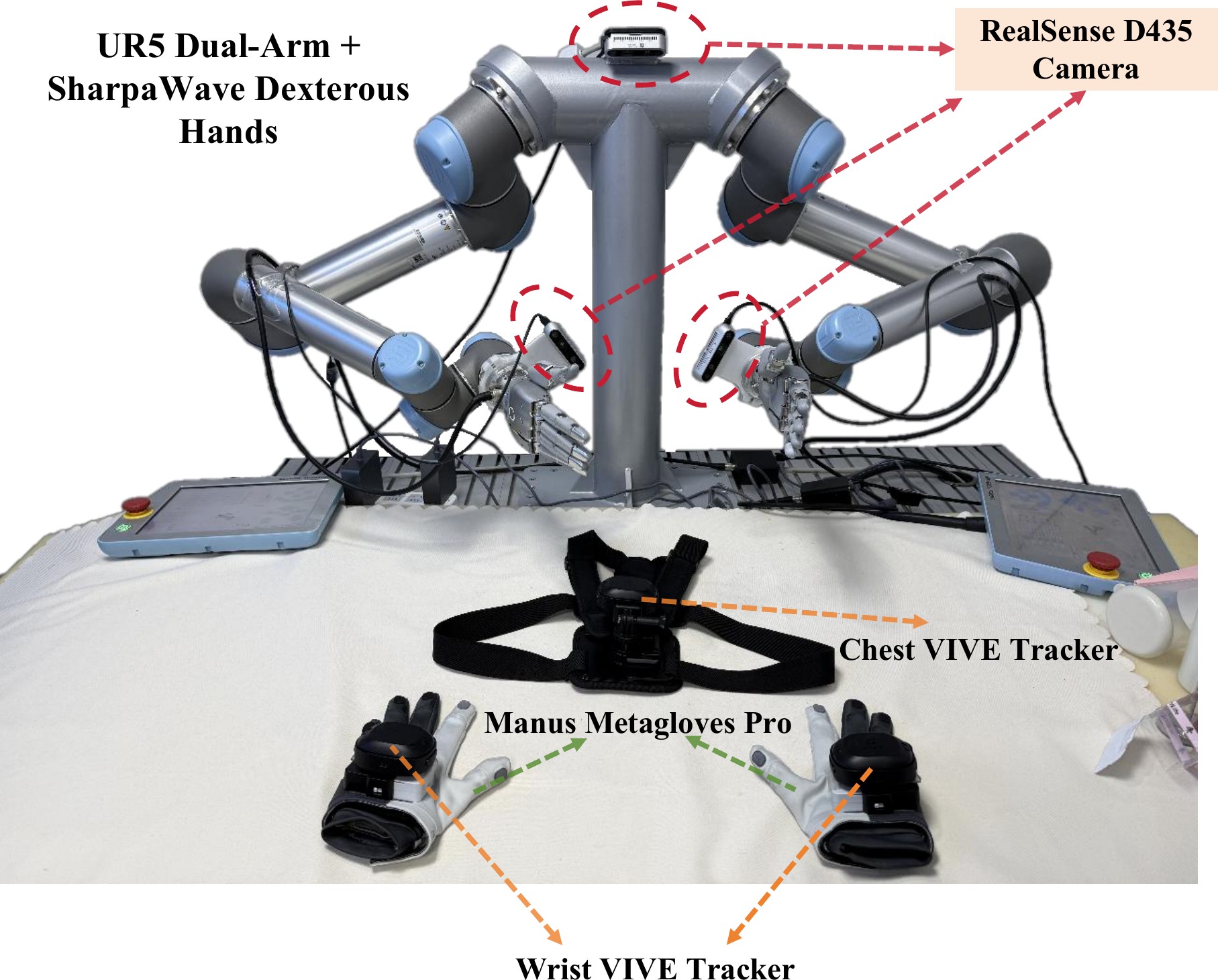
The hardware is two 6-DoF UR5 arms, two 22-DoF SharpaWave hands, three RealSense D435 cameras, and a 320×240 vision-based tactile sensor in every fingertip. Each fingertip yields a raw image, a 6-DoF net force, and a deformation map.
Gate the touch, imagine the contact
DeCAL is a Mixture-of-Transformers with three experts. The understanding expert is Qwen3-VL. A generation expert predicts future visual and tactile latents. An action expert uses factorized flow matching: arm and hand start from separate noise, then coordinate. Information flows one way, understanding → generation → action.
The useful bit is the contact-aware gate. A global tactile token decides how much local fingertip evidence to add. When the hand is in free space the gate stays low and vision runs the show. On contact it jumps, and touch is allowed to move the action. Ablations on Assemble Parts and Twist Cap show dropping the gate costs 15 and 10 percentage points of success.
They also jointly imagine future vision and touch, including force, deform maps, and raw tactile images. Inference skips the pixel decoders and just uses the latents. Average latency is 0.27 s per action chunk.
The scoreboard
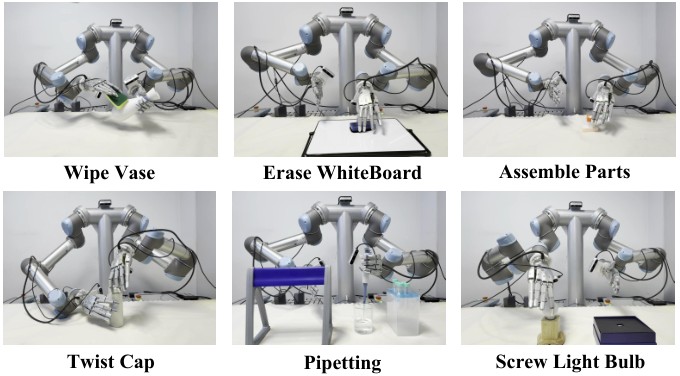
Six tasks, 100 teleop demos each (MetaGlove Pro plus VIVE trackers), 20 trials per method:
| Task | DeCAL SR | Next-best named |
|---|---|---|
| Wipe vase | 100% | DECO 90% |
| Erase whiteboard | 80% | DECO 60% |
| Assemble parts | 65% | InternVLA-A1t 45% |
| Twist cap | 80% | DECO 70% |
| Pipetting | 60% | GR00T N1.6 60% |
| Screw light bulb | 40% | DECO 35% |
Average success is 71%, progress success 83.4%, 15 points over DECO, the strongest tactile specialist they ran. Out of distribution on Twist Cap: unseen background 60%, clutter 70%, unseen lighting 70%, unseen object 75%.
The paper is honest about the rest. Tactile sensors drift. The teleop rig does not give the operator fingertip force. There is no large-scale visuo-tactile pretraining.
A Human’s Take
A gate that shuts up until contact is how I would wire a hand if I had to ship it. Seventy-one percent across wipe, twist, pipette, and a light bulb is a lab average, not a shift. The 40% on the bulb is the number I would put on the slide, not the vase. If they scale tactile data without the operator flying blind on force, this stack gets interesting.