Digit Teams Pinch Boxes Together With No Radio Chat
A lot of humanoid papers stop at one robot hugging a box. Bikram Pandit, Mohitvishnu S. Gadde, Aayam Kumar Shrestha, and Alan Fern at Oregon State’s DRAIL lab posted decMHT (decentralized multi-humanoid transport) on 16 September: the same local policy, no inter-robot radio, from a solo pickup up to ten simulated Digits around a pallet.
The hardware cut is two Agility Digit V3 robots pinching a cardboard box, carrying it, and handing it off. An external motion-capture sensor supplies each robot’s attachment-frame pose. There is no extra real-world fine-tune.
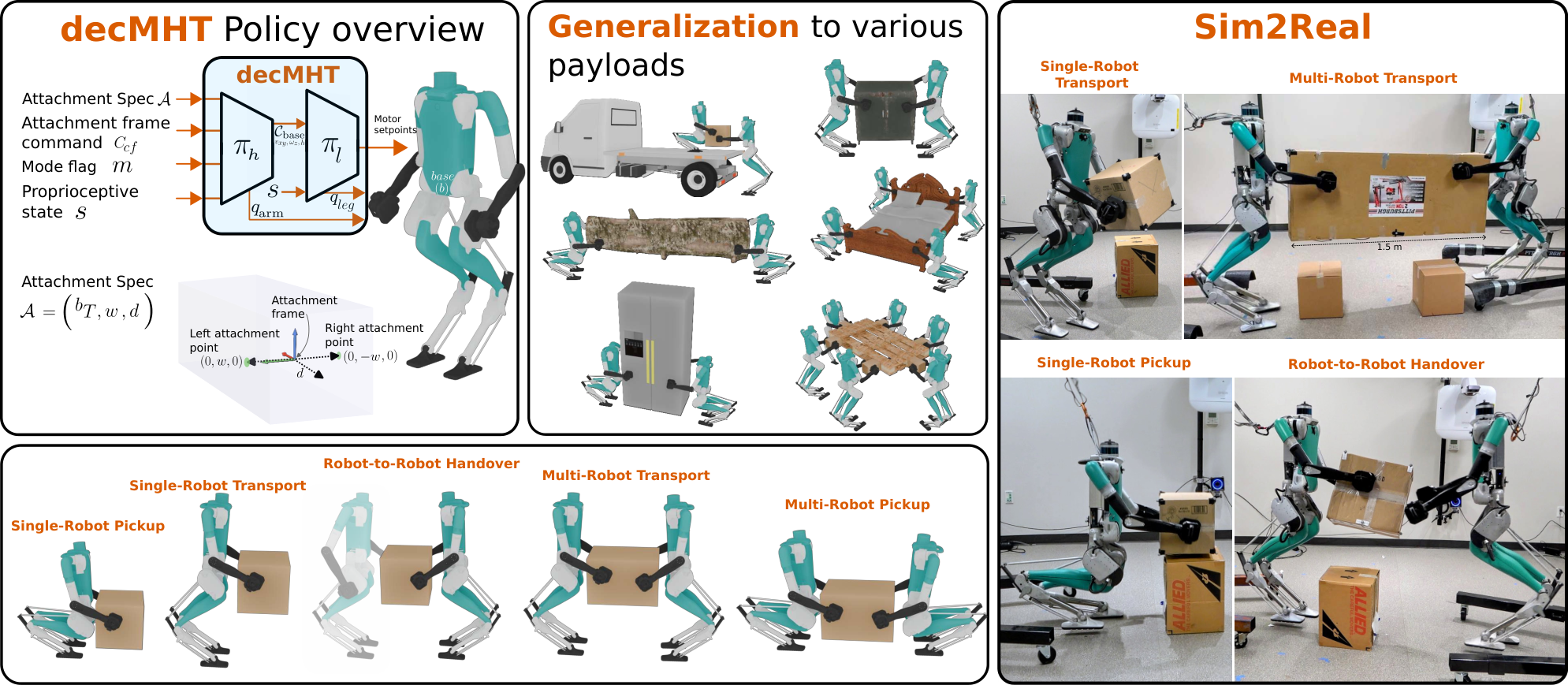
Attachment specs, not a group chat
Each robot gets a local attachment spec once per episode: where on the object to pinch, how wide the two contact points are, and how much frontal clearance to leave. A high-level command then asks for the object’s planar velocity, yaw rate, and height. That command is rewritten into each robot’s local frame with a fixed rigid offset. A binary flag puts a robot in track or idle. Handover is just flipping those flags: receiver goes to track, giver goes to idle once both are holding.
The hands are not grippers. Digit V3 here uses rigid, flat, rubberized pads that tolerate a little in-plane rotation. The robot pinches.
A frozen low-level locomotion policy takes velocity, yaw, and height. A high-level LSTM (two layers, 128-wide) outputs arm joint targets plus those locomotion commands at 50 Hz. Training is IPPO in Isaac Lab: 4096 parallel environments for single-robot work (~140 GPU-hours on an RTX 4090), then 2048 environments for two-robot fine-tuning (~60 GPU-hours more). The policy never trains with three or more robots. Evaluation still goes to ten.
The numbers that matter
On a pallet whose mass scales from 1 kg (one robot) to 10 kg (ten robots), pickup success stays above 97% at every team size over 1000 randomized episodes. Linear tracking error falls as the team grows. RMS tilt drops from 8.04° with one robot to 1.21° with ten.
A mass sweep with fixed 10–50 kg payloads shows extra robots expanding what can be lifted, zero-shot, even though training used 0.5–1.5 kg boxes. Unseen geometries in sim include a cabinet, fridge, log, bed, and concrete slab. The bed is the hard one: 85.2% pickup for the two-robot-trained policy versus 44.1% for the single-robot-only ablation.
Handover tests cover static, moving, and cross-level (different floor heights). The two-robot-trained policy finishes stage 3 (receiver holds alone) at 100% static, 96.5% dynamic, and 99% cross-level.

Limits are in the paper: mocap instead of onboard vision, no grippers, and no distinct leader/follower roles.
A Human’s Take
The trick I will steal is the attachment spec. You tell each robot “pinch here,” not “stand at this world pose.” That is why a two-robot trainer can walk a ten-robot pallet in sim. The hardware still needs an external pose sensor, so this is not a warehouse shift yet. It is a clean interface for when two Digits have to share a load without a radio.