DECOWAM Splits Base, Arm, and Camera Motion on a Wheeled Quad
A team from Tsinghua, Shanghai Artificial Intelligence Laboratory, Harbin Institute of Technology, and DEEP Robotics posted DECOWAM on arXiv August 20–21: a decoupled whole-body world-action model for a wheeled quadruped with a 6-DoF arm.
Fixed-base world-action models treat the camera as nailed down. On a moving base the pixels mix scene change, arm motion, and ego-motion. DECOWAM’s bet is to stop stuffing all of that into one latent.
Freeze the giant, train the residuals
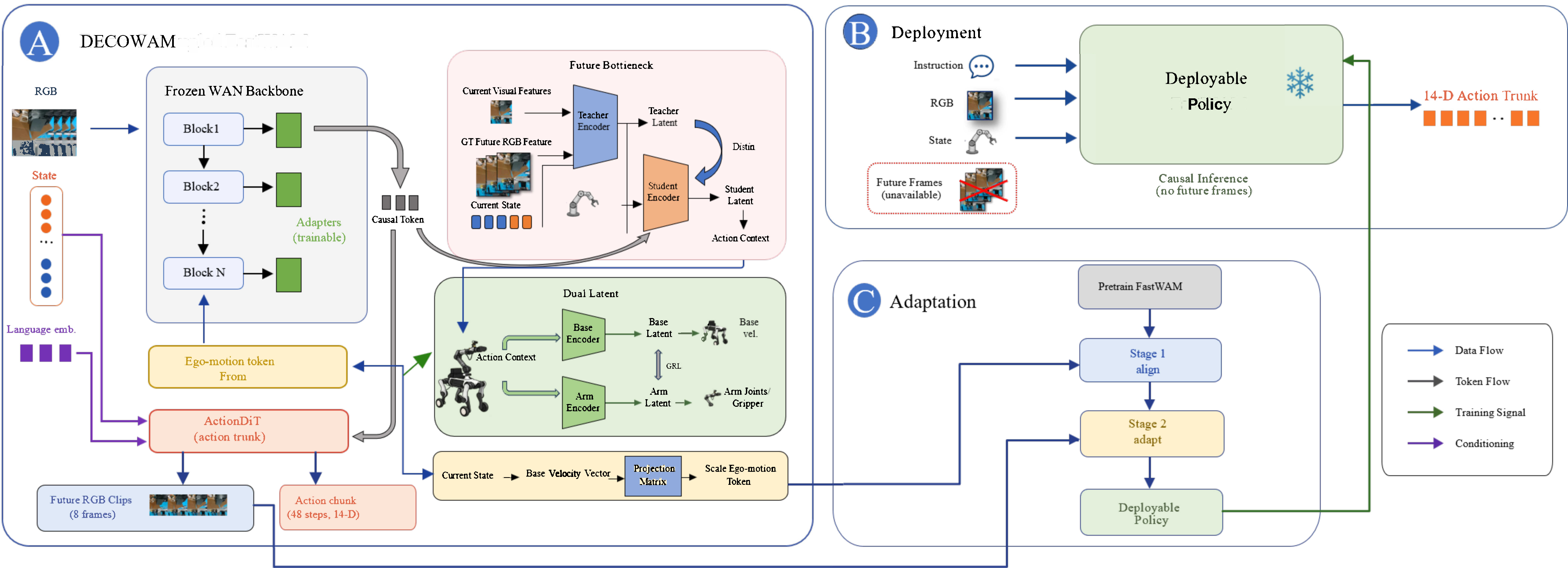
The backbone is FastWAM (Wan-2.2 video diffusion plus an ActionDiT action branch). Stage 1 adapts FastWAM to their data. Stage 2 freezes that checkpoint and trains only residual adapters, a future-information bottleneck, split base/arm latents, and a base-velocity token for the video expert.
Trainable parameters in that second stage: 25.95 million, down from 6,020.75 million in full FastWAM fine-tuning. The abstract says action MSE dropped 21.7% versus FastWAM on a fixed replay protocol.
The action chunk is 48 steps × 14 dimensions: arm joints, gripper, 3-D base velocity, plus loader padding. Video prediction is eight future RGB frames at 384×320.
ARMDOG, and 79 real trials
They also introduce ARMDOG, a synchronized real-robot set: RGB, whole-body state/action, and language. The converted world-action snapshot used in the paper has 217 episodes from 27 task folders and 56,041 frames. After alignment and quality filtering, the full corpus is 1,487 episodes and 343,550 RGB frames (~321.3 minutes at 15 Hz). Bottle pick-and-place and place-block dominate.
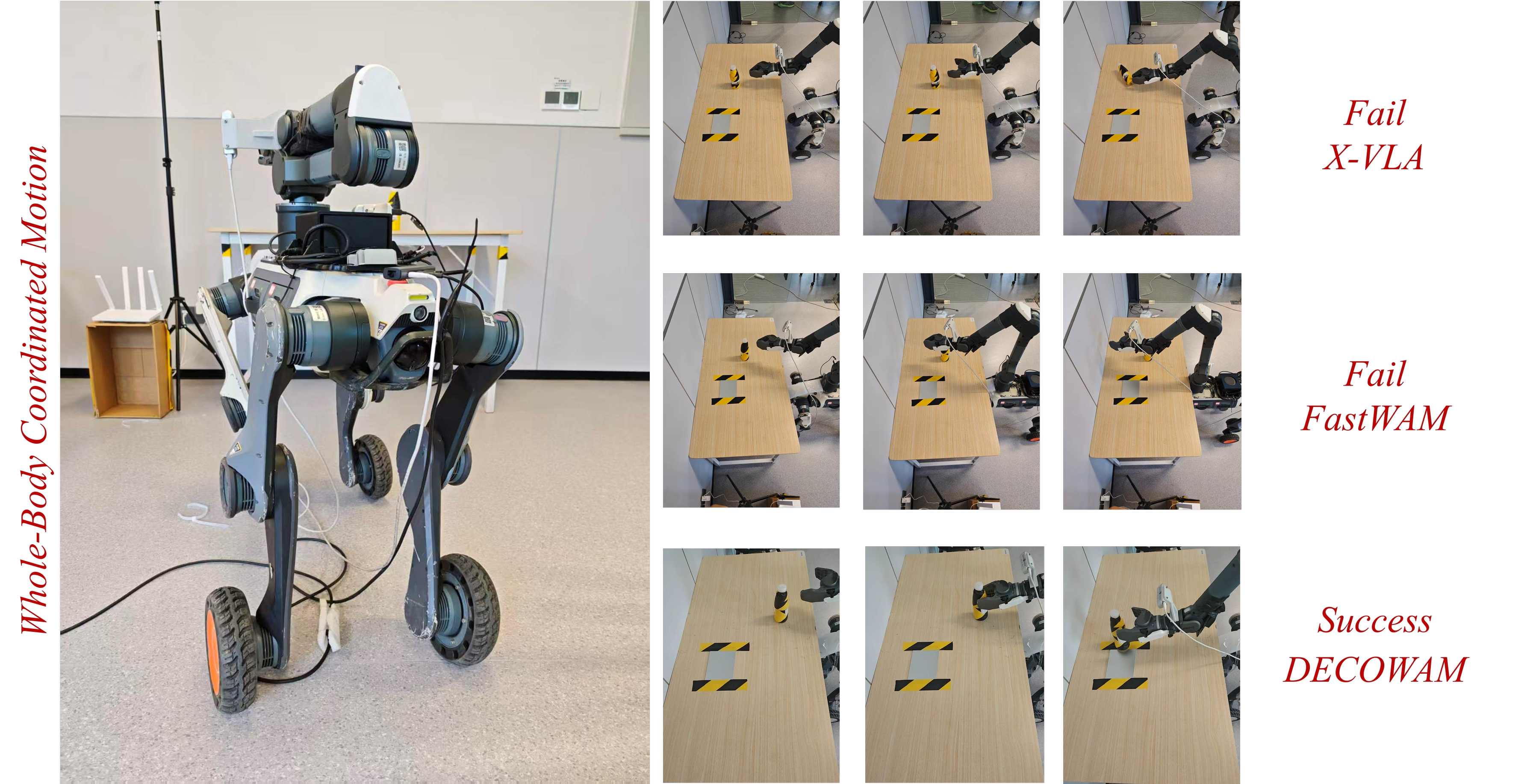
On the physical robot, 79 trials per method: DECOWAM completed 46 tasks (58.2%) with a mean time of 49 seconds. The paper says it led approach and transport among the compared systems, carried 96.4% of successful grasps into transport, and posted the highest whole-body coordination, base-displacement robustness, and autonomous-recovery rates. Task completion stayed comparable to the strongest baseline. The qualitative figure shows X-VLA and FastWAM drifting the base during a tabletop reach that should stay planted; DECOWAM holds.
Affiliations in the PDF: DEEP Robotics is Hangzhou Yunshenchu Technology.
A Human’s Take
Splitting “where the base goes” from “what the arm does” is the kind of unglamorous systems work that actually ships. 26 million trainable parameters beating a 6-billion-parameter fine-tune is the headline for anyone paying a GPU bill. Fifty-eight percent completion on 79 trials is not a warehouse yet. It is a quadruped that finally knows when to stand still.