Deep Whole-Body Parkour Puts Perception Into G1 Motion Tracking
Humanoid control usually splits into two camps: perceptive locomotion that walks over terrain but sticks to pedal gaits, and general motion tracking that copies complex skills on flat floors. Deep Whole-Body Parkour from Tsinghua’s Project Instinct tries to fuse both — whole-body motion tracking with exteroceptive sensing so dynamic, multi-contact skills survive uneven ground.
Paper: arXiv:2601.07701. Project: project-instinct.github.io/deep-whole-body-parkour. Video: YouTube.
What they claim
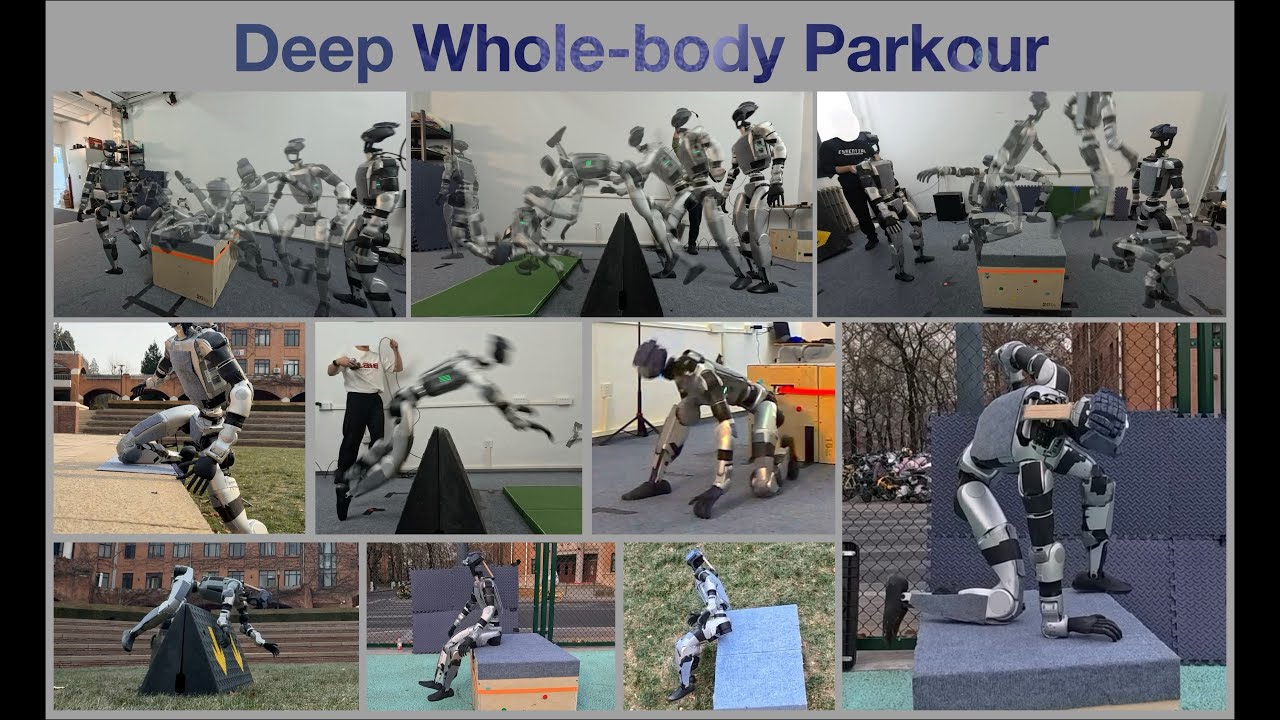
The abstract describes a single policy trained to perform multiple distinct motions across varied terrestrial features, with depth sensing in the control loop. Demo sections on the project page highlight:
- Kneel climb
- Dive roll
- Roll vault
- Jump sit
- Auto position-correction from depth sensing
- Robustness under distractors
Authors argue this expands traversability beyond walking or running into multi-contact parkour-style behavior on unstructured terrain.
Open pieces
The project lists open code for a related shadowing task in InstinctLab, motion-reference data for a G1 29-DoF torso-base model, and policy checkpoints. The broader Project Instinct site also ships InstinctLab, Instinct_RL, and Instinct Onboard repositories for whole-body control research.
Sibling work from the same group includes Embrace Collisions (CoRL 2025) and Hiking in the Wild (perceptive parkour framework, arXiv:2601.07718).
A Human’s Take
Parkour demos are the honesty test for whole-body policies: if the contact schedule only works on a flat mat, you do not have terrain intelligence. Depth-in-the-loop tracking is the piece worth watching — flat-floor acrobatics without perception already exists; surviving bad ground is the product problem.