DigitCode Tokenizes Hand Motion by Bone, Finger, and Whole Hand
Most hand pipelines store continuous joint angles or MANO parameters. Accurate, yes — but you cannot index “the middle finger” as a symbol or mark a pose as anatomically legal. DigitCode (arXiv:2608.03127, submitted Aug 4, 2026) builds a discrete code on Hand Labanotation’s grid and asks a sharper question: what anatomical unit should a token span — bone, finger, or whole hand?
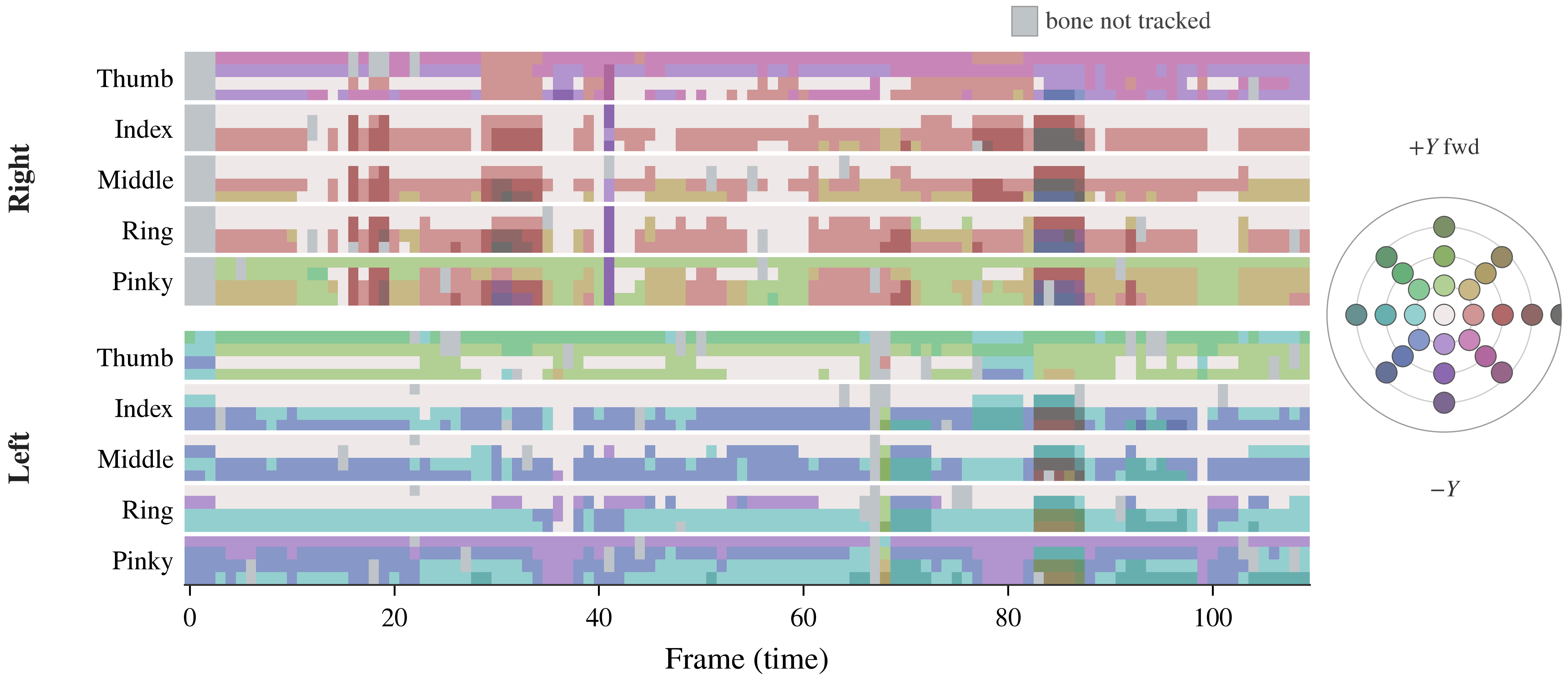
The lever is the unit
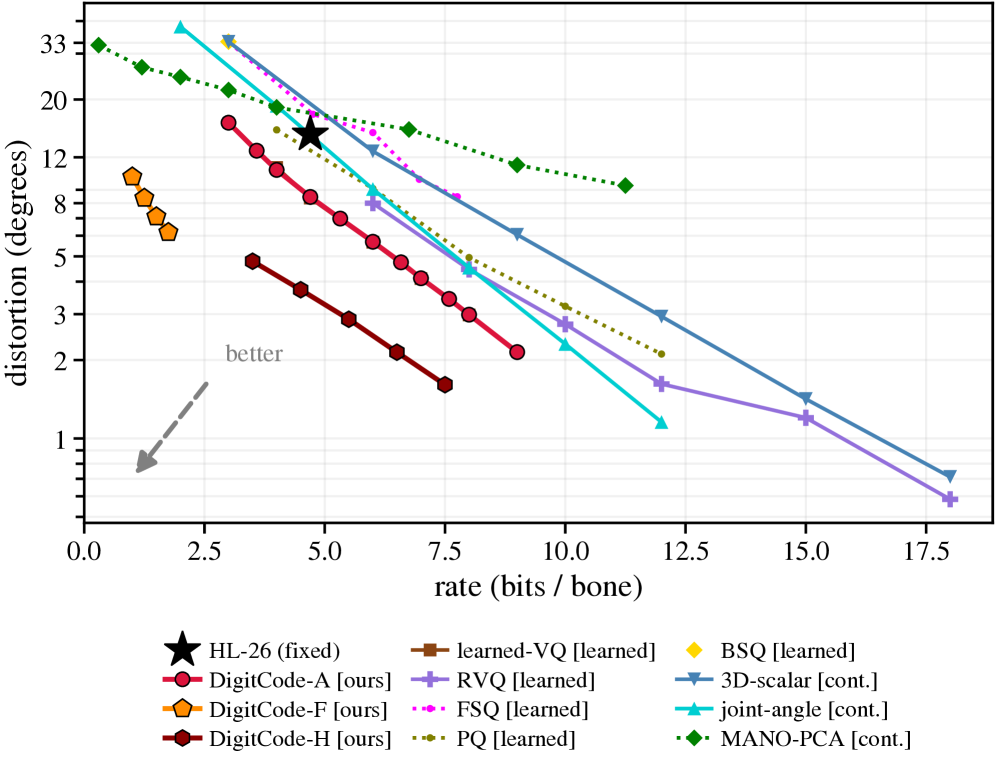
The paper reports that adapting, grouping, and layering HL’s alphabet along the hand hierarchy cuts symbolic quantization error by about three quarters. Headline reconstruction numbers from the abstract and project page:
- Held-out error 14.71° → 3.26° at HL’s own rate (~4.75 vs 4.70 bits); 1.86° at 6.75 bits.
- At a fixed unit, training-free and learned strong quantizers are nearly interchangeable on reconstruction; moving down the anatomical hierarchy is what shifts accuracy.
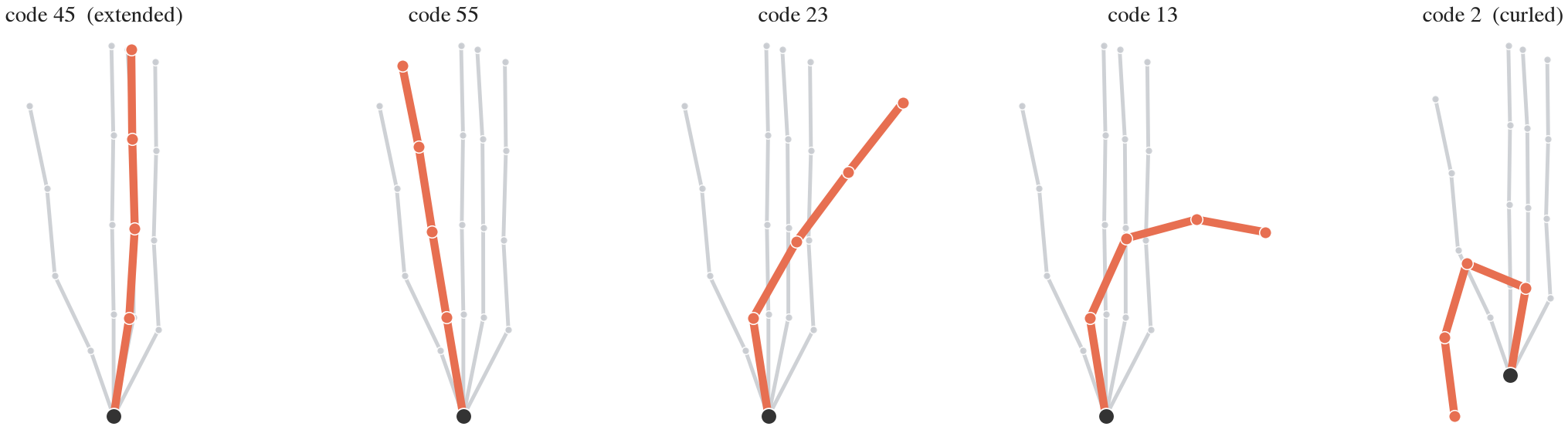
DigitCode-F uses five per-finger tokens — enumerable, legal by construction, locally editable.
Why robot people should care
Because a finger is a genuine unit, one token becomes a training-free handle for:
- Detecting and repairing malformed generated hands (codeword residual detector; no learned model required for the residual).
- Retargeting to robot hands via a finite per-finger codebook → one-time IK table (~640 solves for 5 fingers × 128 codes in the project writeup), then O(1) streaming lookup.
The authors release HandTok, a testbed to compare hand tokenizers unit-for-unit. Project: digitcode-demo.github.io.
A Human’s Take
Continuous MANO is fine for rendering. For robot retarget and “fix that broken finger,” I want addressable parts. DigitCode’s claim that the unit beats the quantizer family is the useful engineering takeaway — and the robot lookup table story is the one I’ll watch for open code and Allegro numbers in the wild.