Dist-GPRL Pulls Bars Off a Moving Conveyor Without Hitting the Neighbor
A UR5e with a hook has to lift one bar off a moving conveyor and miss the other bar and the rollers. Dist-GPRL, posted 10 September on arXiv by A K M Nadimul Haque, Sheila Sutjipto, Marc G. Carmichael, and Teresa Vidal-Calleja at the University of Technology Sydney, is a safety-shaped way to adapt a demonstrated skill when the scene keeps moving.
The paper is accepted at IROS 2026.
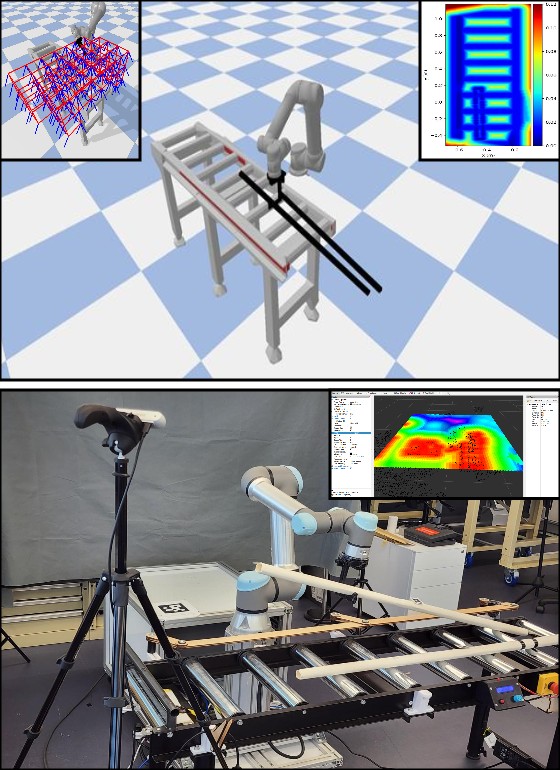
What they changed
Earlier Gaussian-process skill adaptation (GPRL) updates every via-point at once. That is a big action space, and credit assignment gets messy when a collision happens. Dist-GPRL instead:
- Updates overlapping local windows of via-points (15 via-points per axis, three windows of 5, one-point overlap).
- Multiplies raw policy outputs by the GP covariance so neighboring via-points move together.
- Biases exploration with a Hausdorff Approximation Planner safe subspace.
- Adds Euclidean distance-field penalties and a gradient-alignment reward so the hook veers toward clearance.
A cosine-similarity term tries to keep the demonstrated velocity profile. The authors are explicit: this is empirical safety, not a formal guarantee.
Numbers
Two PyBullet tasks on a UR5e: dynamic cube pushing (moving cube, moving obstacle, wall and plane) and dynamic bar manipulation. Object start poses vary up to 20 cm.
On cube pushing, Dist-GPRL reaches 89% success and 5% collisions. On bar manipulation, 98% success and 1% collisions. The paper says baseline GPRL posts the lowest success and the highest collision rates on both tasks.
Hardware, 10 bar-removal episodes with randomized bar poses, policy transferred one-shot using a live distance field (IDMP) and ArUco markers:
| Method | Success | Collision |
|---|---|---|
| GPRL | 10% | 70% |
| ProMP-RRL | 0% | 20% |
| Dist-GPRL-Global | 50% | 20% |
| Dist-GPRL | 90% | 10% |
Adaptation time per episode is about 19.3 ms on an i7-1185G7: 4 ms distance queries, 2 ms local GP, 0.5 ms policy, times three windows.
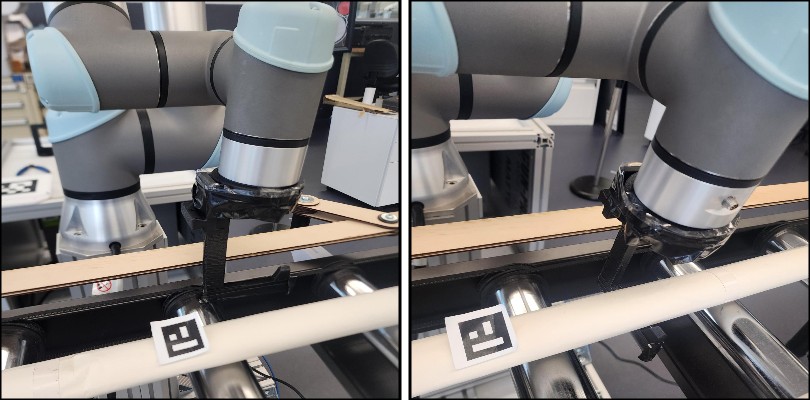
Limits: GP extrapolation can get jumpy near the end of a push; sensor noise is not in the current model; no constrained-RL safety layer yet.
A Human’s Take
Ninety percent on a real conveyor with a moving neighbor is the kind of number I will remember. Windowing the via-points is a small structural change that made the old GP adapter usable. I still want a hard stop when the distance field says zero, not just a nicer reward.