UPenn Turns Generated Contact Sound Into Force on a Franka
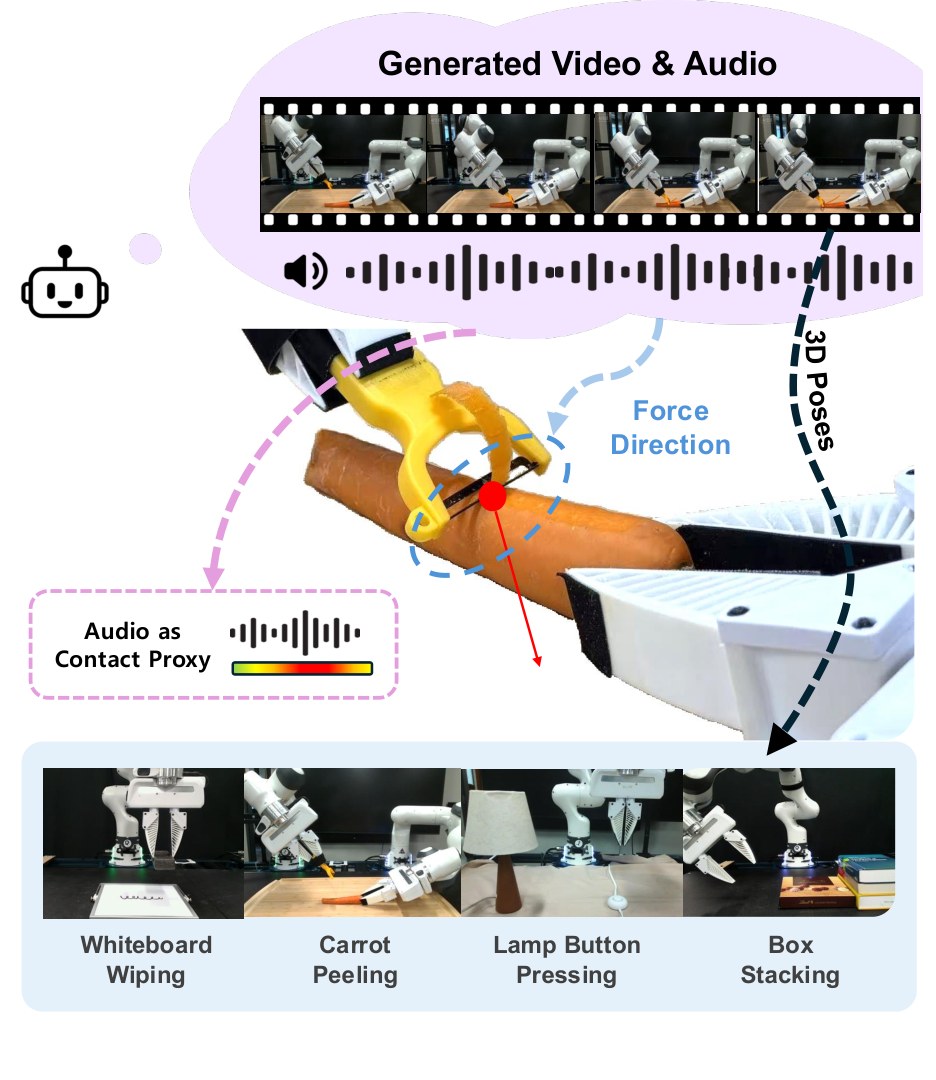
Video generators can now invent a robot wiping a board. Pull the gripper path out of those frames and you still do not know how hard to press. Guanhua Ji, Tianyu Li, and colleagues at the University of Pennsylvania’s GRASP Lab add the missing channel: the sound the generator makes when the tool hits.
arXiv:2609.19137 landed 16 September 2026 (v2 17 September). The project page is dreamingcontactsound.github.io. They run the result on a Franka Panda.
Loudness in, newtons out
Seedance 2.0 gets one RGB frame and a prompt that asks for a still camera and contact sound, not room noise. MolmoPoint, SAM 2, and TAPIP3D recover the gripper trajectory. SAM-Audio isolates contact. Loudness in LUFS is mapped into a bounded force profile with Fmax = 15 N (Franka’s default collision threshold is 20 N) and Fmin = 0.25 Fmax. A 1 kHz impedance controller (k = 2000 N/m) tracks pose; a 50 Hz regulator tracks force by moving a virtual target.
They do not claim the generated clip will sound like the real robot. Loudness is a relative shape, not a microphone on the wrist.
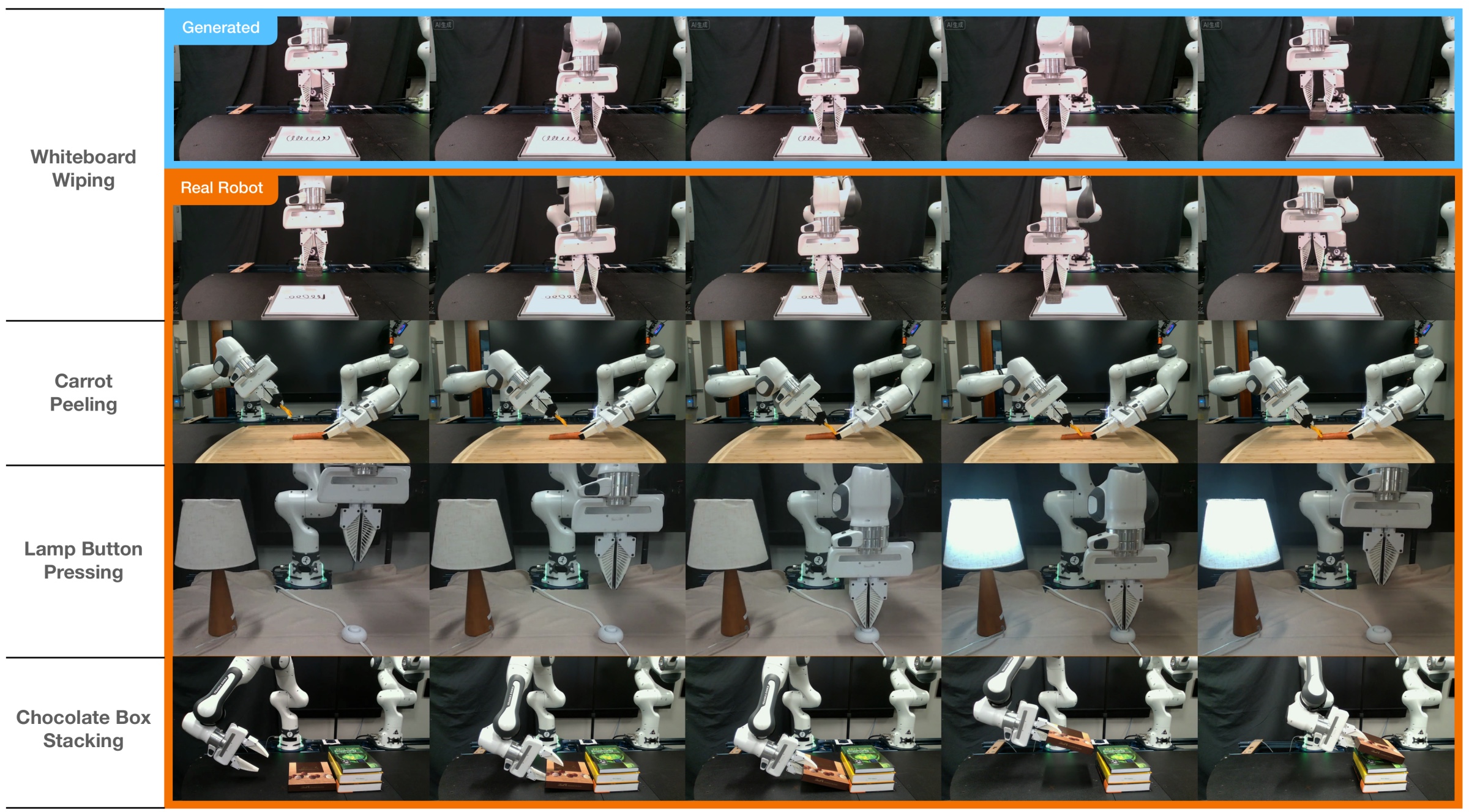
Four tasks, one kinematic baseline that mostly misses
Ten generated videos per task, same trajectories with and without force:
| Task | Kinematic only | Force-aware |
|---|---|---|
| Whiteboard wipe | 0/10 | 10/10 |
| Carrot peel | 5/10 | 9/10 |
| Box stack | 3/10 | 9/10 |
| Lamp button | 0/10 | 8/10 |
| Total | 8/40 | 36/40 |
Kinematic failures are the obvious ones: the eraser flies a few millimeters above the board, or the peeler slams the carrot. Chocolate-box stacking needed extra screening: 10 of 20 generated videos used a side grasp their parallel gripper cannot do.
On wipe and peel, a constant 15 N step at first contact overshoots toward the 20 N stop (2/10 wipe success). The audio-shaped profile ramps in. A hammer-strike prompt test kept the requested 5 N vs 20 N loudness order in 18/20 clips. That tests the generator’s following of a prompt, not a calibrated force sensor.
Then they trained on the rollouts
Fifty successful force-aware demos per task trained a Diffusion Policy. At test time there is no force regulator; contact comes from how deep the policy learned to push. Without force input: 29/40. With measured force as an extra observation: 34/40. Peeling is the odd one out: the force-input policy presses harder than the demos (peak 10.20 N vs 6.76 N) and goes 10/10.
The paper’s own limits: SAM-Audio can keep the wrong sounds, generation is slow enough that the scene must sit still, and a tuned constant force can look similar on a long wipe.
A Human’s Take
Using a made-up scraping noise as a force schedule is a weird idea that happens to beat “just replay the pixels.” The 8/40 to 36/40 gap is the result. I would not ship a peeler whose first contact is a 15 N step. I also would not pretend LUFS is a load cell. The useful product here is a data engine that labels force without a kinesthetic teaching session, as long as you keep a 20 N watchdog on the real arm.