This UR10e Puts a Jacket On You While You Wave and Check Your Phone
Most robot dressing papers freeze the arm. arXiv:2609.04759, posted 4 September by a Hong Kong Polytechnic University group with York and Great Bay University, lets the person move.
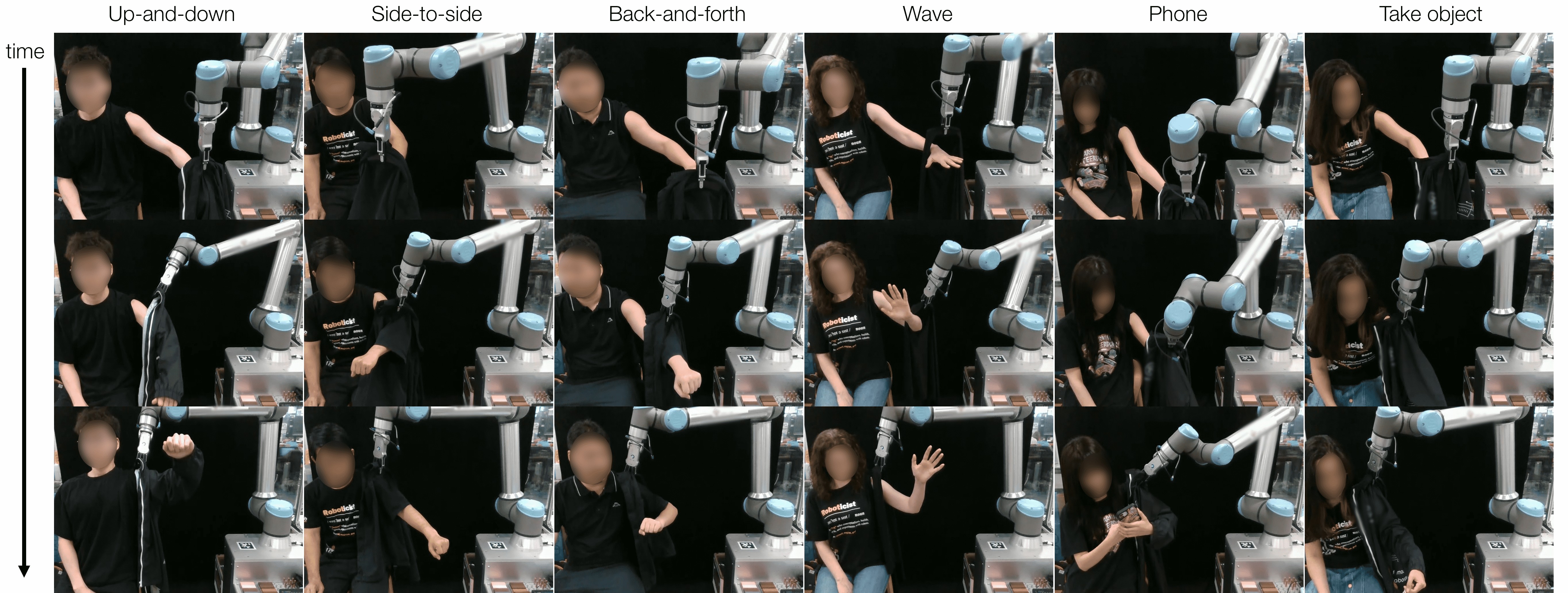
A UR10e holds the garment. After the sleeve is on the hand, the subject can wave, reach for a phone, or take an object. The policy still has to slide the sleeve to the shoulder.
Static demos, moving people
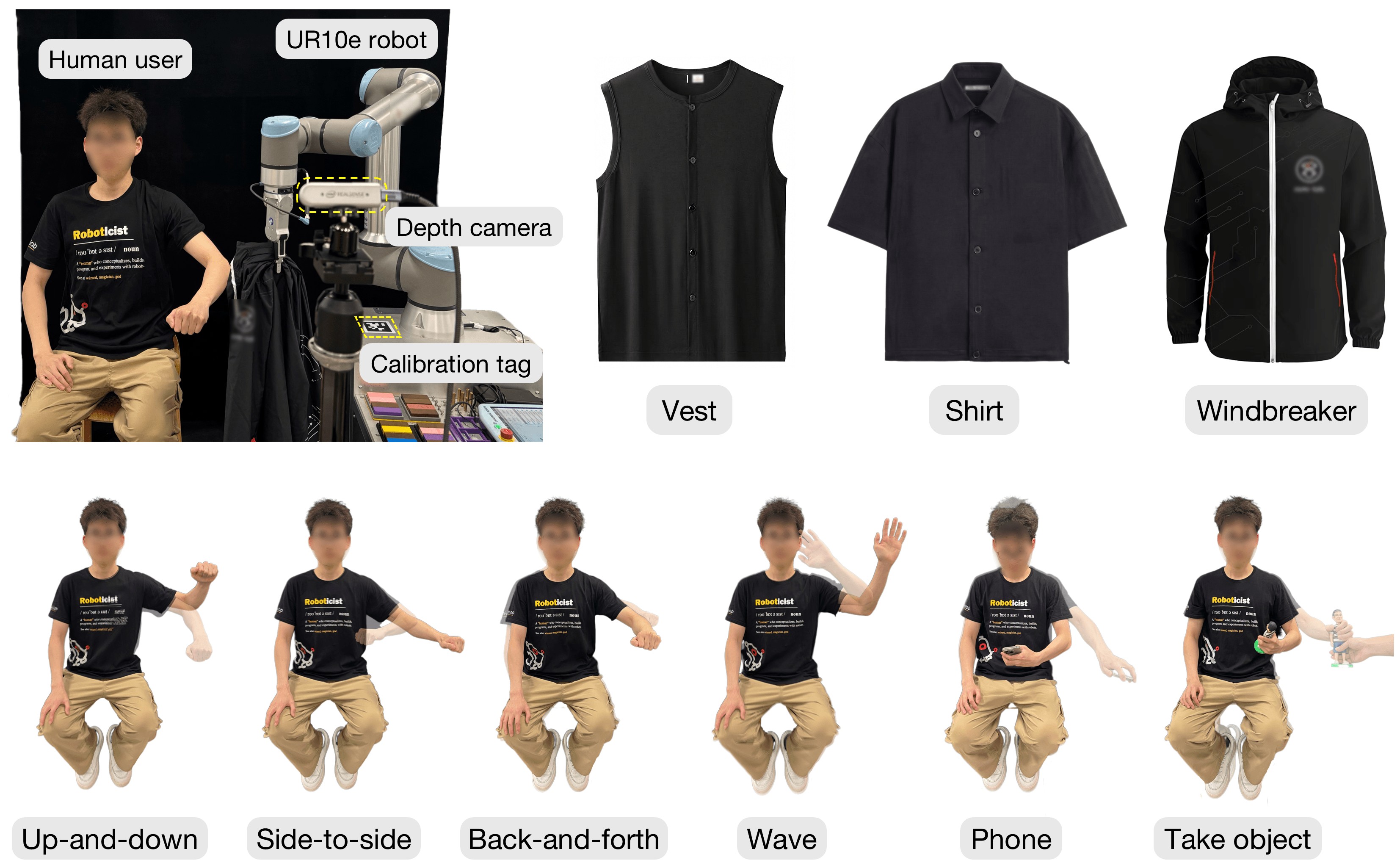
A diffusion policy learns from 210 SpaceMouse demonstrations on static arms with mixed poses. No sim-to-real: simulation and hardware use separate datasets. At runtime, a PDE-diffused scalar field on the arm point cloud picks the uncovered region near the sleeve, then GICP registers that patch frame to frame. The estimated transform warps the pending end-effector chunk. DDIM inference is under 50 ms and registration under 10 ms on an RTX 5070 laptop GPU.
Safety caps: 20 kg·m/s joint momentum, 120 N tool force. Camera is a RealSense D435i.
Nine participants (3 women, 6 men), heights 162–185 cm. Three garments: vest, shirt, windbreaker. Six motion patterns: up-and-down, side-to-side, back-and-forth, waving, phone use, object receiving. Each person ran 28 trials. 36 trials per method, 252 in all.
Overall dressing ratio 0.88 ± 0.105, sleeve-insertion success 89% ± 10.4%. Baselines (DP3, Diff-MPC, image diffusion, BC-LSTM, and an ablation without trajectory adaptation) trail on progress, freedom-of-movement ratings, and comfort. A capability sweep of 150 extra trials shows the policy thinning out at 80–100 cm swings and 0.8–1.0 Hz.
Simulation first
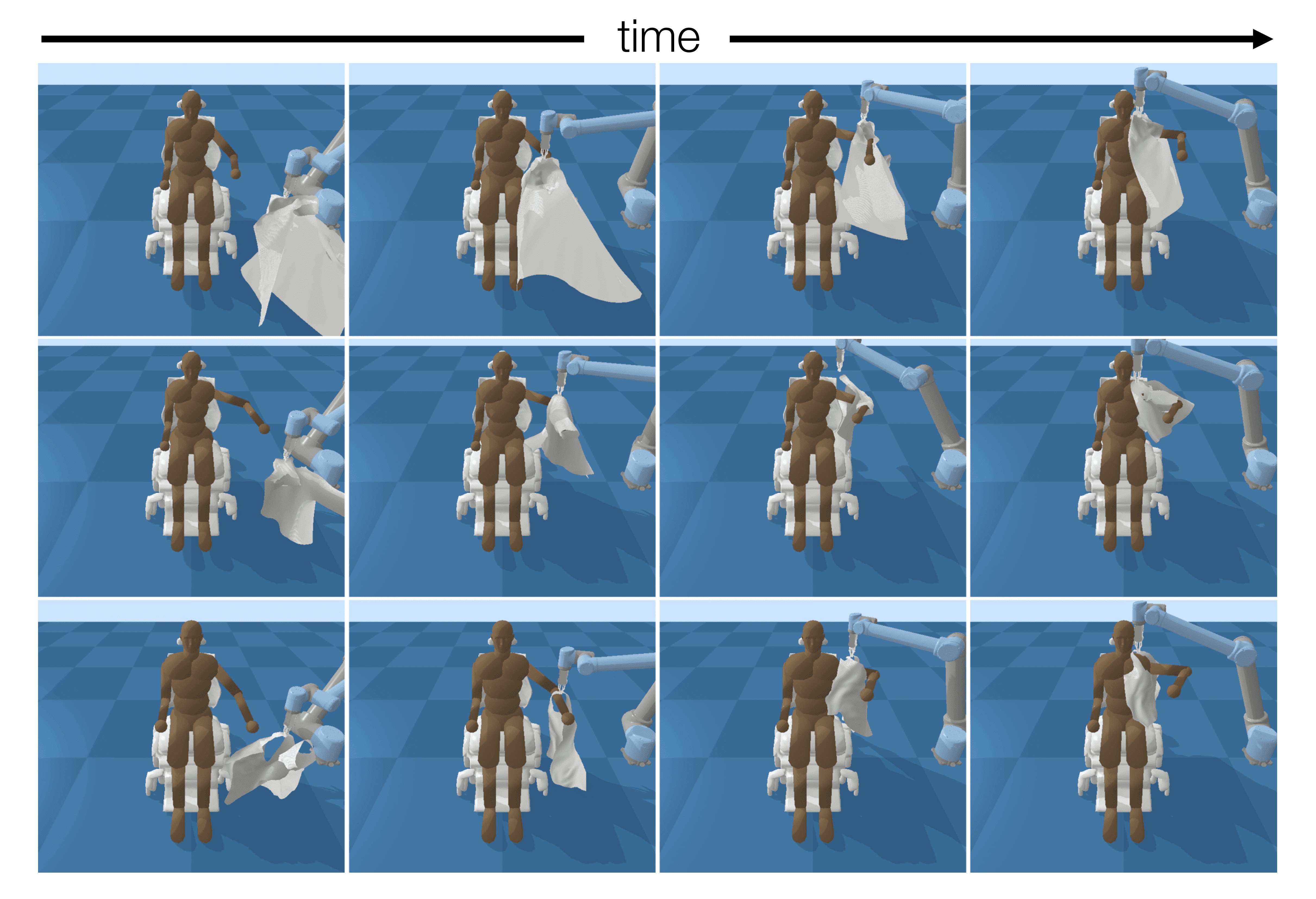
Assistive Gym, four body models, three Cloth3D sleeve types, ten motion patterns, three speeds including 2.0 rad/s. 180 teleop trajectories for imitation methods. Over 1,470 eval trials, the full method stays above 0.95 mean dressing ratio and insertion success even when the arm is moving. Without the adaptation module, insertion fails when the hand pulls away from the opening.
The robot is a cobot arm, not a humanoid. The contact problem is the same one a home humanoid will hit the first time someone shrugs mid-sleeve.
A Human’s Take
If you cannot dress someone who is fidgeting, you cannot dress someone who is tired. The 89% insert number is on scripted lab motions with a force cap, not a bedroom at 7 a.m. Still, teaching on still arms and adapting online is the right split. I would not put this gripper near a collarbone without the 120 N trip.