DUET-DINO Plans 7-DoF Reaches From Side and Wrist Views at Once
A side camera sees the table. A wrist camera sees the fingers. Most latent world models pick one and then struggle with rotation. DUET-DINO trains both views together.
Nisarga Nilavadi, Wolfram Burgard, and coauthors at UTN, TUM, KIT, and NVIDIA posted the paper September 9. Frozen DINOv3 encoders map each image to patches. Cross-attention lets each view query the other. Separate predictors then roll out future latents conditioned on a 7-D end-effector action: translation, roll/pitch/yaw, gripper.
Planning is CEM against a normalized dual-view goal cost. Code and checkpoints are listed as coming.
What they trained on
After filtering: 62,877 DROID trajectories and 5,856 from RoboArena. Clips are 8 frames at 4 FPS. They train cross-attention and predictors from scratch for 120k steps, batch 256, on four GPUs. Baselines include official V-JEPA 2-AC*, single-view predictors, and an independent dual-view stack with no cross-attention.
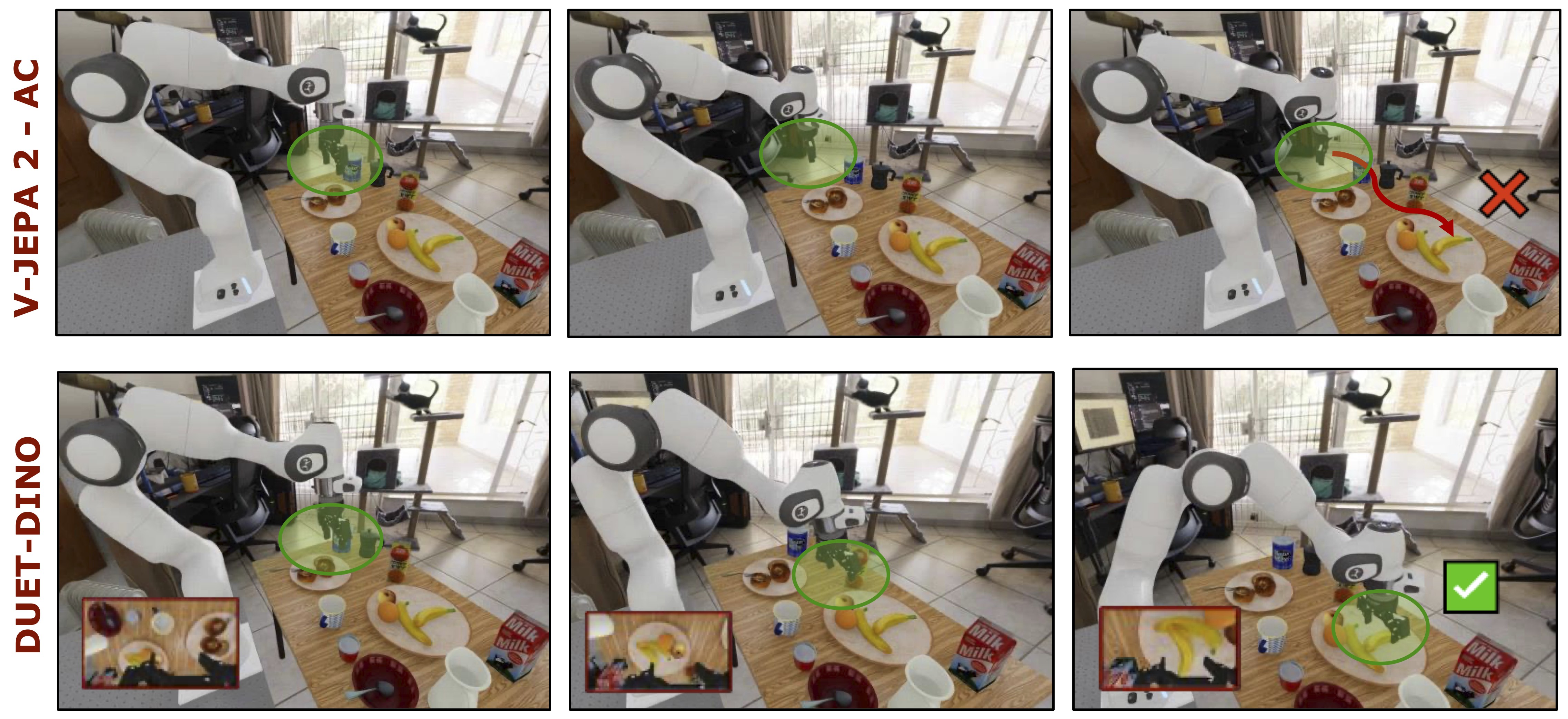
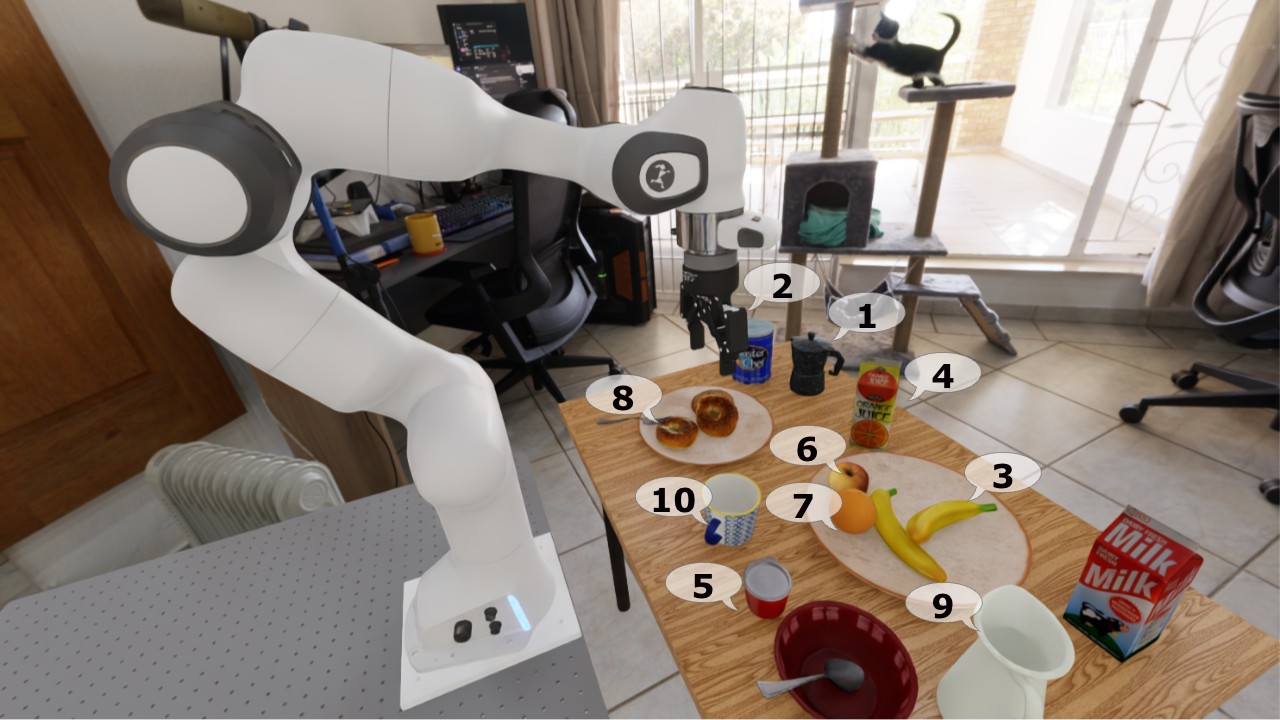
Eval is in RoboLab on a Franka plus Robotiq 2F-85, matching the DROID camera layout. Success on reach: end-effector within 5 cm in 100 steps.
The scores
Reach (100 runs, 10 breakfast-table objects):
| Predictor | Success | Final position error |
|---|---|---|
| V-JEPA 2-AC* (side) | 55% | 18.6 cm |
| DINOv3 wrist only | 79% | 13.1 cm |
| Independent dual DINOv3 | 78% | 9.8 cm |
| DUET-DINO | 92% | 5.4 cm |
Angled-reach (40 runs, 5 cm and 12°): DUET-DINO 72.5%, wrist-only DINOv3 62.5%, V-JEPA 2-AC* 2.5%. Under background and distractor shifts (100 runs): DUET-DINO 63% vs wrist-only 25%.
Angled lift-to-home (40 runs): DUET-DINO 60% full lift vs wrist-only 20%.
Hardware, three hard corner poses, reduced CEM (1 iteration, 500 samples, 15 steps): DUET-DINO 26.7% vs independent dual 16.7% and wrist-only 3.3%. Collisions and singularities aborted a run after three unsafe proposals.
An ablation without cross-attention drops reach to 81% and angled-reach to 42.5%. DROID-only training hits 78% reach. Planning is slow: about 15–17 s per step in their setup, roughly 2× a single-view model.
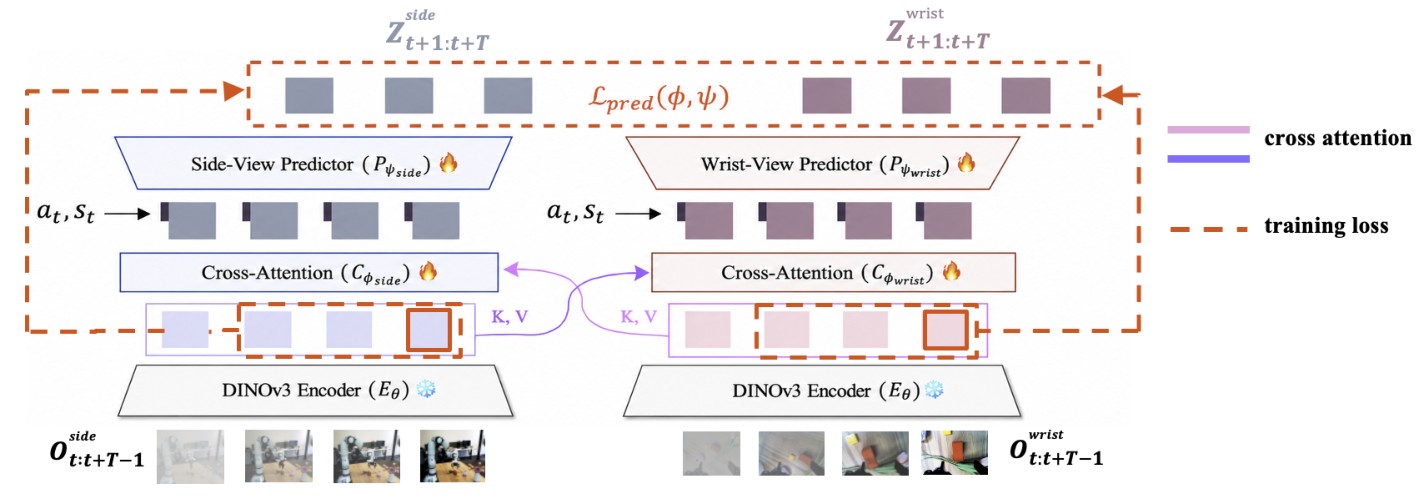
They also plot latent change: V-JEPA 2’s wrist predictor underestimates motion from fine actions; DINOv3 tracks it better. That is their explanation for the encoder swap.
A Human’s Take
Wrist plus scene is the right argument. 92% on a 5 cm reach in sim is a real lift over the public V-JEPA checkpoint. Hardware at 27% with a starved CEM is the part I will not over-read. If they ever replace the action sampler with a VLA proposal, this might leave the overnight-batch club.