Duke Humanoid V2 Aims Two Cameras So Reach Is Not Blind
A robot can put a hand on a cube it cannot see from that pose. Then it has to twist the torso, walk, or guess. Boxi Xia, Boyuan Chen, and colleagues at Duke University treat that as a design bug, not a planning bug.
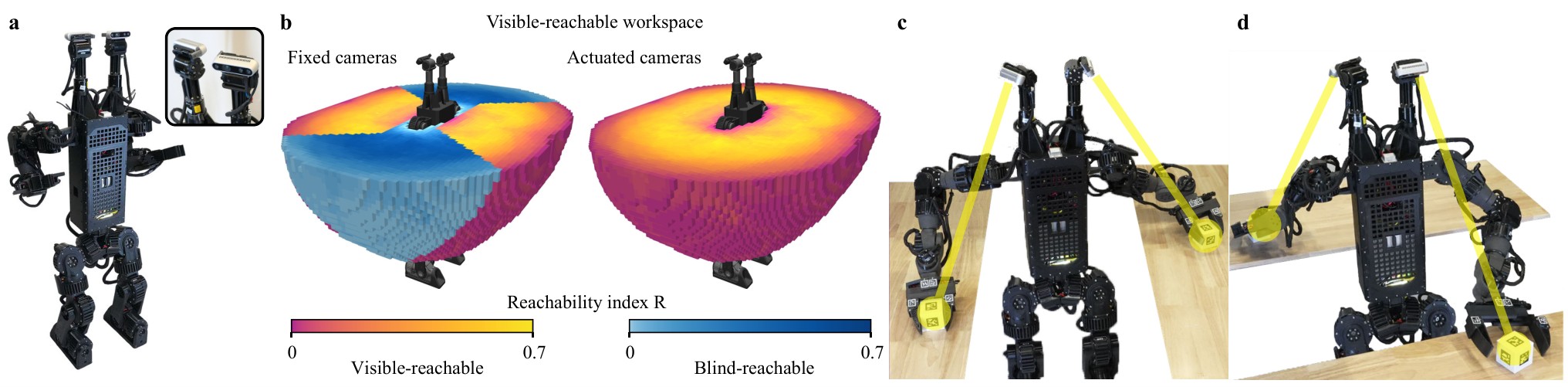
Their September 8 paper introduces the visible-reachable workspace (VRW): keep only the arm-reachable points that an onboard camera can also observe from a feasible reaching configuration. They built Duke Humanoid V2 to measure it.
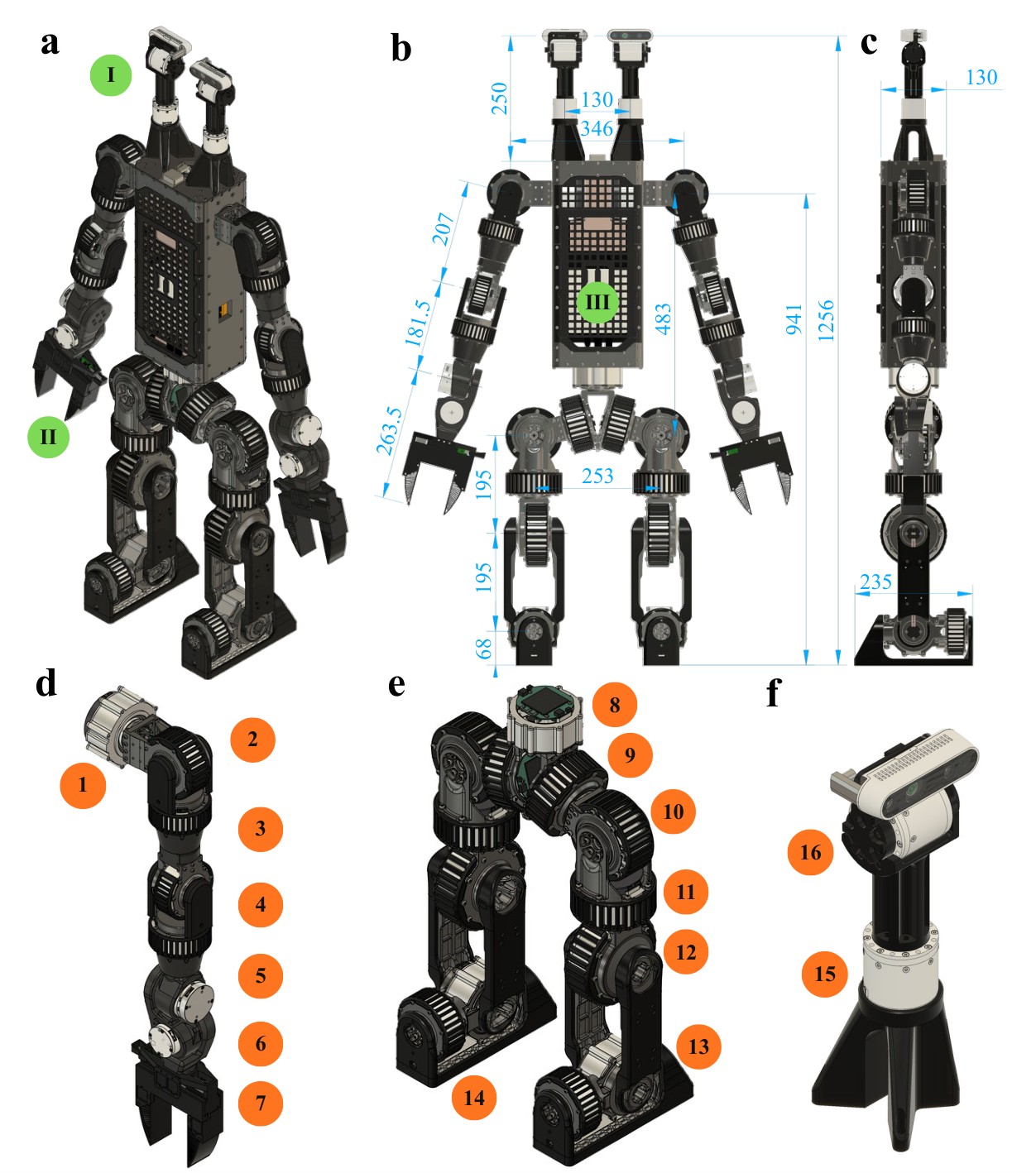
The body is 31 DoF: waist, two 6-DoF legs, two 7-DoF arms, plus two 2-DoF camera gimbals. Parallel grippers add another actuated joint each. It stands 1.2 m, weighs 36 kg, and has a 0.46 m arm reach. Each camera module is an Intel RealSense D436 (90° × 65° RGB, 0.1–3.0 m range) on an independent yaw-pitch gimbal. Camera yaw ROM is ±270°.
The number that moved
On the same robot, actuating the cameras raises visible-reachable coverage from 38% to 97%. Pairwise coverage — can it watch two separated regions at once — goes from 0.45 with one independent camera to 0.95 with two. A third camera only reaches 0.97, while adding 0.58 kg, two gimbal DoF, and $600. They shipped the two-camera layout.
They also ran the same geometric test on other models (camera FOV from published specs or a shared 90° × 65° stand-in). Under that protocol, a fixed-head Unitree G1 sits at 16% visible-reachable. Neck-actuated platforms (PAL Talos, Booster T1, Fourier GR-3, Apptronik Apollo) land between 48% and 76%. None of those can aim two views independently.
Time and energy, not just a heatmap
In a simulated two-target reach-and-grasp (30 trials per scenario, six layouts including a person holding one cube), the dual-actuated setup cut mean completion time 17% and mechanical energy 19% versus the same robot with cameras locked. Success stayed high across configs, 0.967 to 0.994. Search time dropped because the head moved instead of the feet.
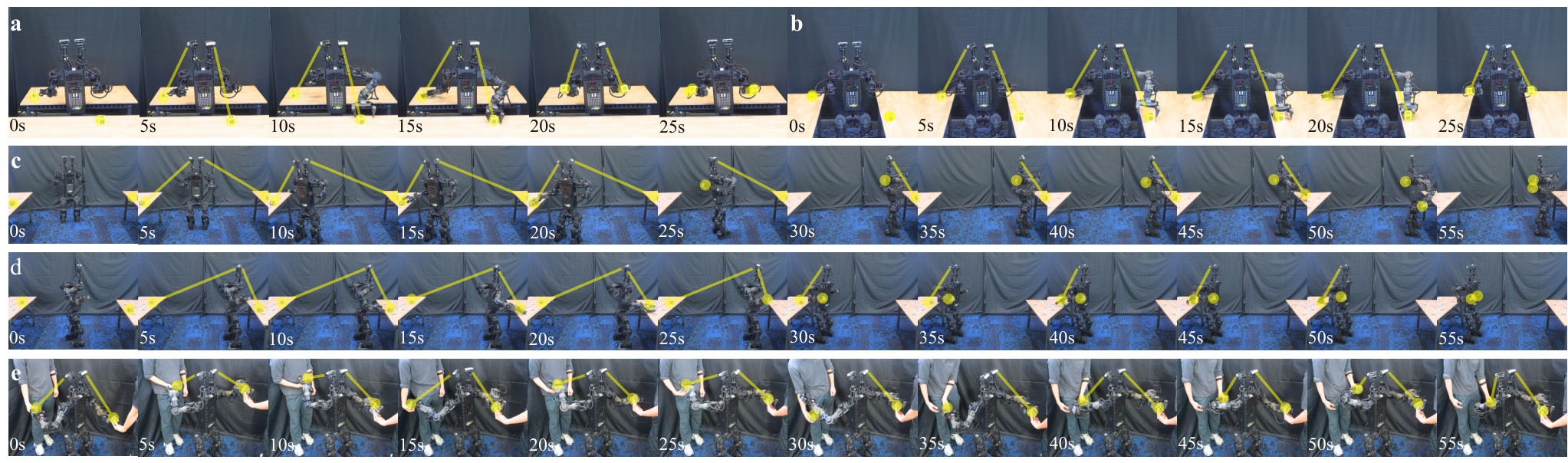
Hardware demos repeat front/back and left/right tabletop grasps without reorienting the body. Far targets still require a walk. A fifth sequence tracks two objects carried by two people; if an arm occludes a target, that camera searches and reacquires.
The control stack is a 50 Hz whole-body residual policy (FlashSAC) with 200 Hz PD tracking, trained in 4,096 parallel environments. They say software and the hardware design will be open-sourced. Project page: generalroboticslab.com/DukeHumanoidv2.
A Human’s Take
Copying a human head is a local maximum if the job is two benches at once. Independent gimbals are an ugly, correct answer: spend a little mass so the torso does not have to pirouette for a second view. I want to see the open CAD and whether those cameras stay calibrated after a week of walking. Until then, 38% to 97% is the kind of design delta you can actually budget.