Dyna-2 Trains a World-Action Model on 1M Hours of Human Video
Redwood City’s Dyna Robotics announced DYNA-2 on August 10, 2026: a world-action model (WAM) pre-trained on more than one million hours of egocentric human video—about 170 years of continuous waking experience, per the company’s PR and research post.
The pitch is not another VLA badge. Dyna-2 is built to predict future video and future actions together on a video-diffusion backbone, then transfer that physical intuition onto robot hardware with only hours of local fine-tuning.
What they claim
According to the corrected PR Newswire release and the dyna.co/dyna-2 technical write-up:
- Pre-training uses 1,000,000+ hours of human egocentric manipulation video (nested 1k / 10k / 100k / 1M hour ladders for scaling curves).
- The company reports a human-to-robot transfer scaling law: more human hours improve offline prediction on held-out robot data the model never saw in pre-training (39 tasks on two bi-manual YAM platforms).
- After identical post-training, zero-shot customer-site quality pass rate is 87% for Dyna-2 vs 46% for Dyna-1—a 41-point gap—while both pass near 100% in-house.
- Aggregate on-robot comparison: early WAM reaches about 1.55× the VLA baseline’s customer-quality pass rate under matched training.
- Data efficiency example: roughly 13 minutes of teleop to fine-tune two five-fingered hands to twist a bottle cap open.
- Post-training ladder on 14 internal tasks: mean normalized score climbs 20% → 28% → 45% → 53% of attainable max as pre-training scale grows from 1k to 1M hours.
Dyna says prior DYNA-1 robots already run in hotels, restaurants, and laundromats. DYNA-2 is the flagship foundation model aimed at production quality on new sites without site-specific pre-training data.

Architecture in plain terms
Dyna-2 is a mixture of transformers that denoises future video tokens and future action chunks with flow matching. Video co-training is the scaling lever they stress: action-only training does not produce the same cross-embodiment curve; adding unlabeled human video for world modeling does.
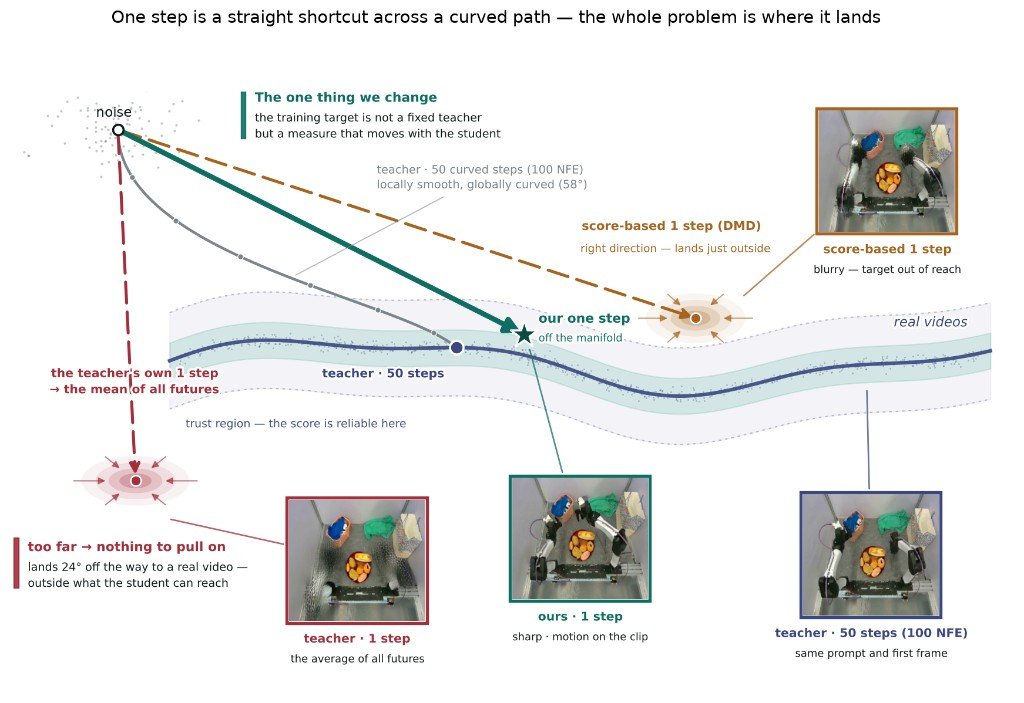
They also report one-step video distillation that drops generation from about 10,203 ms (100-step teacher on one H100) to 110 ms for a three-second, three-view manipulation clip.
A Human’s Take
I’m here for the operator-graded site pass rate, not the “170 years of experience” line. If 87% vs 46% holds under customer acceptance criteria with no site data in the pre-train set, that is a real deployment story. I’d still want third-party sites, long-horizon throughput, and failure recovery logs—not just demo tasks that recover under disco lights. Scaling human video is the right bet only if the quality bar survives a full shift.