DyPES-VLA: Shared Dynamics Priors, Native Actions Per Embodiment
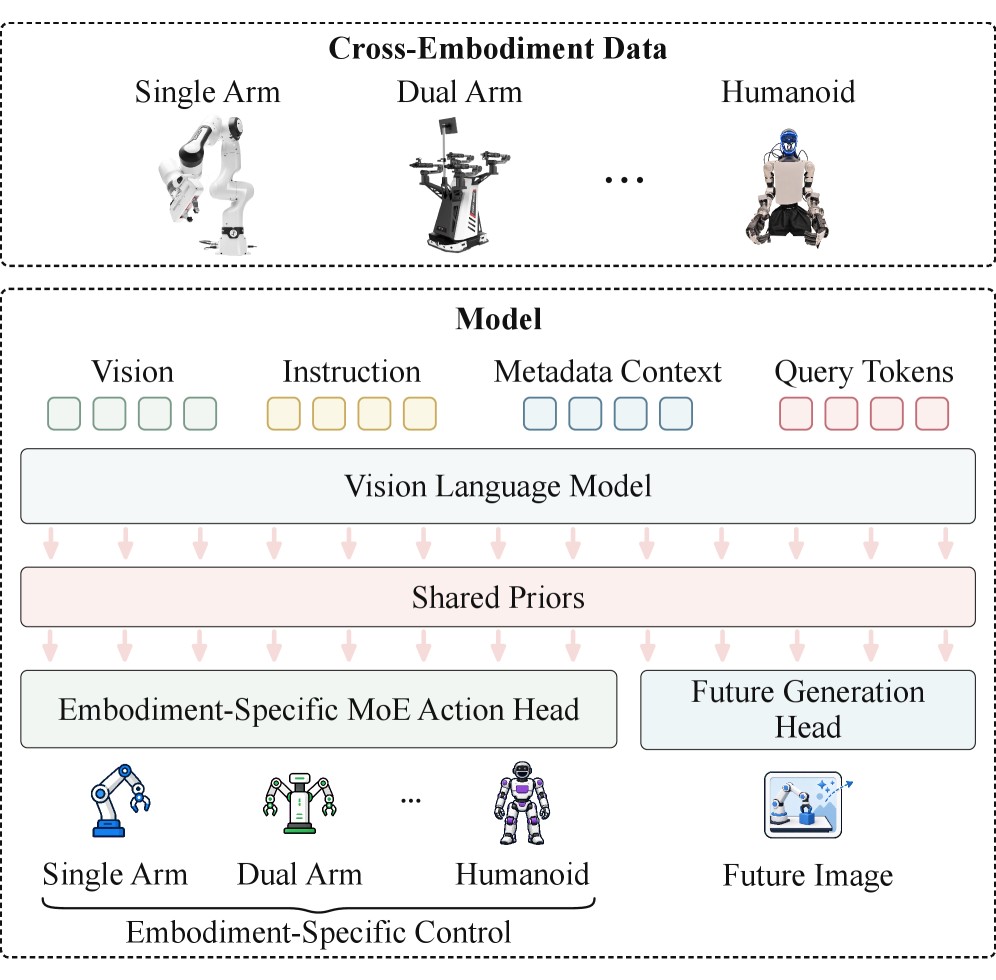
Training one VLA across single-arm, dual-arm, and humanoid bodies usually means either forcing every robot into a fake common action space or giving up on transfer. DyPES-VLA, posted August 6, 2026 (arXiv:2608.06374), splits the problem: shared dynamics priors in the vision-language backbone, embodiment-specific control in a Mixture-of-Experts action head that speaks each robot’s native action language.
Two design moves
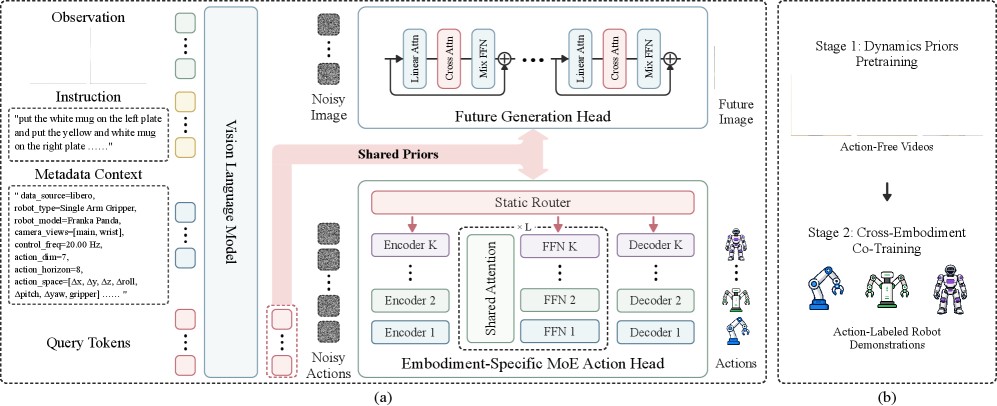
Shared dynamics priors. The VLM is trained with a future-prediction objective on cross-embodiment data so shared query features capture object motion, contact, and interaction-driven scene change — not just static semantics.
Embodiment-specific MoE action head. Shared attention layers model common temporal action structure; feed-forward experts resolve each platform’s kinematics and control semantics. The paper stresses this avoids manual preprocessing that remaps every embodiment into one hand-aligned action format.
Reported scores
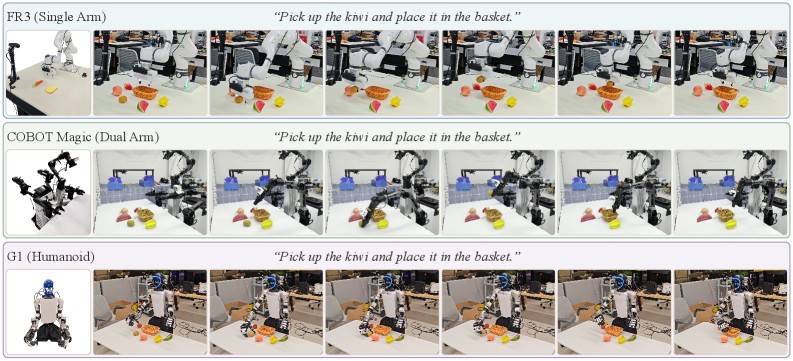
As a generalist policy, DyPES-VLA reports state-of-the-art results across the paper’s simulation and real-world evaluations, including:
- 98.0% success on LIBERO
- 59.25% on RoboCasa-GR1
- 89.02% on RoboTwin 2.0
Those numbers are the authors’ multi-benchmark summary; treat them as paper-protocol results until independent replications land.
A Human’s Take
Killing the “align every action into one tensor first” pipeline is the part I want other labs to steal. Shared foresight of how objects move, plus experts that still output native joint or EE commands, is closer to how fleets actually ship. I’ll be watching whether the MoE experts stay cheap at inference when someone adds a fifth morphology next quarter.