EATR-Stereo Lets a Head-Cam Humanoid Keep the Other Eye
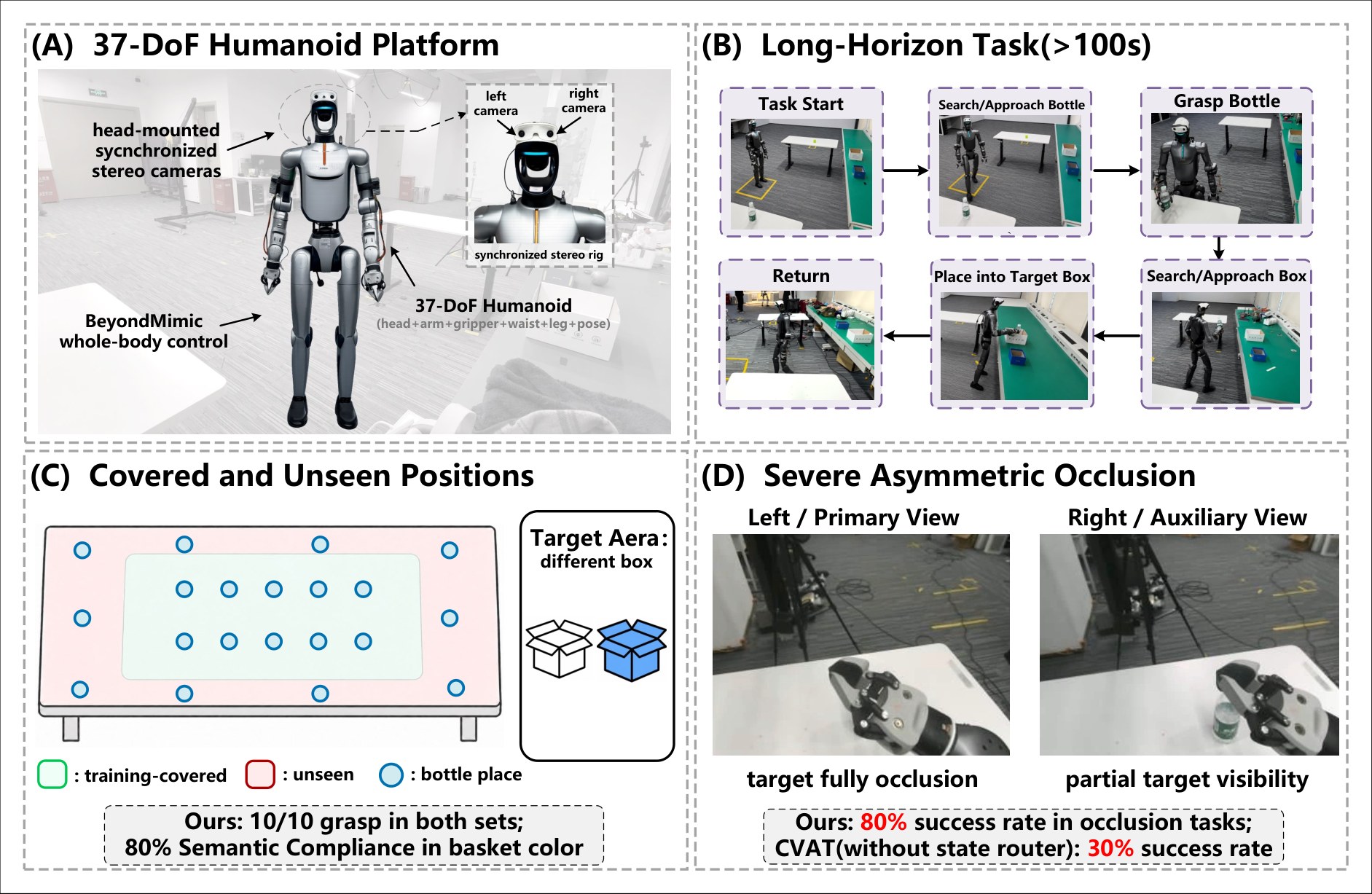
A humanoid’s head cameras bounce with every step. One view gets a hand in the way; the other still sees the bottle. EATR-Stereo, from Harbin Institute of Technology and Honor, is a token-routing add-on that keeps the pretrained primary view and only pulls in the paired stereo frame when the body says it would help.
On a 33-DoF HONOR Omega 1.0 with a 37-D proprioceptive state (33 joints plus a 4-D base quaternion), the paper reports 60.0% full-task success, 100.0% grasp success, and 80.0% stage success on search–approach–grasp–place–return jobs that last more than 100 seconds.
How the routing works
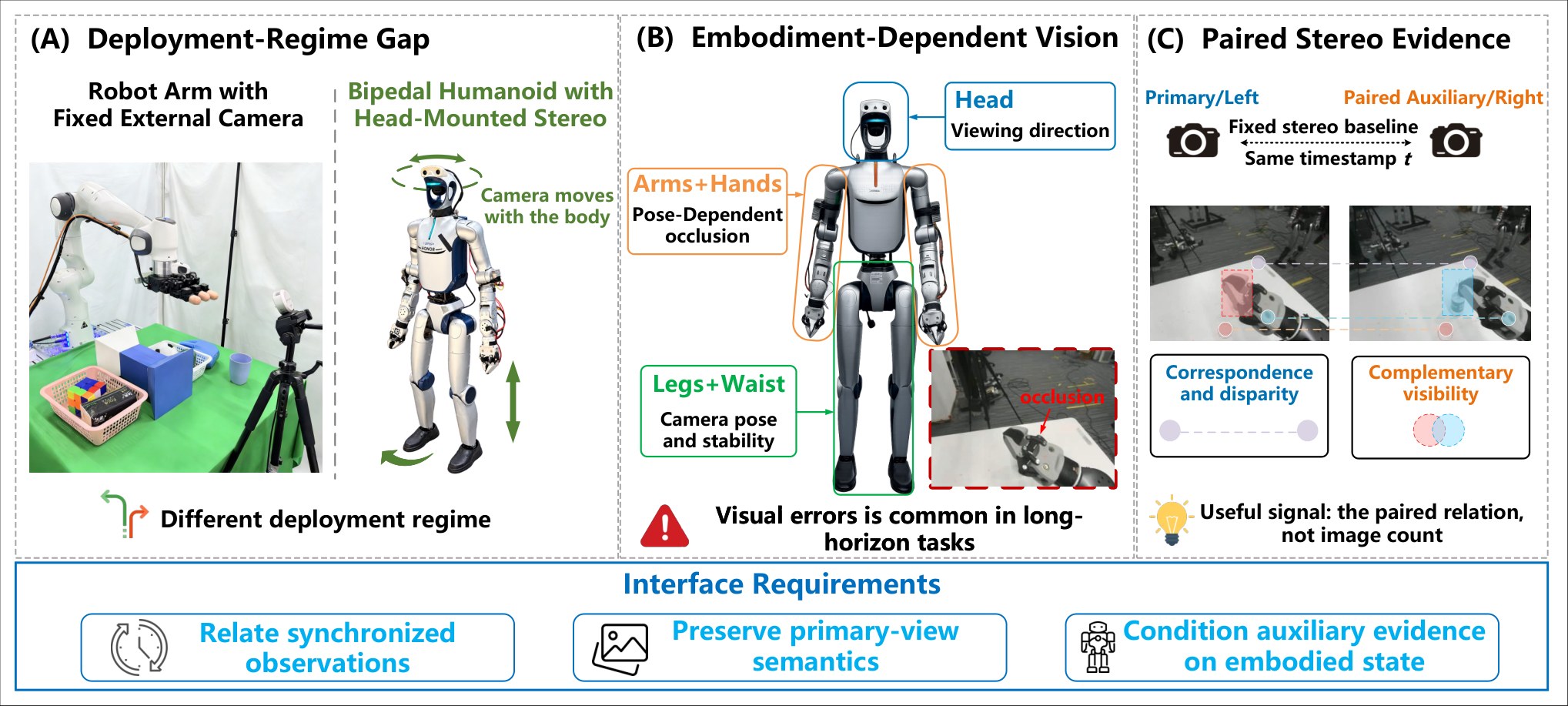
The authors freeze a Cosmos vision–language model inside GR00T N1.7. Primary-view tokens stay in the original pathway. The other camera becomes Cross-View Auxiliary Tokens (CVATs) by querying the synchronized auxiliary sequence. A body-segmented encoder (legs, arms, head, waist, pose) then gates those tokens token-by-token.
They trained nine configurations on 1,000 segmented-task demonstrations for 60,000 steps. Policies run at 10 Hz on an RTX 4090 and emit 30-step action chunks, stitched with a local cubic B-spline.
What beat the baselines
Over 180 physical trials (20 per method, split in-distribution / unseen bottle positions):
- EATR-Stereo: 12/20 full-task (60%), 20/20 grasps
- StereoPolicy on the same backbone: 45% full-task, 85% grasp
- Default two-image GR00T: 35% full-task
- Monocular GR00T: 35% full-task, 55% grasp
Under severe asymmetric occlusion — bottle gone from the primary view, still partly visible in the auxiliary — recovery hits 80% (8/10) in 22.4 s mean, versus 30% for CVAT without the body router.
Training cost stays close to frozen GR00T: 10.95 hours versus 10.35 hours on 16 H20 GPUs. An estimated-depth VLA that fine-tunes four VLM layers reached the same 80% stage rate in 41.8 hours.
In RoboCasa365 simulation (18 tasks, 360 trials, no wrist cameras), EATR-Stereo led at 43.33% (156/360).
A Human’s Take
Stereo on a biped is mostly a self-occlusion problem. Hands, torso, and gait keep eating the primary frame. Routing the spare camera instead of fusing it into mush is the part I would steal.
One hundred percent grasp on twenty trials is a lab number, not a warehouse number. I want the same routing on a longer shift, with the bottle behind a moving coworker instead of a staged hand.