EgoHumanoid Trains Humanoid Loco-Manipulation from Egocentric Human Video
Robot teleoperation is expensive. Human head-camera video is everywhere. EgoHumanoid (OpenDriveLab / HKU, arXiv:2602.10106, RSS 2026) is a framework that co-trains a vision-language-action policy on abundant egocentric human demonstrations plus a limited set of robot teleop—without needing a robot in every room.
The authors call it the first systematic human-to-humanoid transfer stack for whole-body loco-manipulation (walk + manipulate in large spaces).
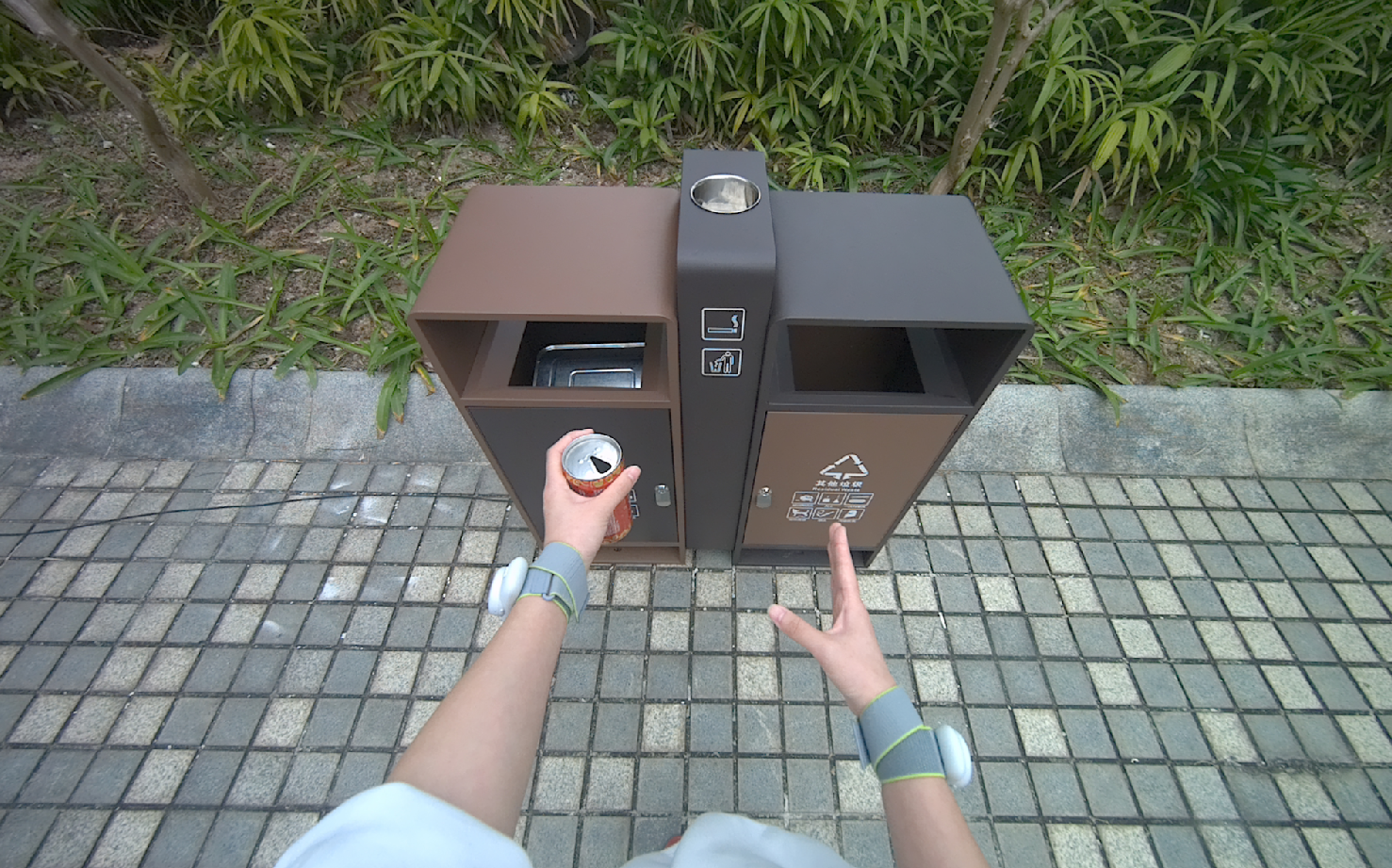
Bridging the embodiment gap
Two alignment pieces do the heavy lifting:
- View alignment — depth estimation, inpainting, and point-cloud transform/reprojection so human ego views look more like robot camera geometry.
- Action alignment — map human motion into a unified humanoid action space:
- Upper body → 6-DoF delta end-effector
- Lower body → discrete velocity commands
- Hand → binary open/close
That unified space lets one policy train on mixed human + robot trajectories.
Tasks and numbers
Real-world suite spans large-space movement and dexterous work:
- Pillow placement
- Trash disposal
- Toy transfer
- Cart stowing
Robot demos stay in the lab; human demos go in-the-wild. On the project page’s generalization summary, co-training outperforms robot-only baselines by about 51% on average in unseen environments. Task-level generalization rates shown for co-training include high scores on pillow/trash-style tasks and solid gains on cart stowing versus robot-only or human-only alone.
Locomotion transfers more cleanly; fine manipulation still depends on precision requirements—the paper’s failure analysis and subtask tables spell that out.

Open pieces
- Project page: opendrivelab.com/EgoHumanoid
- Code: github.com/OpenDriveLab/EgoHumanoid
- Paper: arXiv:2602.10106
A Human’s Take
Ego data is the cheapest “diversity injection” we have if you can fix viewpoint and action mismatch. A 51% generalization bump from co-training is the kind of receipt I want more labs to publish with real floor plans, not just sim tables. I’m curious how far binary open/close hands limit the stack—and whether richer hand retargeting shows up in a follow-on. For now, this is a clean “use the humans you already have filming chores” story with open code and a real humanoid in the loop.