3D-Printed EIT Skin: Geometry-Scalable Touch for Humanoid Surfaces
Dense taxel arrays get expensive when you try to wrap a whole humanoid. A multi-lab team (Czech Technical University in Prague, CU Boulder, Eindhoven University of Technology) posted a different route on August 3, 2026: a 3D-printed conformal EIT tactile skin that localizes contact from a continuous conductive layer instead of a grid of discrete sensors (arXiv:2608.02080).
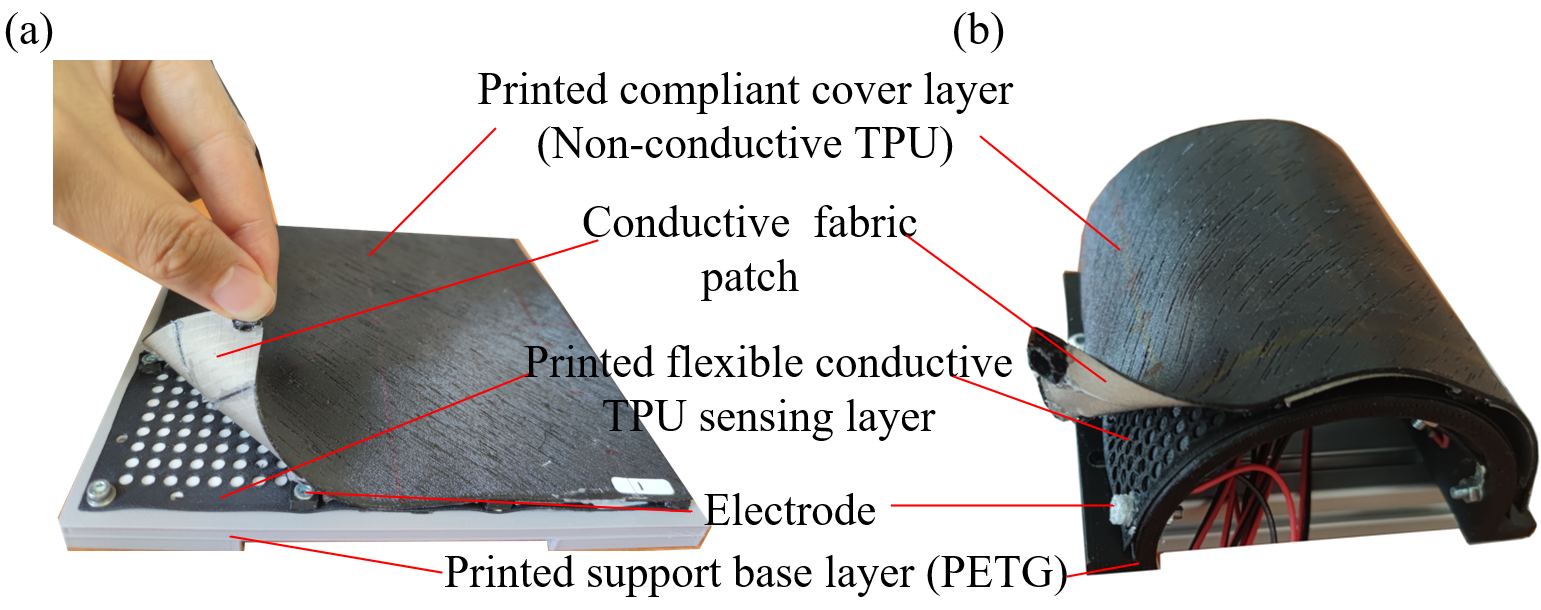
How the stack works
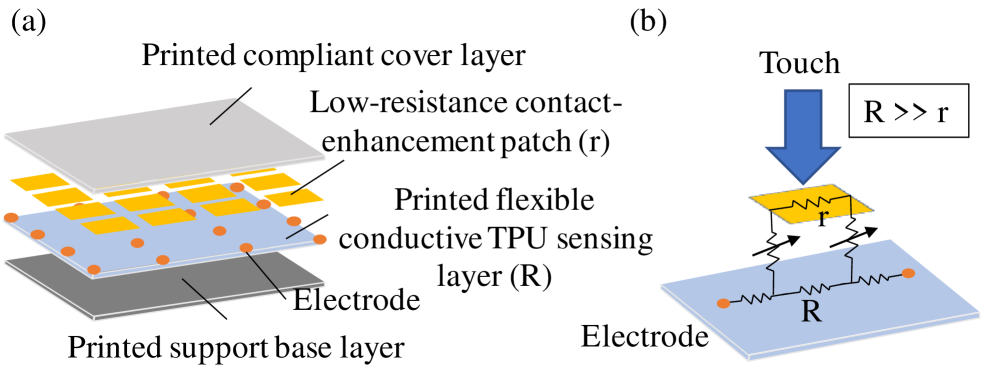
The skin is a layered print: flexible conductive TPU as the sensing domain, conductive fabric contact-enhancement patches, a printed support base, and a compliant cover. Touch increases coupling between the low-resistance patches and the higher-resistance TPU layer. Boundary voltage changes across 16 electrodes are reconstructed with a one-step Gauss–Newton electrical impedance tomography solver.
Key design choices from the electromechanical study: fabric patches beat printed conductive TPU or spray for sensitivity; 0.4 mm sensing thickness balances response and printability; moderate porosity in the TPU layer helps without wrecking the print.
Results that stick
- Planar sensor: localization tightens with force; at higher loading levels mean error falls to about 6 ± 3 mm (loading indices 11–13; measured forces roughly 1.5–16 N across the sweep).
- Curved U-shaped sensor (40 mm radius, 100 mm length): 6 ± 4 mm mean localization error over 18 contact positions, no supervised post-processing.
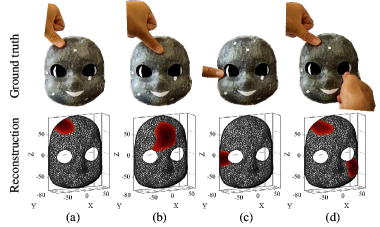
- iCub-face geometry: qualitative proof-of-concept reconstructions near touch locations (fabrication tweaks needed for high curvature).
Multi-contact demos on the planar pad show distinct hotspots for one, two, and three simultaneous contacts, with the expected blur of a diffusive imaging modality.
A Human’s Take
Whole-body touch is one of those unsexy bottlenecks that makes humanoids safer around people. Printing the skin geometry from CAD instead of hand-wiring thousands of taxels is the kind of manufacturing shortcut I want more of. Six millimeters on a curved patch is not fingertip resolution — and the authors say so — but it’s a real path to torso- and face-scale coverage. Follow-ups I care about: fully printed electrodes, hysteresis under repeated contact, and a controller that actually uses the map to soft-stop a fall.