ergoCub Won’t Drop the Box Until You Mean It
A humanoid holding a package has to know the difference between a real take and a bump. Pasquale Marra, Stefano Berti, Gabriele M. Caddeo, and Lorenzo Natale at the Italian Institute of Technology (with the University of Genoa) fine-tune NVIDIA Isaac GR00T N1.5-3B on that problem. The paper, arXiv:2609.05282, went up 4 September 2026.
The robot is ergoCub. Both hands wear Xela fingertip taxels. The prompt is “Get the box and pass it to human.”
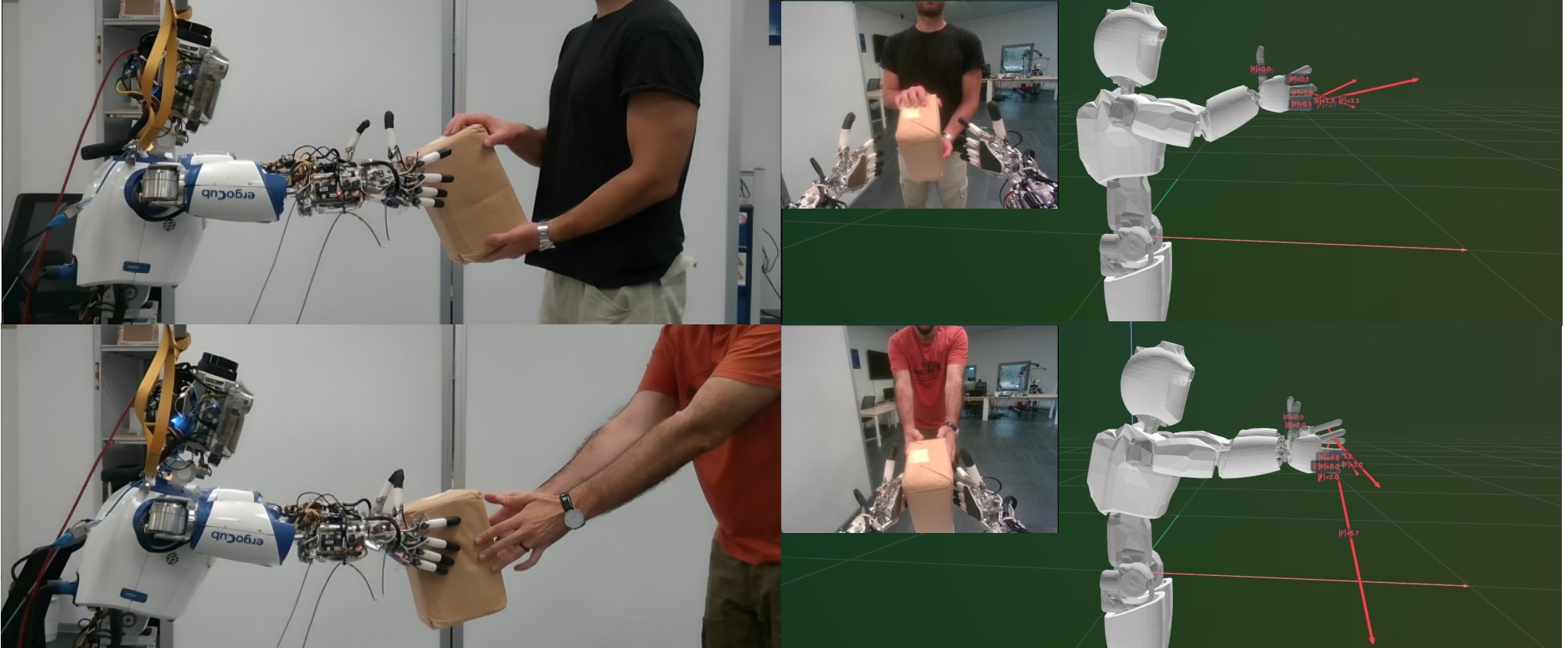
Tactile history plus a soft arm
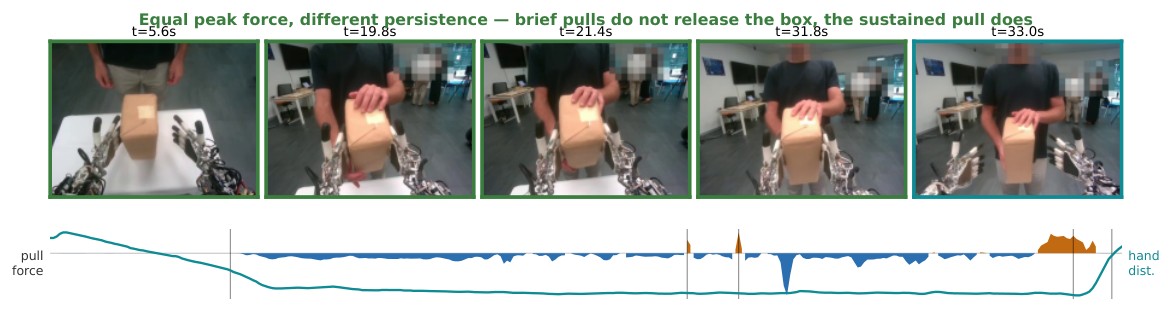
Vision alone cannot tell a sustained pull from a tap. The policy runs at 10 Hz; the taxels run near 70 Hz. The authors pack about 0.9 s of three-axis fingertip forces into a 24-dimensional Temporal Tactile Encoding (TTE) instead of a single-frame force vector.
A compliance layer yields the hands along measured fingertip forces (Kp=50, Kd=40) before the torso-and-arms inverse-kinematics controller. GR00T still outputs 16-step Cartesian chunks; they execute the first 8.
Eight people gave 50 teleop demos each (25 with compliance, 25 without) on a Meta Quest 3. Then 10 new participants ran 10 trials per policy: five release-expected, five hold-expected. Three policies:
- P1: TTE + compliance
- P2: compliance, no tactile
- P3: TTE, no compliance
The scores
Over 300 scored trials:
| P1 (full) | P2 (no tactile) | P3 (no compliance) | |
|---|---|---|---|
| Success | 93% | 54% | 82% |
| Success with 2.8 s release window | 92% | 45% | 80% |
| Median release delay | 1.70 s | 2.35 s | 2.00 s |
| Peak pull force | 4.07 N | 4.67 N | 4.74 N |
| Satisfaction (1–7) | 6.2 | 3.3 | 4.7 |
| Ranked first / safest | 9 / 10 | 1 / 0 | 0 / 0 |
P3 dropped the box in 4% of its trials — the only policy that did. Instantaneous force (an earlier ablation) false-opened 51 times on a held-out “challenging” set; TTE did it 3 times and never held a false opening longer than 1.5 s.
T9, short impulsive pulls at genuine-take magnitudes, is the hard case (P1 at 60%). Code and data are promised after acceptance.
A Human’s Take
Release timing is the whole job. Tactile history decides; compliance makes the hand-off feel less like a tug-of-war. 93% with naive users is the number I will remember. I still want this on an object that is not a cardboard box, and I want the thumbs in the sensor set. Four fingers per hand is a start.