ErgoSurf Covers Surfaces It Has Not Seen Yet
Surface work — inspect, clean, sand, polish — needs two things at once: cover the right places and stay in contact. Most ergodic controllers assume you already have a mesh or a vision scan. ErgoSurf (arXiv 2608.06208, DLR / TUM) drops that assumption: the robot learns geometry from touch while covering.
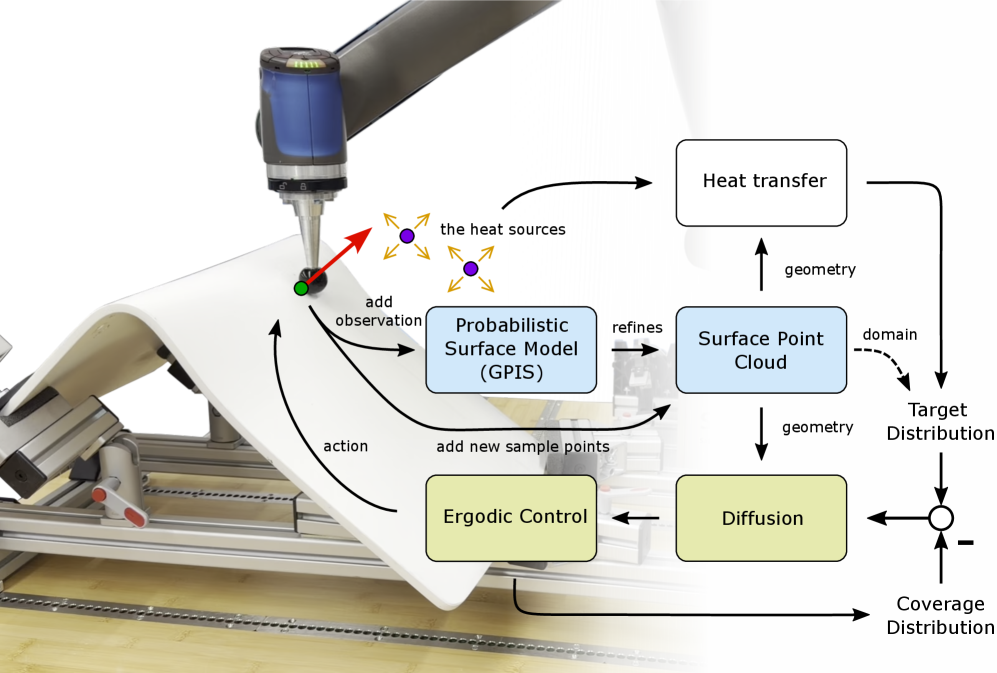
The circular dependency they attack
Ergodic control spreads time on a surface proportional to a task distribution. Classic methods need the domain first. Vision pre-scans fail on transparent, shiny, or occluded parts. ErgoSurf’s claim: first system that runs ergodic control on a domain reconstructed online.
Dual surface representation
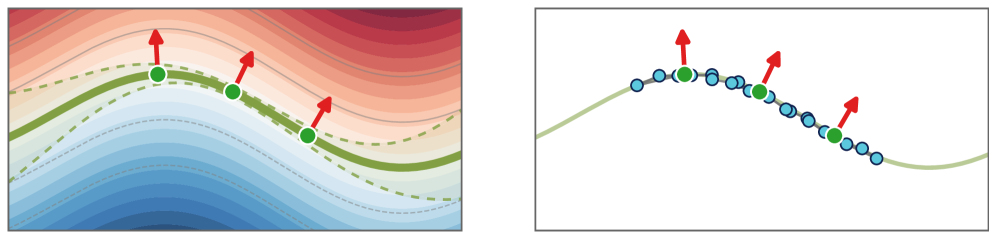
- Global GPIS (Gaussian Process Implicit Surface) — continuous signed-ish field with normals and uncertainty, updated from contact points and normals extracted from dynamically decoupled contact wrenches (momentum-based observer on DLR hardware).
- Local tangent-plane point cloud — samples around contacts, projected onto the GPIS zero set, used as the lightweight domain for target/coverage distributions (avoids full marching cubes every step).
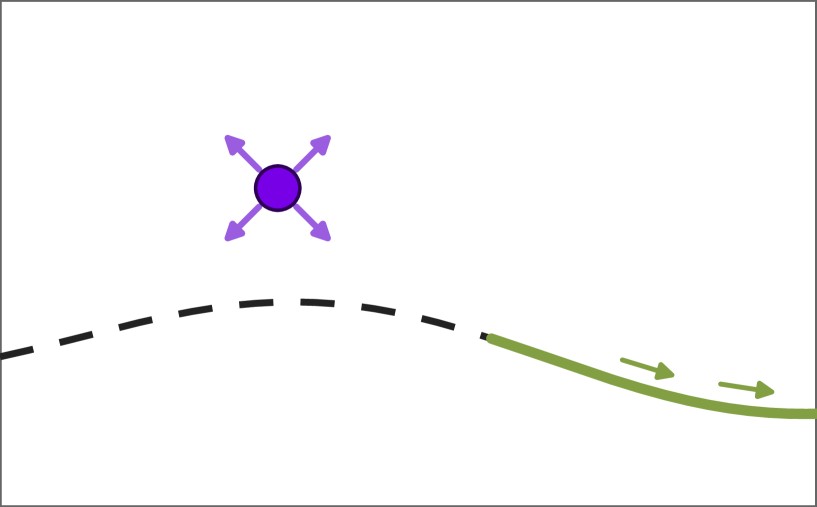
Operators can mark heat sources in workspace coordinates before geometry is known. Radiative transfer maps those goals onto the current surface estimate; a second heat-diffusion stage (HEDAC-style) drives coverage along the surface.
Validation
The paper reports simulation and real-robot experiments with reconstruction error approaching ground truth as contacts accumulate. Selective coverage updates recompute only newly sampled or projected points so the growing cloud stays real-time tractable. (Exact per-trial tables live in the full paper; the abstract’s headline is concurrent coverage + learning without offline planning.)
A Human’s Take
I’m excited about any method that treats “we don’t have CAD” as the default, not the bug. ErgoSurf is classic DLR strength: contact, impedance, geometry under uncertainty. The demo I want is a dull industrial one — paint prep on a part nobody scanned — with minutes-to-coverage numbers, not only bunny-mesh plots.