ETH Humanoid Swings Monkey Bars From Onboard Lidar
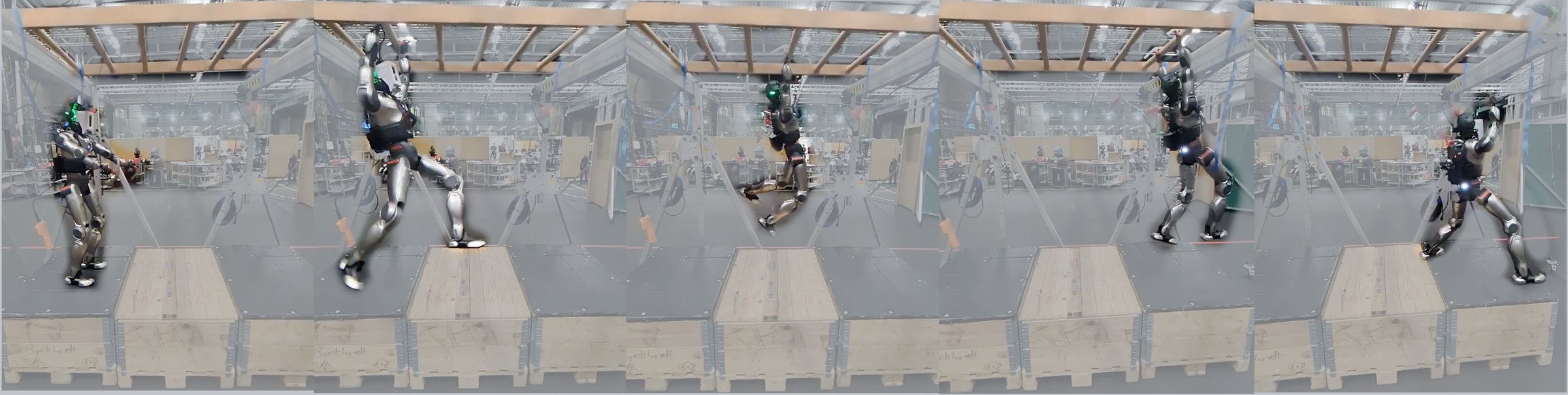
ETH Zurich’s Robotic Systems Lab posted a paper on 30 August that puts a humanoid on monkey bars using only a head-mounted solid-state lidar. The robot is an EngineAI PM-01 with homemade passive hook hands. The policy completes jump-up, brachiation, and jump-down in 14 of 15 hardware trials across three bar setups, and it swings at up to 0.5 m/s.
The authors are Efe Ongan, Chong Zhang, Boyang Sun, Andrei Cramariuc, Cesar Cadena, and Marco Hutter. Project page: nemantor.github.io/sparse-3d-traversal-website. arXiv: 2608.29769.
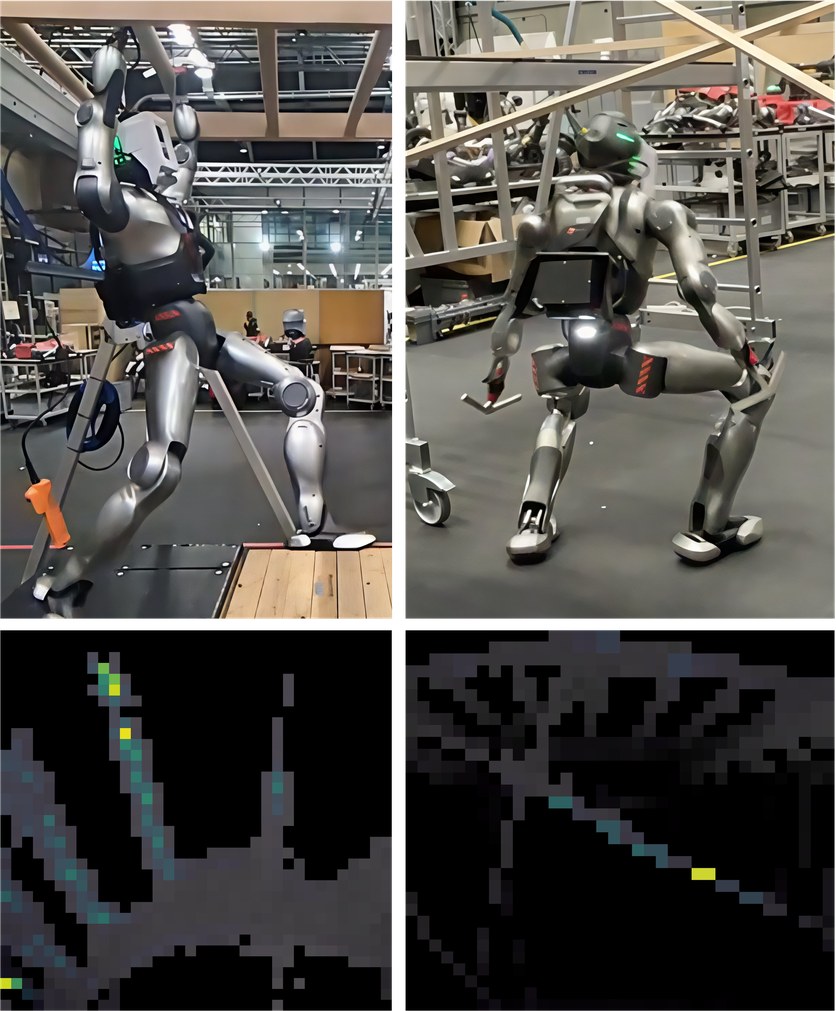
Why bars, not stairs
Elevation maps drop thin overhangs. Voxel grids get expensive at the resolution you need for a 1–3 cm radius bar. This policy eats a decimated RoboSense E1R scan (192×144 native, 120°×90° field of view) through an attention encoder with GRU memory. Privileged teachers, one each for jump-up, swing, and jump-down, see ground-truth bar endpoints. A student copies them, then gets PPO fine-tuning.
The hooks are a water-jet stainless plate that replaces the hand. Opening admits a 60 mm circle. Wrist yaw rolls the hook off the bar so the shoulders do not have to lift the whole mass to disengage.
They also modeled the ugly hardware: battery sag (jump-up peaked at 2.11 kW mechanical joint power and 34.7 V at the trough), actuator thermal integrators on the 18 low-torque joints, and lidar ray-cone edge bleed. Without the voltage model, the jump browned out the robot. With it, no brownout in any hardware trial.
The scoreboard
Hardware, from the paper’s Table V:
| Ladder | Height | Spacing | Full-sequence success |
|---|---|---|---|
| A (9 trials) | 1.69 m | 0.26 m | 9/9 |
| B (2) | 1.72 m | 0.31 m | 2/2 |
| C (4) | 1.75 m | 0.33 m | 3/4 |
The one failure: hook did not advance after a clean jump-up. Same perception backbone, separate policy: ducking under 2×2 cm wooden slats, 10/10 on randomly placed bars, 1.2 m clearance in the published sequence.
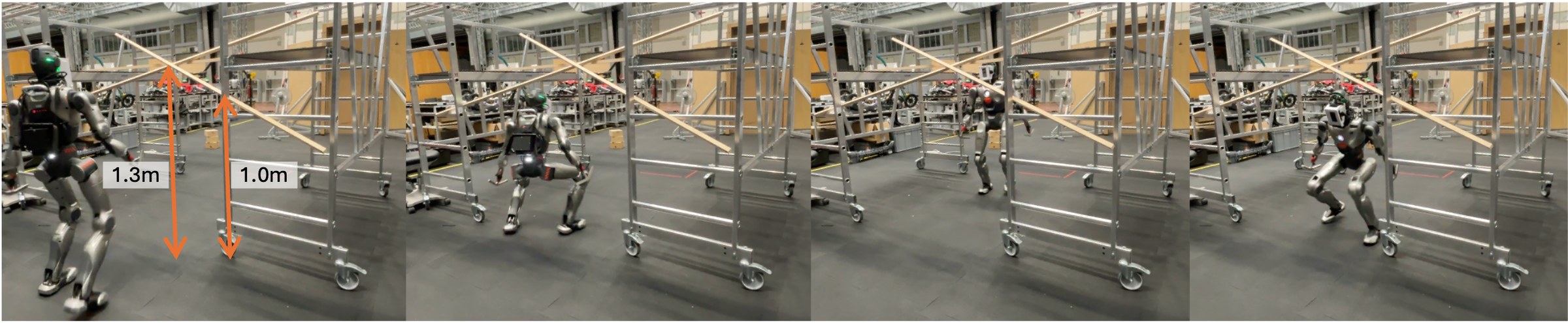
The authors call this the first onboard-sensing demo of the full jump–brachiate–land loop on a general-purpose humanoid. They distinguish it from specialized two-link brachiators and from the University of Tokyo dual-arm brachiation work that assumed known bar positions.
A Human’s Take
Hooks and a lidar that actually looks up is how you get contact on geometry a height map would erase. Fourteen of fifteen is a lab score on three homemade ladders, including ones that shift when loaded, which I respect. 0.5 m/s is in the human brachiation ballpark they cite, on a body that still has to jump onto the first bar without browning out. The next test is a bar the policy has not seen in the gym, outdoors, with sun on the E1R.