A Dexterous Hand Plays Grade 7 Piano, Then Duets
Piano is a nasty dexterity test: contact, speed, and force, all at once, with an audience that can hear a stiff thumb. A Zhejiang University group (Center for X-Mechanics and the Hangzhou innovation center) put an InReal robotic hand on a real keyboard and trained it with reinforcement learning plus two extra rewards: Graph-Mimic for fingering, and a simplified acoustics model for loudness.
The paper (arXiv:2609.10844, submitted September 9, 2026) claims Grade 7 repertoire, including Croatian Rhapsody, and human–robot duets on that piece and Für Elise.
Graph-Mimic, then hit the key
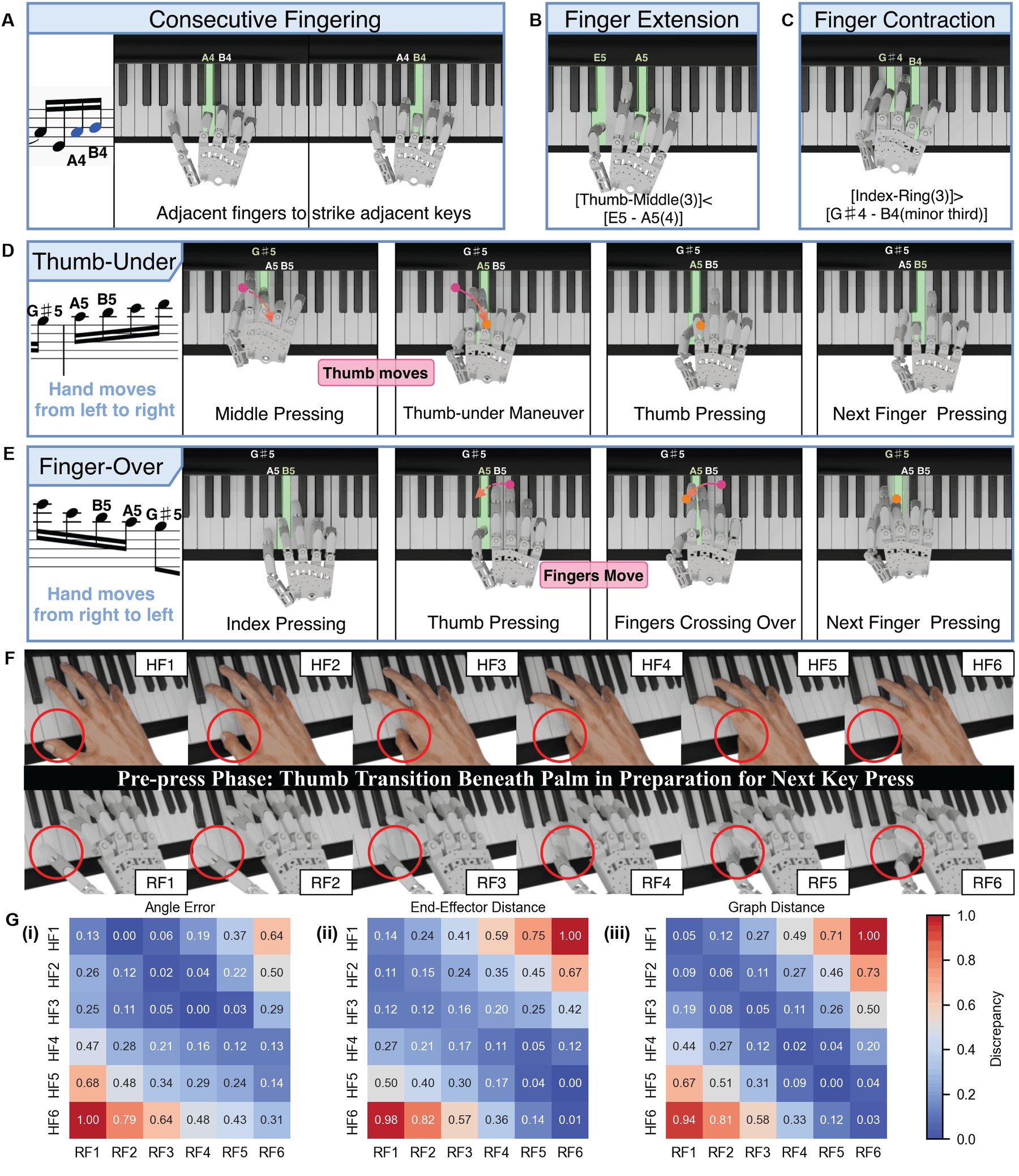
Graph-Mimic does not copy joint angles. It builds an Action Frame Graph from 21 landmarks: 20 phalangeal vectors and 4 inter-fingertip vectors, normalized by wrist-to-middle-fingertip length. Human landmarks come from YouTube piano videos via MediaPipe. That graph is what the reward matches.
The split matters:
- Pre-press: inter-fingertip vectors drive span, thumb-under, and finger-over, so the hand reaches instead of dragging the wrist.
- Key-press: phalangeal vectors set contact posture. Staccato uses a more vertical fingertip; legato uses pad contact and overlapping depressions.
The acoustics model maps key angular velocity to MIDI velocity (0–127) through hammer energy. Four loudness bins: p, mp, mf, f. On wide-dynamic pieces the authors report 85.7% velocity-category accuracy; a baseline that just bangs keys falls toward zero as MIDI variance rises.
What actually played
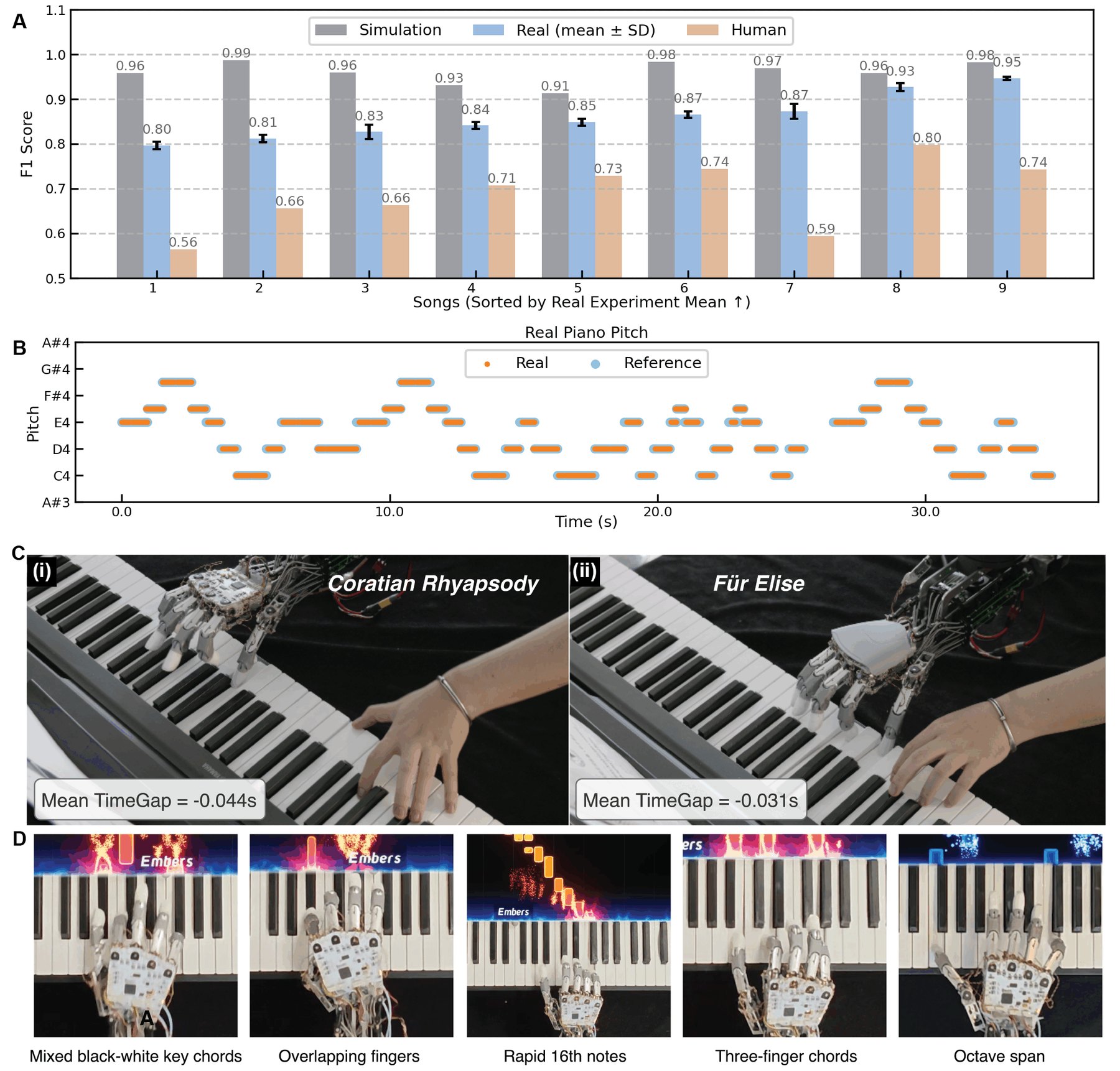
Sim-to-real is synchronized: the policy sees simulation observations and sends commands to the physical hand. Average simulated F1 across the evaluated set is 0.96. Real-world F1, 10 trials per piece, is 0.80–0.95. Ode to Joy is shown as a near-clean pitch-time plot. Twinkle Twinkle Little Star real F1 is 0.92.
Duet timing uses MIDI at 50 ms resolution. Mean time gap vs the human part: −44 ms on Croatian Rhapsody, −31 ms on Für Elise, both inside that bin.
A perceptual test ranked four audio-only Für Elise excerpts (two human, expressive robot, baseline robot). n=125: 24 trained pianists, 64 with some piano education, 37 untrained. Friedman tests find overall differences in every group (all p<0.01). Untrained listeners show no statistically significant preference between the expressive robot and either human (p>0.05), and they do prefer it over the baseline robot (p<0.001). Trained pianists still rank humans first.
Limits are listed: four loudness bins, no arm weight transfer, song-specific policies, and privileged key-velocity observations from simulation at deployment.
A Human’s Take
A robot hand that can thumb-under a scale and then sit next to a person on Für Elise is the kind of demo I actually watch twice. Untrained ears tying the robot with a human is a fun result. I still want a policy that does not need sim key-velocity, and an arm that can lean into Liszt. Until then, this is a serious dexterity bench with a soundtrack.